The Quiet Panic: What Math Anxiety Feels Like in Real Life
You sit down at your desk and open the book. Suddenly, your heart begins to race, and your palms feel cold and sweaty. The numbers on the page seem to blur together, turning into an unreadable puzzle.
This is not just simple dislike or boredom. It is a real, physical feeling of dread that locks up your brain.
Many people face this quiet terror every single day. For some, it starts in childhood when a teacher calls on them in class. For others, it shows up later in life when they have to split a restaurant bill or budget their monthly expenses.
You might feel like you are the only one struggling with this fear. It is easy to think that you were just born without a "math brain."
But that is simply not true. Your brain is not broken, and you are not bad at learning.
You are experiencing a common psychological response that we can easily change. When we understand why this fear happens, we can start to take away its power.
Let us look at how this anxiety works in your mind and body. Once we see the science behind the panic, we can use simple steps to quiet the noise and finally find peace with numbers.

Why Your Brain Freezes When You See Numbers
To beat this fear, we must first understand what is happening inside your head. It all comes down to a tiny, almond-shaped part of your brain called the amygdala.
The amygdala is your brain's alarm system. Its job is to protect you from danger, like a wild animal or a falling branch.
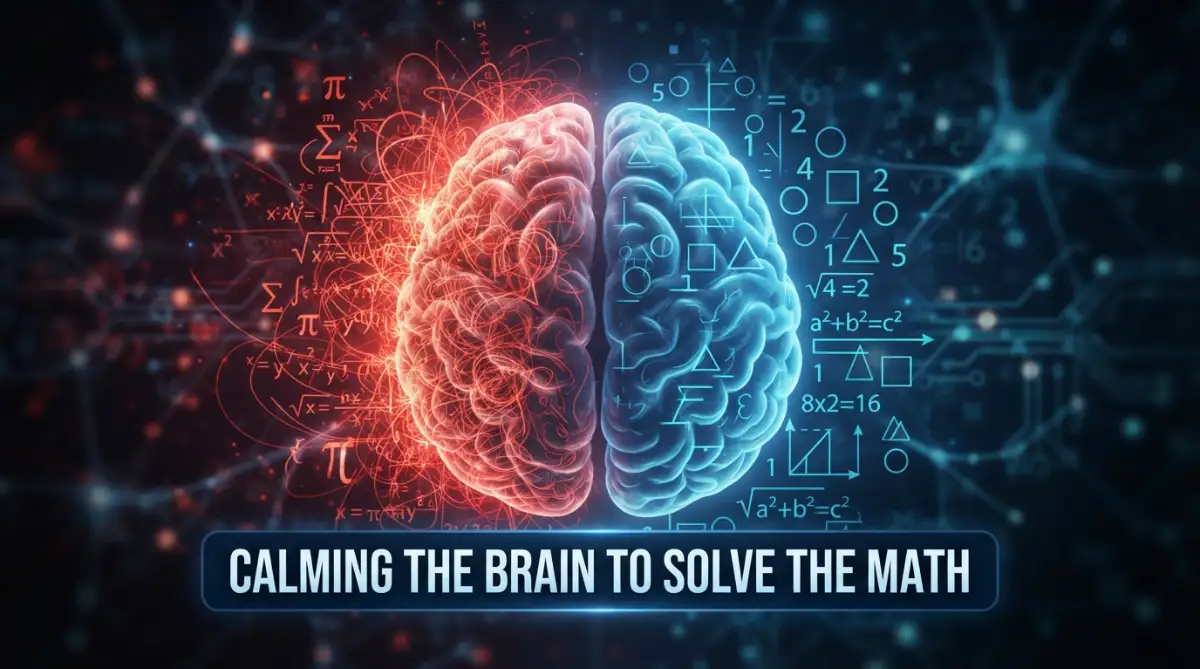
When you feel anxious about math, your brain treats the numbers like a physical threat. The amygdala screams in danger, triggering your fight-or-flight response.
This reaction sends blood away from your thinking brain and down to your muscles. Because of this, the part of your brain that handles logic suddenly loses its energy.
The Loss of Working Memory
This logic center is called your working memory. Think of your working memory as a mental scratchpad.
It holds the numbers and steps you need while you solve a problem. But when panic sets in, your working memory gets filled with anxious thoughts instead.
There is simply no room left to do the math. You are not failing because you lack ability; you are failing because your mental scratchpad is completely full of worry.
Researchers have proven this exact process in multiple brain studies. When students feel anxious, their brains are busy fighting the anxiety rather than processing the numbers.
Once we calm the alarm system, the working memory opens back up. This is the key to learning math without the pain.
Common Math Myths vs. Cognitive Science Facts
Many of our fears come from false ideas we learned when we were young. Let us look at what the science actually says about these common beliefs.
Common MythScience-Backed RealitySome people are born with a "math brain" and others are not.The brain is like a muscle that grows stronger with practice.You must be fast at math to be truly good at it.Deep, slow thinking is actually better for complex problem-solving.Making mistakes means you are bad at numbers.Mistakes actually cause your brain to grow new pathways.Math is only about memorizing rigid rules and formulas.Math is about pattern recognition, creativity, and logic.
Step-by-Step Science-Backed Strategies for Anxious Learners
Now that you know the science, let us look at some practical tools. You can start using these methods today to lower your stress and build real confidence.
1. Write Down Your Fears Before You Start
This might sound too simple to work, but it is highly effective. Before you open your math book, take a piece of paper and a pen.
Spend five minutes writing down exactly how you feel about the upcoming study session. Write about your fears, your worries, and your doubts.
Do not try to make it sound nice or positive. Just dump all of your anxious thoughts onto the page.
A famous study from the University of Chicago looked at this exact practice. Researchers found that students who wrote about their anxieties before a test scored significantly higher.
By writing down your worries, you are literally dumping them out of your working memory. You are leaving those anxious thoughts on the paper so they do not crowd your mind while you study.
Once you finish writing, you can crumble the paper up and throw it away. This simple physical act sends a message to your brain that the worry is gone.
2. Master the Art of Box Breathing
When physical anxiety starts to rise, you must calm your body before you can calm your mind. You cannot think clearly when your heart is beating too fast.
Box breathing is a simple tool used by deep-sea divers and athletes to stay calm under pressure. It works by resetting your nervous system in less than two minutes.
- Step A: Breathe in slowly through your nose for a count of four.
- Step B: Hold your breath gently for a count of four.
- Step C: Exhale slowly through your mouth for a count of four.
- Step D: Hold your lungs empty for a count of four.
Repeat this cycle four or five times before you begin your study session. You will feel your heart rate slow down and your muscles relax.
When your body is calm, your brain knows that you are safe. This allows your working memory to turn back on so you can focus on the numbers.
3. Shift to a Growth Mindset
The way you talk to yourself matters more than you think. If you keep saying "I am bad at math," your brain will believe you.
This is called a fixed mindset. It makes you feel like your abilities are set in stone.
Instead, you need to practice a growth mindset. This is the belief that you can improve your skills through effort and practice.
- Instead of saying: "I cannot do this problem."
- Try saying: "I cannot do this problem yet."
- Instead of saying: "I made a mistake; I am so stupid."
- Try saying: "This mistake is helping my brain grow stronger."
When you add the word "yet" to your sentences, you open the door for future success. It changes a painful dead-end into a simple step on your learning journey.
How to Build a Safe and Effective Math Study Routine
The way you set up your study space and schedule can also reduce your stress levels. Here is how to create a calm routine that works for your mind.
Use the Pomodoro Technique to Avoid Burnout
When you feel anxious, studying for hours feels impossible. Instead, break your work into tiny, manageable chunks of time.
Set a timer for twenty minutes. Promise yourself that you will only focus on one simple concept during this time.
Do not worry about completing the entire chapter. Just focus on what is in front of you for those twenty minutes.
When the timer rings, stop immediately. Take a five-minute break to walk around, drink water, or stretch.
This method keeps your brain from feeling overwhelmed. It teaches your mind that math study is not an endless mountain of pain.
Create a Comforting Learning Space
Your physical surroundings have a huge impact on your stress levels. If your desk is messy and loud, your brain will feel even more anxious.
Find a quiet spot with plenty of natural light. Keep only the tools you need in front of you, like a pencil, eraser, and clean paper.
Remove your phone from the room to avoid distractions. You can also play soft, lyric-free music in the background to help soothe your mind.
The Power of Low-Stakes Practice
Many people feel anxious because they think math always comes with a grade or a test. To break this fear, you need to practice without any pressure.
Think of it like learning to play an instrument. You do not start by playing on a stage in front of a crowd.
You practice alone in your room where no one can hear you make mistakes. You must do the same thing with math.
Play Math Games
Use free apps or online games to practice basic skills. Games are low-stakes because you can try again as many times as you want.
There are no grades, no red ink, and no judgment. Playing games turns math back into a puzzle instead of a threat.
Practice with the Answer Key Open
Many students try to solve hard problems without any help, get stuck, and then panic. Instead, study with the answer key right next to you.
If you get stuck on a step, look at the answer. See how the author got from point A to point B.
Copying down the correct steps is not cheating; it is a highly effective way to learn patterns. It keeps your frustration low and your momentum high.
Why Mistakes are Actually Good for Your Brain
We are often taught that mistakes are bad. In school, mistakes meant a red mark on your paper and a lower grade.
But cognitive science shows us a completely different story. Mistakes are actually the exact moments when your brain grows the most.
When you make a mistake, your brain experiences a tiny moment of struggle. This struggle signals your brain cells to build new connections to solve the problem next time.
The Science of Synapses
Your brain is made of billions of pathways called synapses. Every time you try a hard problem and fail, these synapses fire and try to find a new path.
If you only solve easy problems that you already know how to do, your brain does not grow at all. True learning only happens when you step into the struggle.
So, the next time you get a wrong answer, do not feel bad. Take a deep breath and smile.
Your brain just found a path that does not work, which means you are now one step closer to finding the one that does.
Moving Forward with Confidence
Overcoming math anxiety is not about becoming a genius overnight. It is about taking small, gentle steps toward feeling comfortable with numbers.
Start by being kind to yourself. Recognize that your fear is a physical reaction that you can control with practice.
Use the box breathing method to quiet your body. Write down your worries to clear your mind.
Work in short, easy sessions and treat your mistakes as signs of real progress. Over time, the panic will fade, and you will find that you are fully capable of learning.
You have all the tools you need to succeed. Just take it one step, and one number, at a time.
Taking the Reins: Advanced Psychological Tools for Long-Term Math Confidence
Now that we understand the basics of brain panic, we must look at how to build lasting strength. True confidence does not come from memorizing a list of rules for a single test.
It comes from building habits that change how your brain reacts to stress over time. Let us explore some advanced methods that will help you stay calm and clear-headed, no matter how hard the math problem looks.
Building Muscle Memory Through Active Retrieval
Many students study by reading through their old notes or looking at solved examples in their textbooks. This feels easy, but it actually tricks your brain into thinking you understand the material when you do not.
When you just look at a solved equation, your brain is resting because someone else did the hard work. You must make your brain work to make the learning stick.
This process is called active retrieval. Instead of reading a solved problem, cover the solution with a sheet of paper and try to write down the steps on your own.
If you want to understand why passive reviewing fails to help you learn, you can explore the science behind it. Understanding why cramming fails to save your grades shows us how passive habits leave us empty-handed when stress levels rise during a test.
When you practice pulling information directly from your memory, you build stronger paths in your brain. This makes the steps easier to recall the next time you face a similar challenge.
tructuring Your Notes to Quiet the Inner Noise
When your notes are messy, your thoughts will be messy too. A structured page helps keep your mind organized and keeps anxiety from building up.
One of the best ways to keep your math notes clean is by using a specialized note-taking layout. You can learn how to set this up by reading about how to use the Cornell method for active study tools.
When you use this method for math, draw a line down your paper to divide it into two columns. In the right-hand column, write down the step-by-step math problem as your teacher explains it.
In the left-hand column, write down the explanation of each step in your own simple words. For example, if you write a step to divide both sides by two, write "We do this to get the variable by itself" on the left.
This keeps you from getting lost when you look back at your notes days later. It connects the abstract numbers to your everyday language, making the concepts feel much friendlier.
Scheduling Peace of Mind to Avoid Late-Night Panic
Procrastination is a natural reaction to fear. When a subject makes us feel anxious, we push it away until the very last minute.
But staying up late to cram for a math test only makes your brain more tired and more prone to panic. You need to create a simple study schedule that gives your mind plenty of time to rest.
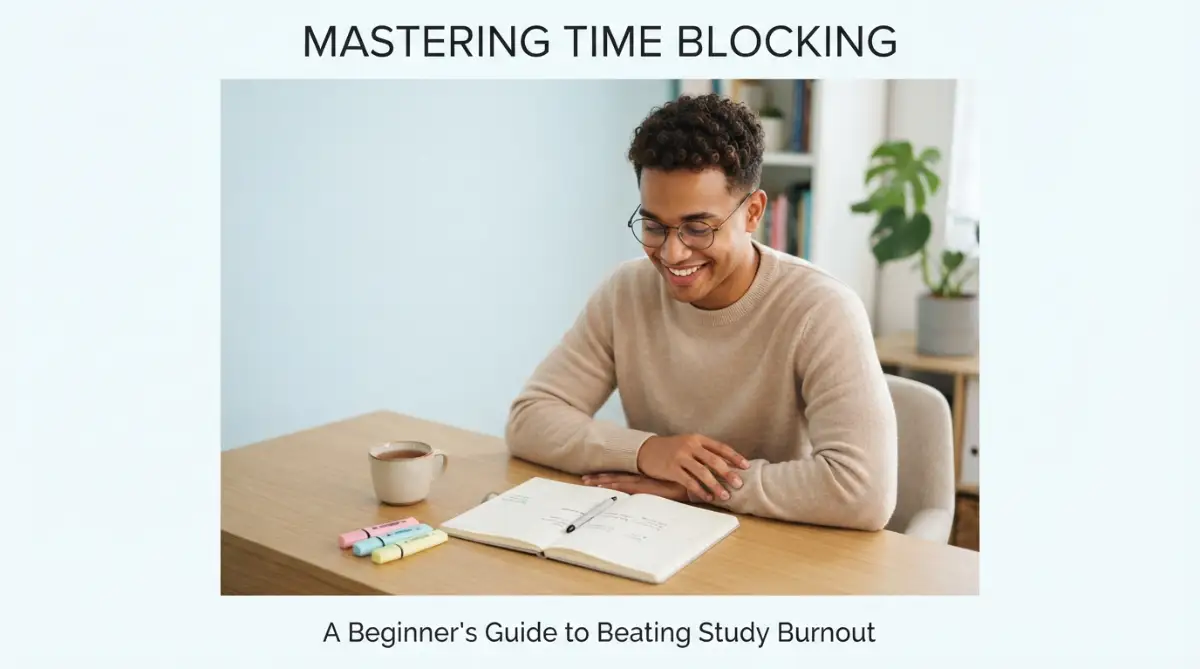
You can manage your study hours easily by learning how to use time blocking to beat study burnout. This system helps you set aside short, specific blocks of time for math when your brain is still fresh and alert.
By dedicating just thirty minutes in the afternoon to quiet practice, you remove the pressure of late-night study sessions. This simple shift helps you build a calm routine that protects your mental health.
Cognitive Restructuring: Rewriting Your Inner Math Narrative
Sometimes, the biggest hurdle is the story we tell ourselves about our abilities. If you grew up believing you were bad at numbers, your brain will automatically look for proof to support that belief.
To change this, we can use a psychological tool called cognitive restructuring. This method comes from cognitive-behavioral therapy, which is highly effective at reducing anxiety.
You start by noticing the negative thoughts that pop into your mind when you see a math problem. Write these thoughts down on a piece of paper so you can look at them clearly.
Ask yourself if these thoughts are actually true, or if they are just feelings caused by stress. For instance, a thought like "I will never understand this" is not a fact; it is just a reaction to a difficult moment.
Replace that thought with a realistic statement like "This step is hard, but I can figure it out if I take it slowly." Research published in the ERIC educational database shows that changing these negative self-talk patterns directly reduces math anxiety and helps students feel more confident in their skills.
Dual Coding with Verbal and Visual Scaffolds
Your brain has two main channels for processing new information: a verbal channel for words and a visual channel for pictures. When you try to learn math using only numbers and formulas, you are only using one of these channels.
This can quickly overload your thinking brain and make you feel overwhelmed. To prevent this, you should try to use both channels at the same time.
This learning strategy is known as dual coding. When you solve a math problem, do not just write down the numbers.
Draw a simple picture or a diagram that represents what the numbers are doing. If you are working on a word problem about distance, draw a little car moving along a straight line.
Combining words, drawings, and numbers together makes the ideas much easier to understand. This dual approach is grounded in cognitive studies on Dual Coding Theory, which show that using both visual and verbal channels makes it much easier for our minds to process complex ideas.
The Hidden Traps: Pitfalls That Keep You Stuck in the Panic Cycle
When we are trying to overcome a deep fear, it is easy to fall into old habits that actually make our anxiety worse. Let us look at some of the most common traps that nervous learners fall into, and how you can avoid them.
The Illusion of Competence
This trap happens when you spend hours watching online math tutorials or looking at beautiful study guides. You feel like you are learning because the person on the screen makes the steps look so simple.
But watching someone else solve a problem is not the same as doing it yourself. When you close the video and try to do the work, your brain still does not know how to start.
This creates a false sense of security that breaks down as soon as you face a real test. To break this habit, always grab a pencil and copy down the steps along with the video.
Never let yourself be a passive viewer when studying numbers. You must get your hands dirty with the practice to build real skill.
The Toxic Cycle of Avoidance
When we are afraid of something, our natural instinct is to run away from it. You might put off your math homework to clean your room, check your phone, or watch a movie.
This avoidance gives you a quick moment of relief, which makes your brain feel good. But as the deadline gets closer, the pressure builds up like water behind a dam.
By the time you finally sit down to work, the panic is twice as strong as it was before. This cycle of avoidance actually trains your brain to be more afraid of math over time.
code
Code
Feel Fear ---> Avoid Study ---> Temporary Relief ---> Higher Pressure ---> Massive Panic
Break this cycle by facing the work for just ten minutes. Usually, once you start, the fear begins to lose its grip.
Staying Isolated in Your Struggle
Many anxious learners feel deeply ashamed of their struggles. You might think that everyone else in your class understands the lessons easily while you are left behind.
Because of this shame, you might hide your confusion, stay quiet in class, and avoid asking for help. You wear a mask of understanding while feeling like an imposter on the inside.
But staying quiet only keeps you stuck in the dark. The truth is that many of your peers are likely feeling the exact same confusion but are too afraid to speak up.
Sharing your struggles with a classmate, a tutor, or a helpful teacher removes the weight of shame. It shows you that you are not alone, which instantly makes the journey feel lighter.
Your Action Plan: Small Wins That Build Unshakable Math Confidence
You do not have to change everything overnight. The path to overcoming your fear is built on small, daily victories that accumulate over time.
Let us look at a simple action checklist you can use to guide your study session tomorrow.
Your Daily Action Checklist:
- Clear your workspace: Remove your phone, messy papers, and loud distractions to create a peaceful study zone.
- Write down your worries: Spend five minutes putting your fears on paper, then throw the page away to clear your working memory.
- Do your breathing exercises: Practice three rounds of box breathing to lower your heart rate and calm your nervous system.
- Set a short timer: Work for just twenty minutes using the Pomodoro method, focusing on one single concept.
- Keep the answers open: Study with the solutions nearby so you can check your work and understand the patterns without feeling stuck.
- Celebrate your mistakes: Remind yourself that every wrong answer is a sign that your brain is actively growing new pathways.
Believe in Your Brain's Power to Adapt
Your past experiences with math do not define your future. Your brain is not a static machine that is bad at numbers; it is a living, changing organ that grows stronger with every challenge you face.
Be patient with yourself as you practice these new habits. Some days will feel easier than others, and that is completely normal.
The goal is not to become a perfect math genius who never makes a mistake. The goal is simply to build a calm, resilient mind that can face challenges with confidence.
You have the tools, the science, and the ability to turn your fear into strength. Take a deep breath, open your book, and take your first step forward today.
Disclaimer
This educational guide is for informational and motivational purposes only. It does not replace professional psychological advice or academic counseling. If you or your child suffer from severe test anxiety or learning difficulties, please consult with a qualified educational psychologist or counselor to receive personalized support.