
The Midnight Coffee and the Dread of a Blank Screen
Imagine sitting at your desk at two in the morning. Your coffee is completely cold, and you have spent hours reading research papers. You finally finish typing your essay and hit the submit button with a sigh of relief.
A week later, you receive your graded paper back. Your heart sinks when you see a disappointing grade at the top of the page. Your professor left a brief comment: "Your writing is good, but your central argument is weak and unclear."
This situation happens to thousands of college students every single week. You spend days gathering facts and organizing paragraphs, only to lose points on the single most important sentence of your paper.
A weak thesis statement acts like a cracked foundation under a beautiful house. No matter how nice the walls look, the structure will eventually collapse. When your central claim is shaky, your entire essay loses its direction and purpose.
Many students feel deeply discouraged when their hard work does not translate into good grades. You might feel like you are bad at writing, but the real issue is just a misunderstanding of how a thesis works.
Fortunately, writing a strong thesis statement is a skill that anyone can learn. By identifying a few common errors, you can transform your essays and make your arguments much more powerful.
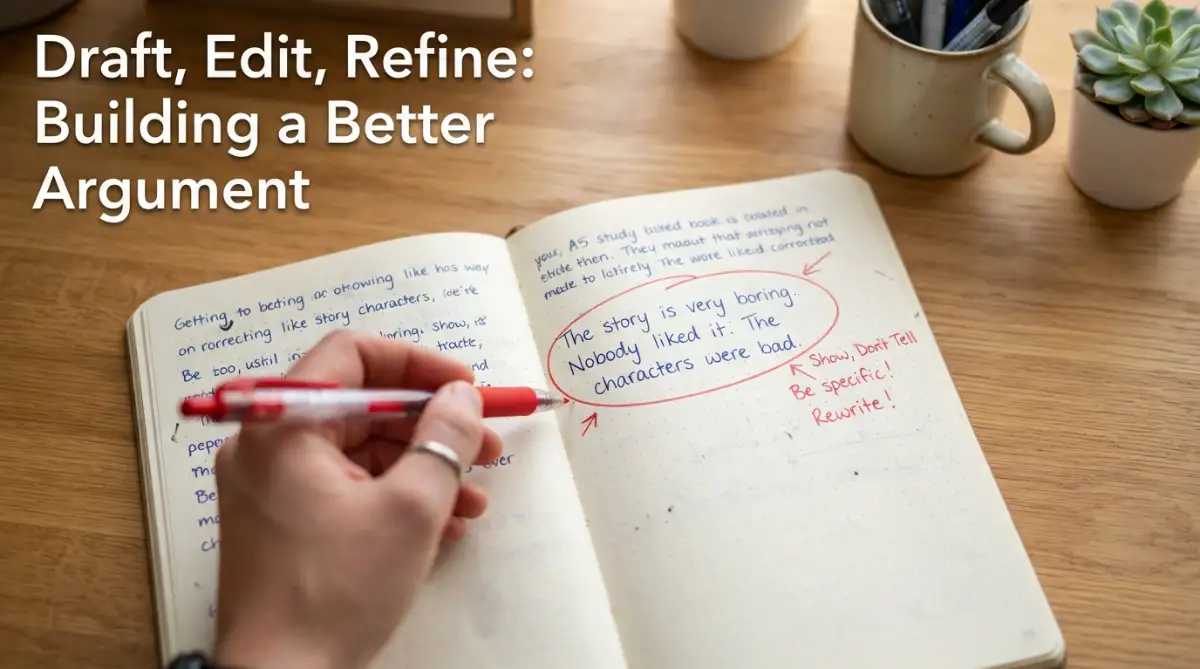
The Core Errors That Quietly Break Your Essay's Backbone
To fix your essay, you first need to know what is going wrong. Let us explore the most common traps that students fall into when drafting their thesis statements.
One of the biggest issues in student writing is trying to cover too much ground. When you choose a massive topic, you cannot say anything meaningful in a five-page paper.
For example, many students write a statement like this:
- Weak Example: "Technology has changed modern education."
This claim is too wide to argue effectively. Technology includes everything from pencils to artificial intelligence, and education covers preschool to college.
To fix this, you must narrow your focus to a specific area and a specific outcome.
- Stronger Example: "While digital tablets offer interactive learning tools, their constant use in elementary classrooms reduces student attention spans and slows reading comprehension."
In this revised version, we specify the technology (digital tablets), the target group (elementary classrooms), and the specific effects (reduced attention spans and slower reading). This gives your paper a clear roadmap to follow.
A thesis statement must be an argument, not a simple statement of fact. If nobody can reasonably disagree with your statement, then you do not have a thesis.
Consider this common error:
- Weak Example: "The United States Constitution was signed in Philadelphia."
This is a historical fact that cannot be debated. There is no reason to write an argumentative essay about a date and a location.
Instead, you need to take a stance on how or why this event matters.
- Stronger Example: "The signing of the United States Constitution in Philadelphia exposed deep divisions over state power, establishing a federal system that continues to spark debate today."
This statement is open to discussion and analysis. It invites the reader to look at how those historical divisions still affect modern political debates.
MythRealityA thesis statement should be a proven fact.A thesis must be a debatable claim that requires evidence.The longer a thesis statement is, the better it is.A clear, concise thesis is always more powerful than a wordy one.You must write your thesis first and never change it.Your thesis should evolve as you discover new evidence during research.
Many students treat their thesis statement like a simple announcement. They use phrases that tell the reader what they plan to do, rather than actually making an argument.
- Weak Example: "In this paper, I will discuss the negative effects of social media on teenagers."
This style feels highly informal and weakens your authority as a writer. It sounds like you are preparing to write the paper rather than presenting your actual conclusions.
Instead of announcing your intentions, state your points directly with confidence.
- Stronger Example: "Social media platforms harm adolescent mental health by encouraging unhealthy social comparison and disrupting sleep patterns."
By removing the introductory announcement, your writing instantly sounds more academic and persuasive. You are no longer just talking about your paper; you are actively making your point.
Another major problem is when writers use weak verbs and tentative language. If you sound unsure of your own argument, your readers will not believe you either.
Students often use hedging words like "might," "could," "maybe," or "seems to."
- Weak Example: "It seems that plastic pollution might possibly harm some ocean animals."
This sentence is too timid. It does not take a strong stance, which makes the entire essay feel unimportant.
You should use strong, active verbs to show that you stand behind your research.
- Stronger Example: "Single-use plastic pollution threatens marine ecosystems by poisoning coral reefs and endangering critical wildlife species."
Notice how the stronger version removes the tentative language. It clearly states the cause, the effect, and the specific damage being done.
When writing about books, plays, or poems, students often summarize what happens instead of analyzing the deeper meaning. A literature essay is not a book report.
- Weak Example: "In The Great Gatsby, Jay Gatsby throws massive parties to get the attention of Daisy Buchanan."
This is simply a summary of the plot. Anyone who has read the book already knows this information.
Your thesis should explain why the author wrote the story this way or what deeper message the book carries.
- Stronger Example: "Through Gatsby’s failed pursuit of Daisy, Fitzgerald suggests that the traditional American Dream is an illusion built on hollow materialism."
This claim goes beyond the surface plot. It analyzes the author's message and gives you a clear argument to prove with quotes from the text.
Whenever you draft a thesis, always ask yourself: "So what?"
If a reader looks at your thesis and asks that question, your claim needs to be stronger.
For example, if your thesis is "Exercise is good for you," a reader might say, "So what? Everyone knows that."
But if you write, "Daily moderate exercise reduces stress levels in college students by lowering cortisol production," you have answered the "so what" question with clear, useful information.
Some writers try to please everyone by agreeing with both sides of an argument. While it is good to acknowledge other views, a thesis must ultimately take a side.
- Weak Example: "Some people think school uniforms are good because they save money, but others think they limit freedom, so both sides have good points."
This statement does not make a clear choice. It leaves the reader wondering what the essay will actually argue.
Instead, you can use a concession clause to show you understand both sides while still picking a primary direction.
- Stronger Example: "Although school uniforms limit personal expression, they should be required because they reduce peer pressure and lower clothing costs for families."
This approach acknowledges the counterargument but still takes a clear, defensible position. It shows that you have considered the entire issue before making your decision.
It is a common mistake to think your thesis statement is set in stone the moment you write it down. In reality, writing is an ongoing process of discovery.
As you look for sources and draft your body paragraphs, you might find new information that changes your mind. This is completely normal and healthy.
Do not be afraid to go back and rewrite your thesis to match the actual evidence you found. Your final thesis should perfectly match the main points you discussed in your body paragraphs.
If your essay ended up focusing on different points than you originally planned, adjust your thesis to reflect those new ideas. This keeps your entire paper cohesive and easy to follow.
You do not need to use massive, complicated words to sound smart in college. In fact, using big words incorrectly is a fast way to confuse your reader and weaken your essay.
Focus on using simple, clear, and precise language. State your main claim in a way that anyone can understand on the first reading.
Clear writing shows clear thinking. When you write a simple but deep thesis, your professors will appreciate how easy it is to follow your thoughts.
Master-Level Methods for Crafting Unshakeable Thesis Statements
Developing a powerful argument is not about using big words or sounding overly academic. Instead, it is about learning how to structure your thoughts so that your reader can follow your logic effortlessly.
Many students make the mistake of writing their thesis in a hurry, thinking it is just a box to check off. To build a truly outstanding essay, you must treat your central claim as a dynamic tool that guides your writing process.
The Reverse-Engineering Technique
One of the most effective secrets of professional academic writers is to write the thesis statement last. This might sound strange because your high school teachers probably told you to always start with your thesis.
In college, your ideas will naturally develop and change as you write your draft. If you force yourself to stick to a thesis you wrote before you did your research, you will likely end up with a messy essay.
Instead, try writing a temporary or "working" thesis first. Use this temporary sentence to keep your initial draft on track, but remain open to changing it completely later.
Once you finish writing all your body paragraphs, look at the evidence you actually presented. Then, rewrite your final thesis statement to match the points you made in your essay.
This simple change ensures that your introduction and your body paragraphs are in perfect alignment. It saves you from having to rewrite entire paragraphs when your ideas shift during the drafting phase.
The Three-Story Thesis Strategy
A great way to check the depth of your argument is to use the "three-story" writing model. This method helps you move past simple descriptions and into deep analytical thinking.
The first story of your thesis is the "What" story, which simply states the basic facts or observations. The second story is the "How" story, which explains how those facts work or how they relate to each other.
The third story is the "Why" story, which explores the deeper meaning or why the argument actually matters to your reader.
Most average college essays stay on the first or second story, leaving the reader wanting more depth. If you want to impress your professor, you must take your writing up to the third story.
Always explain the larger significance of your ideas in your thesis statement. This shows that you are not just repeating facts, but that you are actively engaging with the academic conversation.
Testing Your Argument Against a Counter-Position
A strong thesis is one that can stand up to heavy criticism. To test the strength of your argument, try to write a single sentence that argues the exact opposite of your thesis.
If you find that the opposite argument sounds silly or impossible to defend, then your thesis is likely too weak. It means your claim is a simple fact rather than a real debate.
But if the opposing statement sounds like a reasonable argument that someone could make, you have a solid thesis. This exercise helps you see where your argument might be weak so you can strengthen those areas before you submit your paper.
For detailed guidelines on how academic readers analyze student claims, you can review writing resources like the Purdue Online Writing Lab. These expert guides show exactly how professional graders evaluate the strength of your thesis statement.
If you find yourself rushing through your essay draft at the last minute and struggling to structure your thoughts, you might want to learn about understanding why cramming fails to help you organize your research schedule better.

Silent Pitfalls That Can Lower Your Essay Grade
When you are working under the pressure of a deadline, it is incredibly easy to make simple mistakes that hurt your grades. Knowing what traps to avoid is just as important as knowing what to include.
The Tragedy of the Disappearing Argument
One of the most painful experiences for any college writer is when their argument disappears halfway through the essay. You start with a clear, strong thesis in your introduction, but your body paragraphs slowly wander away from it.
By the time the reader reaches the third page, your paper feels like three different essays glued together. This happens when you do not use your thesis statement as a filter for your evidence.
Every single paragraph in your essay must directly support your central claim. If you have a paragraph that is interesting but does not prove your thesis, you must either remove it or rewrite it.
Do not let your hard work go to waste by including unrelated facts just to meet the word count. Keeping your focus tight and clear is always better than adding unnecessary fluff.
Writing What You Think the Professor Wants to Hear
Another common mistake is writing a safe, boring essay because you are afraid of taking a real stance. You might try to write a thesis that everyone already agrees with to avoid losing points.
In reality, professors are bored of reading the same safe arguments over and over again. They want to see you take a creative risk and defend an original point of view.
When you write a safe thesis, you miss the chance to show your critical thinking skills. Do not be afraid to argue a unique perspective, as long as you have the academic research to support it.
To see how top-tier universities expect you to build these original arguments, you can check the guides at the Harvard College Writing Center. These university standards can give you a clear target to aim for in your next assignment.
Quick Guide: Do's and Don'ts for Your College Thesis
To keep your writing on track, follow these straightforward guidelines for your next essay draft.
- Do write your final thesis statement after you finish drafting your main body paragraphs.
- Do make sure your claim can be reasonably debated by another intelligent person.
- Do use specific, active verbs that show clear direction and confidence in your writing.
- Do keep your statement concise, ideally limited to one or two sentences.
- Don't use empty announcements like "In this essay, I will show you why."
- Don't try to cover an entire broad subject in a short five-page college paper.
- Don't hide behind weak words like "maybe" or "seems to" because you are afraid to take a side.
- Don't repeat simple historical facts that do not require any analysis or evidence.
Your Step-by-Step Action Plan for a Stronger Essay
To build a better essay, you do not need to rewrite your entire style of learning. You just need to change the way you approach your introductory paragraph.
The Tomorrow Action Plan
The next time you get a writing prompt, do not start by writing the actual essay. Instead, take a few minutes to write down three different versions of your thesis statement.
Make one version focus on the causes of the issue, make another focus on the effects, and make the third focus on a potential solution. Show these three options to a classmate or your professor during office hours.
Ask them which version sounds the most interesting and which one they would want to keep reading. This simple collaborative step takes less than ten minutes, but it can save you hours of rewriting later.
A Word from the Writing Desk
Writing is a skill that grows stronger with every single draft you create. No one writes a perfect thesis statement on their first try, and even the best academic writers have to edit their work multiple times.
Do not let a disappointing grade on an old paper make you feel like you are not cut out for college writing. With the right strategies and a bit of patience, you can master the art of the thesis statement.
Start applying these simple changes to your very next assignment. You will find that when your thesis is strong and clear, the rest of your essay practically writes itself.
Disclaimer
The academic writing advice, examples, and study suggestions provided in this article are for informational and educational purposes only. Writing standards and grading criteria can vary greatly between different colleges, departments, and individual professors. Always consult your course syllabus and follow your specific instructor's assignment guidelines to ensure academic success.
Master-Level Methods for Crafting Unshakeable Thesis Statements
Developing a powerful argument is not about using big words or sounding overly academic. Instead, it is about learning how to structure your thoughts so that your reader can follow your logic effortlessly.
Many students make the mistake of writing their thesis in a hurry, thinking it is just a box to check off. To build a truly outstanding essay, you must treat your central claim as a dynamic tool that guides your writing process.
The Reverse-Engineering Technique
One of the most effective secrets of professional academic writers is to write the thesis statement last. This might sound strange because your high school teachers probably told you to always start with your thesis.
In college, your ideas will naturally develop and change as you write your draft. If you force yourself to stick to a thesis you wrote before you did your research, you will likely end up with a messy essay.
Instead, try writing a temporary or "working" thesis first. Use this temporary sentence to keep your initial draft on track, but remain open to changing it completely later.
Once you finish writing all your body paragraphs, look at the evidence you actually presented. Then, rewrite your final thesis statement to match the points you made in your essay.
This simple change ensures that your introduction and your body paragraphs are in perfect alignment. It saves you from having to rewrite entire paragraphs when your ideas shift during the drafting phase.
The Three-Story Thesis Strategy
A great way to check the depth of your argument is to use the "three-story" writing model. This method helps you move past simple descriptions and into deep analytical thinking.
The first story of your thesis is the "What" story, which simply states the basic facts or observations. The second story is the "How" story, which explains how those facts work or how they relate to each other.
The third story is the "Why" story, which explores the deeper meaning or why the argument actually matters to your reader.
Most average college essays stay on the first or second story, leaving the reader wanting more depth. If you want to impress your professor, you must take your writing up to the third story.
Always explain the larger significance of your ideas in your thesis statement. This shows that you are not just repeating facts, but that you are actively engaging with the academic conversation.
Testing Your Argument Against a Counter-Position
A strong thesis is one that can stand up to heavy criticism. To test the strength of your argument, try to write a single sentence that argues the exact opposite of your thesis.
If you find that the opposite argument sounds silly or impossible to defend, then your thesis is likely too weak. It means your claim is a simple fact rather than a real debate.
But if the opposing statement sounds like a reasonable argument that someone could make, you have a solid thesis. This exercise helps you see where your argument might be weak so you can strengthen those areas before you submit your paper.
For detailed guidelines on how academic readers analyze student claims, you can review writing resources like the Purdue Online Writing Lab. These expert guides show exactly how professional graders evaluate the strength of your thesis statement.
If you find yourself rushing through your essay draft at the last minute and struggling to structure your thoughts, you might want to learn about understanding why cramming fails to help you organize your research schedule better.
Image Here-----------------
Silent Pitfalls That Can Lower Your Essay Grade
When you are working under the pressure of a deadline, it is incredibly easy to make simple mistakes that hurt your grades. Knowing what traps to avoid is just as important as knowing what to include.
The Tragedy of the Disappearing Argument
One of the most painful experiences for any college writer is when their argument disappears halfway through the essay. You start with a clear, strong thesis in your introduction, but your body paragraphs slowly wander away from it.
By the time the reader reaches the third page, your paper feels like three different essays glued together. This happens when you do not use your thesis statement as a filter for your evidence.
Every single paragraph in your essay must directly support your central claim. If you have a paragraph that is interesting but does not prove your thesis, you must either remove it or rewrite it.
Do not let your hard work go to waste by including unrelated facts just to meet the word count. Keeping your focus tight and clear is always better than adding unnecessary fluff.
Writing What You Think the Professor Wants to Hear
Another common mistake is writing a safe, boring essay because you are afraid of taking a real stance. You might try to write a thesis that everyone already agrees with to avoid losing points.
In reality, professors are bored of reading the same safe arguments over and over again. They want to see you take a creative risk and defend an original point of view.
When you write a safe thesis, you miss the chance to show your critical thinking skills. Do not be afraid to argue a unique perspective, as long as you have the academic research to support it.
To see how top-tier universities expect you to build these original arguments, you can check the guides at the Harvard College Writing Center. These university standards can give you a clear target to aim for in your next assignment.
Quick Guide: Do's and Don'ts for Your College Thesis
To keep your writing on track, follow these straightforward guidelines for your next essay draft.
- Do write your final thesis statement after you finish drafting your main body paragraphs.
- Do make sure your claim can be reasonably debated by another intelligent person.
- Do use specific, active verbs that show clear direction and confidence in your writing.
- Do keep your statement concise, ideally limited to one or two sentences.
- Don't use empty announcements like "In this essay, I will show you why."
- Don't try to cover an entire broad subject in a short five-page college paper.
- Don't hide behind weak words like "maybe" or "seems to" because you are afraid to take a side.
- Don't repeat simple historical facts that do not require any analysis or evidence.
Your Step-by-Step Action Plan for a Stronger Essay
To build a better essay, you do not need to rewrite your entire style of learning. You just need to change the way you approach your introductory paragraph.
The Tomorrow Action Plan
The next time you get a writing prompt, do not start by writing the actual essay. Instead, take a few minutes to write down three different versions of your thesis statement.
Make one version focus on the causes of the issue, make another focus on the effects, and make the third focus on a potential solution. Show these three options to a classmate or your professor during office hours.
Ask them which version sounds the most interesting and which one they would want to keep reading. This simple collaborative step takes less than ten minutes, but it can save you hours of rewriting later.
A Word from the Writing Desk
Writing is a skill that grows stronger with every single draft you create. No one writes a perfect thesis statement on their first try, and even the best academic writers have to edit their work multiple times.
Do not let a disappointing grade on an old paper make you feel like you are not cut out for college writing. With the right strategies and a bit of patience, you can master the art of the thesis statement.
Start applying these simple changes to your very next assignment. You will find that when your thesis is strong and clear, the rest of your essay practically writes itself.
Disclaimer
The academic writing advice, examples, and study suggestions provided in this article are for informational and educational purposes only. Writing standards and grading criteria can vary greatly between different colleges, departments, and individual professors. Always consult your course syllabus and follow your specific instructor's assignment guidelines to ensure academic success.