
The Hidden Weight of Financial Rejection
"I remember sitting at my kitchen counter late one Tuesday night, staring at my phone screen as an email popped up saying my loan application was denied. My car's transmission was failing, my rent was due in three days, and my credit score was a complete mess. If you have ever felt that cold, sudden panic of needing cash for an emergency and getting turned down by a bank, I want you to know you are not alone—and there is a simple, realistic way to change their minds."
I know the feeling of sitting at your computer, heart racing, as you click the "Submit" button on a loan application. You wait for those few seconds while the screen loads, hoping for a "Yes" but secretly fearing a "No." When the screen finally says "We are sorry, we cannot approve your request at this time," it feels like a heavy punch to the stomach. It is not just about the money you didn't get; it is about the feeling that you are not good enough in the eyes of the bank.
This struggle is real for millions of people. You work hard, you pay your bills, and yet, the system seems to speak a language you don't understand. Rejection can make you feel stuck, frustrated, and deeply anxious about your future. You might need that money for a car repair, a medical bill, or to finally get rid of high-interest credit card debt. Without it, you feel like you are running on a treadmill that is moving just a little too fast.
Many people fail to get the funding they need because they fall into these common traps:
- The "Black Box" of credit scores. You think your score is fine, but the bank sees something you don't, leaving you confused and annoyed.
- Bad advice from the internet. You follow "quick fix" tips that actually hurt your reputation with lenders.
- Missing the small details. Lenders look for specific patterns in your bank account that you might not even realize are there.
- Applying to the wrong banks. Not every bank is a good fit for your specific life situation.
- The "Application Spree." You apply to five places at once, thinking it helps your odds, but it actually scares the banks away.
This cycle of rejection doesn't just hurt your wallet; it eats away at your mental peace and your self-confidence.
I am here to tell you that the system is not as scary as it looks. Banks are not your enemies; they are businesses that run on data and trust. When they say "No," it usually just means they don't have enough "proof" that lending to you is a safe choice. To qualify effortlessly, you don't need to be a millionaire. You just need to know how to present your life in a way that makes the bank feel safe.

How to Get Your Personal Loan Approved Fast
- Audit Your Credit Report: Look for simple errors and get your credit card utilization under 30% to immediately boost your score.
- Shrink Your DTI Ratio: Keep your monthly debt obligations under 35% of your pre-tax income so lenders see that you have breathing room.
- Pick the Right Lenders: Stay away from traditional big banks if your credit is average; try local credit unions or online fintech lenders instead.
- Organize Your Paperwork: Create a digital 'Trust Folder' with your pay stubs and tax returns to prove to the bank that you are stable."
Your Simple Roadmap to a Faster Approval
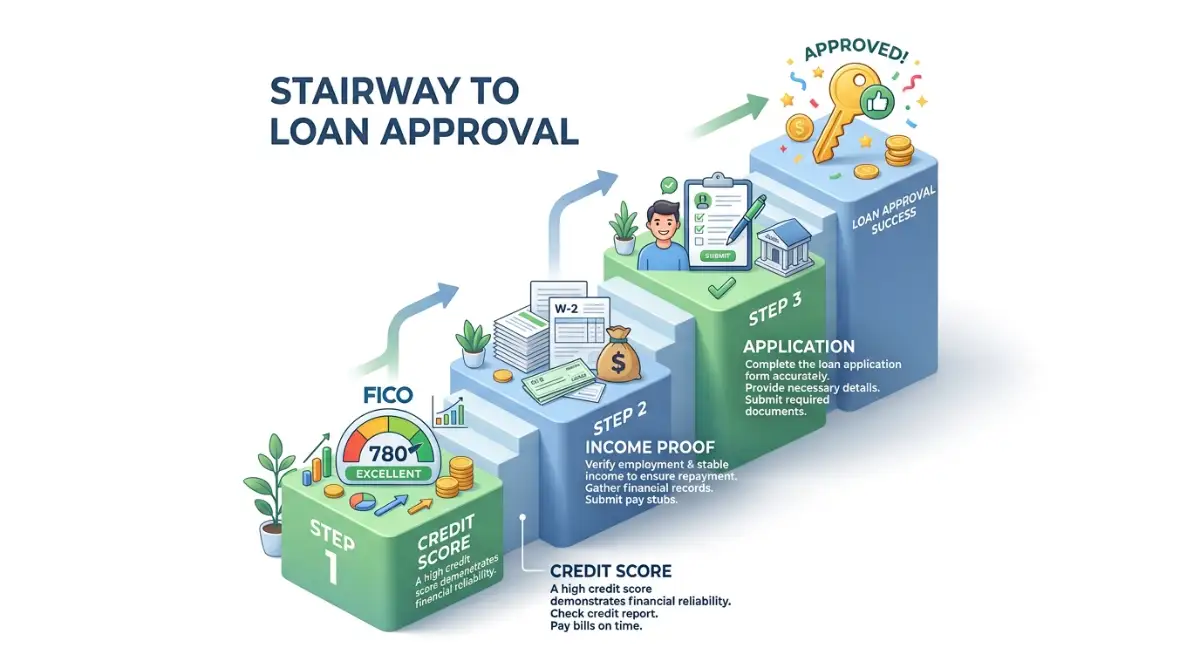
Getting a loan shouldn't feel like an impossible puzzle. It is actually a very logical process. If you check the right boxes before you apply, you can walk through the door with total confidence. Here are the first three steps to help you qualify for a personal loan without the headache.
Step 1: Mastering Your Credit Reputation
Your credit score is like your "report card" for the adult world. It tells the bank how you have handled your promises in the past. But here is a secret: the number itself is not the only thing that matters. The story behind the number is what lenders really look at.
Start by getting a free copy of your credit report. Don't just look at the score. Look for small errors. Sometimes a bill you paid months ago is still showing as "unpaid" because of a computer glitch. Fixing these small errors can jump your score by thirty to fifty points in a very short time. This is the easiest win you can get.
Next, look at your "Credit Utilization." This is a fancy way of saying "how much of your credit limits are you using?" If your credit card limit is $1,000 and you owe $900, the bank thinks you are desperate. Try to get that balance down to $300 or less before you apply for a new loan. It shows the bank that you have credit but you are too smart to use it all. This one move makes you look like a "low-risk" borrower instantly.
When I was trying to rebuild my own credit, I made the mistake of paying off my largest credit card balance first while completely ignoring two tiny, outdated collections on my report. A financial mentor told me to clear those small, easy errors first, and my score jumped almost immediately. Focus on those quick, simple wins first because they make a massive difference to lenders.
Want to see exactly how to check your report and fix errors step-by-step? Watch this quick, helpful video to clean up your credit profile before you read the rest of our guide below!
Step 2: The "Pizza Slices" Rule for Your Income
Banks look at something called the Debt-to-Income (DTI) ratio. Think of your monthly income like a whole pizza. If you have already given away six slices to pay for your rent, your car, and your other cards, there are only two slices left for you to eat. The bank will not give you a new loan because they know you will be "hungry" and won't be able to pay them back.

To qualify effortlessly, you want your debt payments to take up less than 35% of your income. If your ratio is too high, you have two choices: pay down a small debt or show more income. Many people forget to list things like side jobs, regular bonuses, or even government support on their applications.
When you list every dollar you earn, your "pizza" gets bigger. This makes your debt look smaller by comparison. I suggest you take a month to pay off any tiny, annoying debts—like a $200 store card—before you apply for the big loan. Clearing those small "slices" opens up space for the lender to say "Yes" to your new request. It is about showing the bank that you have breathing room in your budget.
My Debt-to-Income "Pizza Slice" Calculator
Before you apply, write down where your monthly income (your pizza) is actually going:
Action Plan: If your DTI ratio is over 35%, try to pay off one small credit card balance to completely delete its minimum payment from your monthly debt column."
Step 3: Choosing the Right Lending Partner
Not all banks are the same. If you go to a giant national bank, you are just a number in a cold machine. If you don't fit their "perfect" box, the computer will reject you in seconds. If your credit is not perfect, stay away from the "Big Four" banks for now.
Instead, look at Local Credit Unions. These are non-profit groups owned by their members. Because they aren't trying to make billions for shareholders, they can be much more flexible. They often look at the "human side" of your story. If you walk into a credit union and explain your situation, a real person might look at your application instead of just a robot.
Another great option is Online Fintech Lenders. These companies use modern technology to look at things other banks ignore, like your education or your job history. They are built for speed and often have much easier qualification rules. Most of them offer a "Soft Credit Pull" quote. This means you can see if you are approved without any damage to your credit score. It is like "window shopping" for a loan. Always use this feature to compare different lenders before you commit to a final application.
Quick Q&A: Soft Pull vs. Hard Pull
- Does prequalification lower my credit score? No. Prequalification uses a "soft pull" which is completely invisible to other banks and does not lower your score by even one point.
- When does my score actually drop? Your score only drops when you formally accept an offer and submit a full application, which triggers a "hard pull" (usually a temporary 3 to 5 point drop)."
Why Being Organized is Your Secret Weapon
When you apply for a loan, the bank will ask for papers like pay stubs or tax returns. Most people take three days to find these things. This makes the bank think, "If they are this messy with their papers, they will be messy with my money." Organization equals trust.
I suggest you create a "Trust Folder" on your computer or phone today. Put your last three pay stubs, your most recent tax return, and a utility bill in there. When you can upload these files in five minutes, you look like a professional. You are telling the bank, "I am a person who has my life in order."
Think of it like this: if you were lending $5,000 to a friend, would you choose the friend who lost their wallet twice last month? Or the friend who keeps a neat budget? Banks feel the same way. By being organized, you are removing the "fear" from the lender's mind. You are making it easy for them to trust you.
The Power of the "Stability" Factor
Lenders love stability. If you have lived in the same apartment for three years and worked at the same job for two years, you are a "Gold Star" borrower. It tells the bank that you are not going to disappear tomorrow.
If you just moved or started a new job, don't panic. Just be ready to show that your new job pays more or that you moved for a better opportunity. Banks understand growth, but they hate random changes. If you can prove that your life is moving in a steady, upward direction, they will be much more likely to give you the green light.
I have seen people with average credit scores get approved simply because they had a very stable job history. The bank knows that a steady paycheck is the best guarantee that the loan will be paid back. Always focus on your strengths. If your score is low, use your job stability to "balance the scale."
Understanding the "Why" Behind Your Loan
When you fill out an application, the bank will ask why you want the money. Be very careful here. If you say "to go on a vacation" or "to buy new clothes," you look like a risky spender. Even if it is true, it is not the best way to qualify.
Banks love Productive Debt. They love lending money for things that make your life better or save you money. The best reason to give is "Debt Consolidation." It tells the bank that you are trying to be responsible and lower your interest rates.
Other great reasons are "Home Improvement" or "Essential Car Repair." These show that you are taking care of your assets. When the bank sees that the money is going toward something useful, they feel much better about hitting the "Approve" button. You are showing them that you are a person with a plan, not just a person who is out of cash.
A Small Secret: The "Relationship" Advantage
Do you have a checking account at a specific bank? That bank can see your daily habits. They see your paycheck coming in. They see that you don't spend more than you have. This "internal data" is often more important than a credit score.
If you have been a loyal customer for years, start your search there. Sometimes, banks have special "pre-approved" offers for their existing customers that are not available to the public. You have already built a bridge of trust with them. Use it! It is often the fastest and most effortless way to get the cash you need.

By following these steps—mastering your score, managing your DTI, and choosing the right partner—you are setting yourself up for a massive win. You are taking the "mystery" out of the process. You are no longer just "asking for money." You are presenting a solid business case for why the bank should invest in you.
In the next part of this guide, we will look at the specific mistakes that can ruin your chances and how you can avoid them. We will also talk about how to handle the "final verification" process so you get your money in your account as fast as possible. You are doing a great job. Keep your head up, and let's get you that approval!
Secrets to Master the Digital Approval System
Now that we have covered the basics of your score and income, it is time to look at the hidden rules. These are the things that bank computers look for but rarely tell you about. If you follow these expert tips, you can push your approval odds from a "maybe" to a "yes" in seconds.
Step 4: The Magic of "Soft Pull" Prequalification
One of the biggest fears people have is that applying for a loan will hurt their credit. This is usually true if you do it the old way. Every time a bank does a "Hard Inquiry," your score drops a few points.
If you apply at five banks in one week, your score could drop significantly. This makes you look desperate to the lenders. They wonder why you are asking so many people for money at the same time.
The secret is to only work with lenders that offer Prequalification with a "Soft" Credit Pull. A soft pull allows the lender to see your basic info without leaving a mark on your record. It is exactly like window shopping for a loan.
You can see your interest rate and your loan amount without any risk to your score. Only when you find a deal you love should you hit the final "Submit" button. This keeps your credit profile clean and strong. It allows you to compare different lenders and find the lowest cost for your wallet.
Step 5: Optimizing Your Bank Statement for AI Scanning
Most modern lenders use smart software to look at your bank history. They do not just read your name; they look for patterns of behavior. They want to see that you are a stable person who can handle a new monthly bill.
Try to avoid having any "Non-Sufficient Funds" (NSF) or overdraft fees in the last 90 days. If the computer sees that you spent more than you had last month, it will flag you as high risk. It assumes that if you cannot manage your own money, you might not pay them back.
Lenders also love to see consistent deposits. If you have a side job or sell items online, make sure that money goes into your main account regularly. This shows the lender that even if one source of money fails, you have other ways to pay.
It creates a picture of a "wealthy" person even if your balance is not huge. Before you apply, try to keep your bank activity very boring and predictable for at least thirty days. This makes you look like a safe and reliable partner to the lender’s computer system.
Professional Guidelines for Permanent Financial Strength
Approval should not be a one-time win; it should be your permanent status. You want to reach a point where you never have to worry about a "No" from a bank again. This starts with building a system that protects your reputation.
- Audit Your Own Data: Once a month, look at your bank statement like a stranger would. Do you see a lot of "returned items" or late fees? If you do, fix that habit immediately.
- The "One-Month" Buffer Rule: Try to keep at least one month of your expenses in a separate account. Banks love to see that you have a "cushion." It proves that if you lose your job, you can still pay them for at least 30 days.
- Keep Your Oldest Accounts Open: Do not close your old credit cards, even if you do not use them. The length of your history is a huge factor. Closing an old card makes your history look "young," which scares lenders.
- Update Your Income Regularly: If you get a raise or start a new job, tell your main bank. When your digital profile shows a growing income, you automatically qualify for better rates and higher loan limits.
By following these professional guidelines, you are building a strong reputation in the digital world. You are telling the bank computers that you are a "Gold Star" borrower. This makes every future financial move you make much easier and cheaper. You are not just solving a problem today; you are building a wealthy future.
The Danger Zones: Mistakes That Kill Your Approval
Even with the best preparation, one small slip can lead to a "Denied" message. I have seen many good people lose their chance because they were in a rush or made a simple error. To keep your path clear, stay away from these five major traps that lenders hate to see.
1. The Multiple Application "Spam" Trap
When you need money fast, it is tempting to apply at five different places at the same time. You might think this gives you a better chance, but it actually guarantees a rejection. Every time you submit a full application, it leaves a "Hard Inquiry" on your report.
If a bank sees ten inquiries in one week, their system screams "Financial Panic!" They think you are desperate or that you are trying to hide something. It makes you look like a high-risk gamble. Always wait for a "Prequalification" before you do a full, final application to keep your record calm and clean.
2. Giving Inconsistent or Old Information
The AI systems that check your data are very smart. They compare what you say on your application with your tax records, and your bank data. If you say you live at one address but your bank statement shows another, the system will flag you for fraud.
Always use your current, legal name and address exactly as they appear on your government ID. Do not use nicknames or old addresses "just in case." Even a small typo in your phone number can cause the system to stop the process. Accuracy is the fastest way to get your cash.
3. Ignoring the "Total APR" and Fees
Lenders love to show you a "small monthly payment" because it sounds easy. They might say, "It is only $50 a month!" That sounds great until you realize you have to pay it for five years for a $1,000 loan. This means you are paying back double what you borrowed.
Always look for the Annual Percentage Rate (APR). This is the real price of the loan. If the APR is over 36%, you should think very carefully. You do not want to solve a small problem today by creating a huge debt trap for next year. Be smart and look at the total math.
4. Not Reading the "Prepayment Penalty" Rule
Some lenders want to keep you in debt for as long as possible. They might add a rule that says if you pay the loan back early, you have to pay a penalty fee. This is a very mean move that can hurt you.
A good loan is a tool that you should get rid of as soon as you have the money. Look for a lender that allows Early Repayment for free. This gives you the freedom to pay the loan off with your next bonus or tax refund. Always keep your freedom to leave the debt whenever you want.
5. Borrowing for "Wants" Instead of "Needs"
A personal loan is a powerful tool, but it is expensive. Using this money to buy a new TV or a fancy outfit is a bad choice. You are basically paying 30% more for that item because of the interest.
Only use these loans for things that keep your life moving, like fixing your car or paying a medical bill. If the purchase can wait for a month of saving, then do not borrow the money. Being honest with yourself about your needs is the first step to building real wealth.
Taking Your First Step Toward Financial Freedom
You have now learned the secrets that the big banks do not want you to know. You know how to build a trust profile, how to choose the right partner, and how to avoid the traps of bad debt. You are no longer a victim of a financial surprise; you are a strategic manager of your own life.
Think about how good it will feel when that "Approved" notification pops up on your phone. The stress will vanish, and you will have the breathing room you deserve. You are taking a proactive step to handle your problems, and that is something to be proud of.
I want you to take a deep breath and look at your situation with new eyes. The money is out there, and you now have the map to find it. Do not let fear or past mistakes stop you from getting the help you need today. You are organized, you are informed, and you are ready to win.
Take your first step right now. Open your bank app, check your balances, and find that digital folder we talked about. Your path to a stress-free financial life is just a few clicks away. You have the knowledge; now go out there and use it to build a better future for yourself and your family.
English Disclaimer
The information provided in this article, "The Hidden Weight of Financial Rejection," is for general educational and informational purposes only. It does not constitute professional financial, investment, or legal advice. While we aim to provide accurate insights into loan qualification and credit management, the financial industry is subject to frequent regulatory changes and varying institutional policies. Consequently, we make no guarantees regarding the accuracy, completeness, reliability, or timeliness of the information presented.
Every individual’s financial situation is unique. Readers are strongly encouraged to consult with a licensed financial advisor, certified credit counselor, or qualified professional before making significant financial decisions or applying for credit products. Any action you take based on the information found in this article is strictly at your own discretion and risk. The website, author, and publisher shall not be held responsible for any direct or indirect losses, damages, or consequences arising from the use of this content.
Please note that external links are provided for convenience only and do not imply an endorsement of those services. Furthermore, if affiliate links are present, we may earn a commission at no additional cost to you. Always verify specific terms, interest rates, and conditions directly with a financial institution before committing to any loan or agreement.
I used to think the banking system was rigged against ordinary people, but learning these basic rules changed my entire outlook. If I could turn my finances around after hitting rock bottom, I know you can do it too. Take just one small step today, even if it is simply opening your banking app to check your current credit card balances.
Disclaimer
The information in this article is for educational and informational purposes only and does not constitute professional financial, investment, or legal advice. Borrowing money and managing credit involve inherent financial risks. Because financial regulations, lending criteria, and market conditions change over time, we make no guarantees regarding the accuracy, completeness, reliability, or timeliness of the content provided.
This content is not a substitute for professional advice. Readers should consult qualified, licensed financial advisors or certified credit counselors before making important decisions regarding loans or credit applications. Any reliance you place on this information is strictly at your own discretion and risk. The website, author, and publisher are not responsible for any direct or indirect loss, damage, or consequences arising from the use of this content.
Furthermore, any external links mentioned are for convenience only and do not imply an endorsement of those third-party services. If affiliate links are present, we may earn commissions at no extra cost to readers. Always verify interest rates, fees, and terms directly with the respective lending institution before proceeding.