
The Silent Business Killer: Why Great Products Fail to Sell
A business does not lose customers only because of a bad product. Sometimes people leave because they cannot quickly understand why your product matters. A clear value proposition helps your audience answer three simple questions: What do you offer? Who is it for? Why should they choose you instead of another option?
Imagine spending months of your life building a brand-new service. You stay up late, drink way too much coffee, and put your heart and soul into every single detail. You finally launch your business, ready to welcome a flood of eager buyers.
But instead of a flood, you get absolute silence. Days turn into weeks, and your website traffic remains dangerously close to zero. You check your analytics dashboard ten times a day, hoping for a miracle, but nothing changes.
The truth is often much simpler but highly overlooked. Your product might be fantastic, but nobody understands why they should buy it. You are shouting into a crowded room, but your message is not connecting with the people who need it most.
If you want to stop feeling invisible, you do not need a larger ad budget. You do not need to discount your prices to the absolute bottom. What you really need is a clear, simple message that instantly tells your dream customer why your business is the answer to their prayers.

Key Takeaways: Create a Message Customers Understand
- A value proposition explains the customer problem you solve and why your solution matters.
- Clear benefits are more persuasive than long lists of product features.
- Strong positioning comes from understanding your audience, not copying competitors.
- Your message should improve continuously based on real customer feedback.
What Actually is a Value Proposition? (It is Not What You Think)
Many business owners confuse a value proposition with a catchy slogan or a mission statement. They write beautiful sentences that sound fancy but mean absolutely nothing to an average person.
Your value proposition is a clear statement that explains how your product solves a customer’s problem. It shows what specific benefits they can expect when they buy from you. Most importantly, it tells them why you are different from your competitors.
The 3-Question Value Proposition Test
A strong message should answer:
If a visitor cannot answer these within seconds, your message needs improvement.
To make this simple, let us look at the clear differences between a slogan and a value statement.
Slogans vs. Value Propositions: The Big Difference
FeatureCatchy SloganValue PropositionMain GoalBuild brand recognition and memory.Explain the clear benefit and drive action.LengthA very short phrase (usually 3-5 words).One main headline, a subhead, and a few bullet points.FocusFocuses on the brand identity.Focuses entirely on the customer’s outcome.Example"Just Do It.""Get your groceries delivered to your door in under 30 minutes."
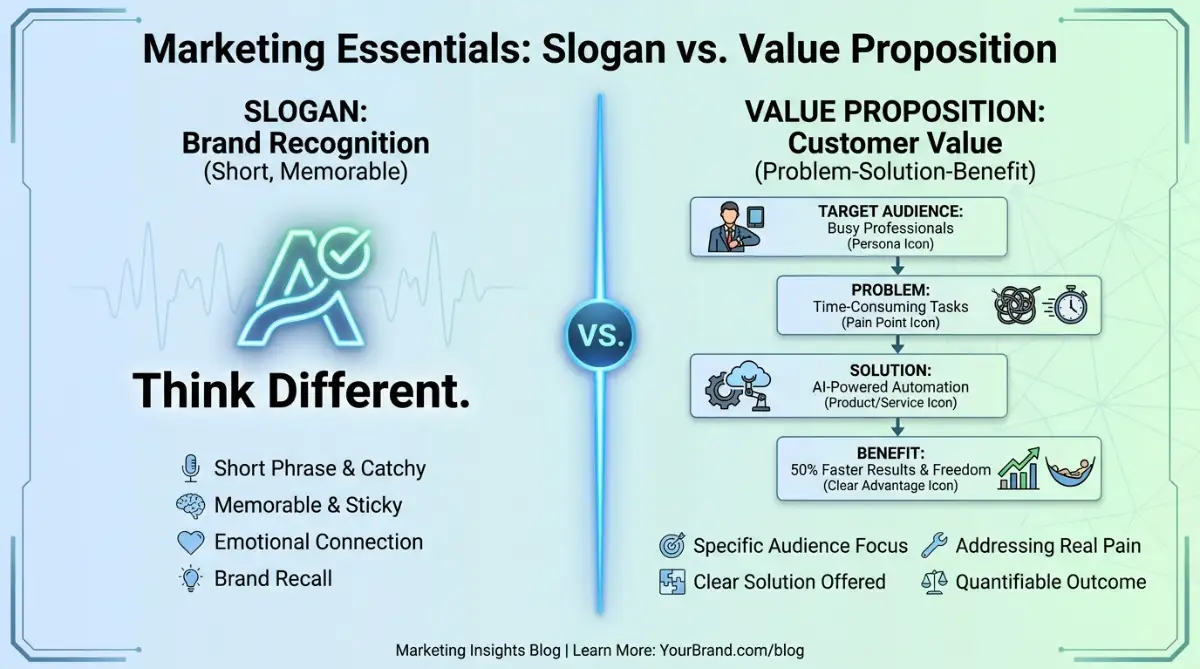
As you can see, the slogan is great for memory, but the value statement does the heavy lifting of selling. If a visitor lands on your website and cannot understand what you do within five seconds, they will leave. A great value statement acts as a hook that keeps them reading.
People do not buy products simply because they have amazing features. They buy products because they want to solve a specific problem in their life or business. They want to move from their current painful state to a much happier, easier, and better state.
If you want a quick visual guide on how to make your brand instantly click with website visitors, watch this short video first. It will show you how to structure your core message before we map out our step-by-step blueprint below
The Step-by-Step Blueprint to Attract Your Dream Customers
Creating a strong value statement does not require creative genius. You do not need to be a professional copywriter to get this right. Instead, you can follow a logical, step-by-step process to build a message that truly resonates.
Step 1: Discover the True Pain of Your Customers
You cannot sell a cure if you do not understand the exact sickness. Your first step is to dig deep into the daily lives of your ideal clients. You need to know what frustrates them, what keeps them awake at night, and what they secretly worry about.
Too many startups focus on demographic data like age, location, or income. While those details are helpful, they do not tell you why someone actually makes a purchase. You must focus on their emotional triggers and frustrations instead.
How to Find the Hidden Pain Points
- Read online reviews of your competitors: Look for one-star and two-star reviews on sites like Amazon, Google, or Trustpilot. What are customers complaining about? What do they wish the product did better?
- Hang out where they talk: Spend time in online forums, Reddit communities, and Facebook groups where your target audience hangs out. Read their posts to see what questions they ask most often.
- Talk to real people: Reach out to five or ten people who fit your ideal profile. Ask them about their biggest challenges in a friendly, casual chat.
When you do this research, write down the exact words they use. Do not try to make their language sound more professional. Using their exact words in your marketing is the easiest way to make them feel understood.
Step 2: List the Features and Map Them to Real Outcomes
Once you know the customer's problem, you need to show how your product solves it. The biggest mistake you can make here is listing only technical features.
Your customers do not care about the technical specifications of your software or the high-quality materials of your physical product. They only care about what those things will do for them.
Let us use a simple analogy. If you go to a hardware store to buy a drill, you do not actually want a drill. What you really want is a hole in your living room wall so you can hang a beautiful family photo. The drill is just the tool to get you there.
The Feature-to-Benefit Translation Formula
To turn a boring feature into an exciting benefit, use the phrase "so that you can."
Take a feature, add that phrase, and see what outcome you get. This simple exercise forces you to focus on the end result for the buyer.
- Boring Feature: Our app has 256-bit data encryption.
- Translation: We use 256-bit encryption so that you can sleep peacefully knowing your bank details are completely safe from hackers.
- Boring Feature: Our agency has a team of ten designers.
- Translation: We have a team of ten designers so that you can get your marketing graphics delivered in less than 24 hours without waiting in line.
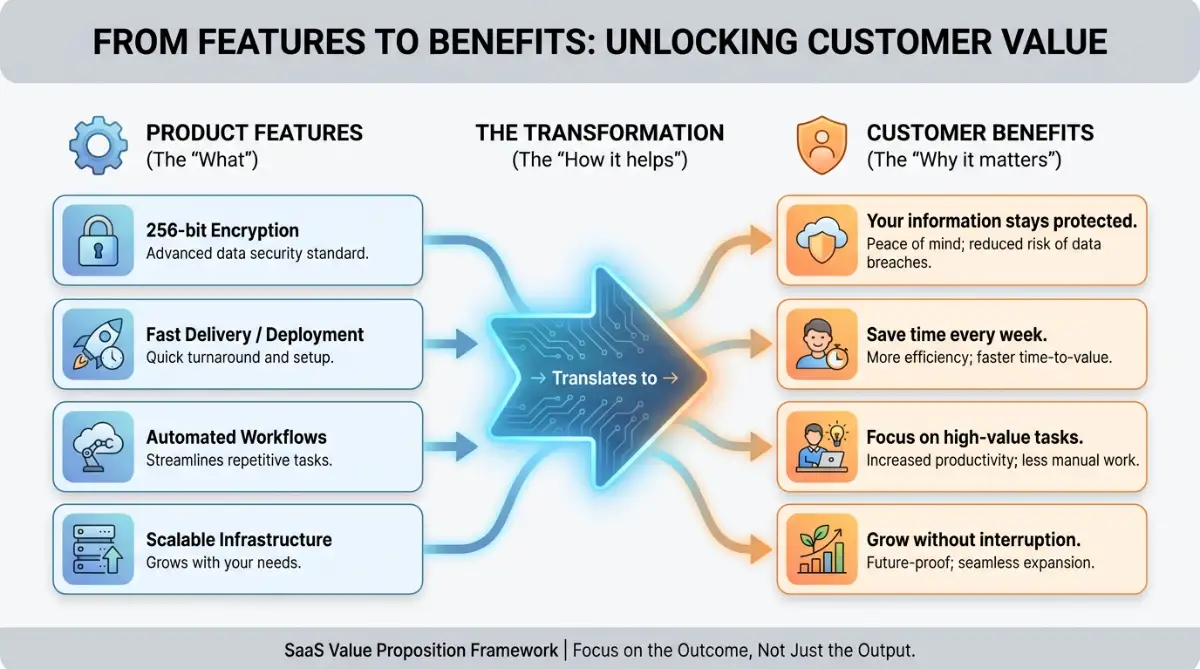
When you write down your benefits this way, they instantly become more persuasive. You are no longer selling a tool; you are selling a happier, safer, or more efficient lifestyle.
Step 3: Define Your Unique Advantage
Your potential buyers always have choices. They can buy from your direct competitors, find a cheap alternative, or choose to do absolutely nothing at all.
You must explain why choosing your business is the smartest decision they can make. This is where your unique advantage comes into play. You do not need to be the absolute best at everything, but you must be different in a way that matters to your audience.
Myth vs. Reality in Business Positioning
- Myth: We must have the lowest price in the market to win customers.
- Reality: Trying to be the cheapest is a quick race to the bottom. Instead, focus on providing more value or saving your customer time, which is often worth far more than a cheap price.
- Myth: We must serve every single person to maximize our sales.
- Reality: Trying to please everyone makes your message boring and weak. By targeting a specific group, your message becomes highly personal and powerful.
To find your unique advantage, think about what you do differently. Perhaps your customer service is incredibly fast and helpful. Maybe your product is designed specifically for beginners who hate complicated technology.
Whatever your advantage is, make sure it is something your target audience actually cares about. If you offer a feature that no one wants, it is not an advantage.
Step 4: Assemble Your Value Proposition Using Simple Formulas
Now that you have gathered your research, translated your features, and found your unique advantage, it is time to write.
You do not need to start from scratch. You can use proven copywriting formulas that have helped some of the most successful startups grow.
I used to spend days trying to invent clever, poetic slogans that made my brand sound high-end, but my conversion rates remained terribly low. The day I threw out the fancy corporate jargon and wrote a simple, direct headline using a basic formula, my inquiries tripled overnight. Trust me, being incredibly clear will always win you more business than trying to sound clever.
Formula A: The Simple Sentence
This is a quick and highly effective formula for any business website.
We help [Target Audience] do [Desired Action] without [Pain Point].
- Example: "We help freelance writers track their taxes without the headache of complicated spreadsheets."
Formula B: The Classic Headline and Subhead
This is the standard format used by most modern software companies and service providers.
- Headline (The Big Benefit): State the ultimate positive outcome you offer in one bold sentence.
- Subhead (The How-To): Explain briefly what you sell, who it is for, and why it is different.
- Bullet Points: List 3 key features translated into emotional benefits.
Let us look at a real-life scenario to see how this works in practice.
Imagine a startup that offers a meal prep delivery service for busy working parents. Their value proposition might look like this:
- Headline: Healthy, home-cooked family dinners delivered straight to your door.
- Subhead: We plan, chop, and deliver fresh ingredients weekly, so busy parents can serve nutritious meals in under fifteen minutes.
- Key Benefits:
- No grocery shopping or meal planning required.
- Easy-to-follow recipe cards that anyone can use.
- Organic ingredients sourced from local farms.
This message is incredibly clear. A busy parent landing on this page immediately understands what the service is, who it is for, and how it will save them time and stress.
Step 5: Test and Refine Your Message
Writing your value statement is only the first part of the process. You must test it in the real world to ensure it actually attracts your ideal customers.
You do not need to spend thousands of dollars on expensive testing tools. You can run simple, low-cost tests to see how people react to your message.
Simple Ways to Test Your Value Proposition
- The Five-Second Test: Show your headline and subhead to a friend or colleague who does not know your business. Let them look at it for exactly five seconds, then hide it. Ask them, "What does this business sell?" If they cannot answer, your message is too complicated.
- A/B Testing on Landing Pages: Create two simple landing pages with identical designs but different headlines. Run small, targeted ads to both pages and see which headline gets more sign-ups or clicks.
- Social Media Feedback: Post different versions of your core message on platforms like LinkedIn or Twitter. Pay close attention to which post gets the most engagement, comments, and questions.
Remember, a great value statement is never truly finished. As your market changes and your business grows, you should continue to update and improve your message based on real customer feedback.
Customer Language Collection System
Every month, collect:
- Questions customers ask before buying
- Complaints about competitor products
- Exact phrases used in reviews
- Reasons customers choose your solution
Your best marketing words often come directly from your customers.
Common Pitfalls to Avoid at All Costs
Even smart entrepreneurs sometimes make mistakes when writing their value statements. To make sure your message hits the mark, avoid these common traps.
1. Using Confusing Corporate Jargon
Do not use words like "synergy," "optimized," or "next-generation." These words make your business sound like a faceless corporation and fail to connect with real humans. Use simple, direct language that an eight-year-old can easily understand.
2. Being Too Broad or Vague
Saying "We offer high-quality services for everyone" tells the customer absolutely nothing. Be specific about who you help and exactly how you help them. The more targeted your message is, the easier it will be to attract the right people.
3. Talking Only About Yourself
Your value proposition is not a list of your accomplishments, certificates, or awards. It is about your customer and their struggles. Frame every sentence around their needs, their goals, and their success.
Frequently Asked Questions
Can a business have more than one value proposition?
Yes, especially if you sell to different types of customers. However, your homepage should focus on one main message that covers your primary audience. You can create separate landing pages with unique value statements for your other customer groups.
How long should a value proposition be?
Keep it short and to the point. Ideally, your main headline should be under ten words, and your subhead should be two to three sentences long. You want visitors to understand your message at a single glance.
What if my product is identical to my competitors?
If your physical product is the same, focus on making your service, delivery, or purchasing experience much better. Often, the way you sell, support, or package a product can become your strongest unique advantage.
Wrapping It All Up
Creating a strong value proposition is the foundation of all your marketing and sales efforts. It turns confused website visitors into happy, paying customers who feel understood.
Stop trying to sound clever or overly complicated. Focus on the real struggles of your dream clients, show them how you can make their lives easier, and explain why you are the best choice for them.
Once you clarify your message, you will stop struggling to find customers. Instead, your ideal clients will easily find you, recognize the value you offer, and gladly pay for your solutions.
Next-Level Tactics for Crafting an Unbeatable Value Message
Getting your initial business message written is a great start. However, to truly stand out from the crowd, you need to go beyond the basics.
Most business owners write a simple headline and then stop there. They think their work is done once they have a neat sentence on their homepage.
If you want to build a brand that lasts, you must use advanced strategies that build deep trust. These pro-level secrets will help you create a highly persuasive message that keeps working for your business day after day.
Speak the Silent Language of Your Buyers
The most successful businesses do not just list the problems they solve. They use the exact words and phrases that their customers use when they are talking to their friends.
To do this, you need to step away from your own desk. You must listen to the natural conversations of your market.
When you use the literal phrasing of your customer, something amazing happens. They read your website and feel like you are inside their mind.
This builds instant trust because it shows you truly understand their daily reality. For instance, instead of saying "We offer efficient task management," say "Stop chasing your team for updates on projects."
One phrase sounds like a boring textbook. The other phrase sounds like a real person who knows exactly how annoying it is to manage a disorganized team.
Connect Your Message Directly to User Experience
Your value statement cannot live in a vacuum on your website. It must match the actual experience a user has when they interact with your brand.
If your website promises "the easiest way to book a flight," but your booking form has fifty fields, your message is a lie. The friction in your design will completely destroy the trust you built with your headline.
This is why your message must guide every single decision in your business. If you promise speed, your service must be incredibly fast.
If you promise simplicity, your design must be beautifully clean. If your brand design is confusing, you risk falling into the traps that explain why your new business is invisible to prospective buyers online.
The Magic of the "One-Reader" Rule
When you write copy for your website, it is easy to try to talk to a giant crowd of thousands of people. You might use words like "To all our valued clients" or "We help companies globally."
This is a massive mistake that dilutes your message. It makes your writing feel cold, distant, and completely corporate.
Instead, always write as if you are speaking to just one single person. Imagine your ideal client sitting right across the table from you at a quiet coffee shop.
How would you explain your business to them over a warm cup of coffee? You would use friendly, warm, and highly direct language.
You would say "you" instead of "they" or "our users." This tiny shift in your writing style makes your website feel like a personal conversation rather than a broadcast.
Map the Hidden Social Outcomes
People do not buy products just for functional utility. They also buy them to achieve social status, feel safe, or project a specific identity to those around them.
Think about why people buy luxury watches. A cheap plastic watch tells the time just as well as a luxury Swiss watch.
But people pay thousands of dollars for the Swiss watch because of the social status and feelings of success it provides. This is an emotional and social outcome.
When writing your value statement, always ask yourself what your product says about the buyer. How does it make them look to their boss, their friends, or their family?
If your service helps a manager save money, it does not just help the company. It also makes that manager look like a hero to their CEO, which helps them secure their next promotion.
Highlighting these subtle, emotional benefits is a secret weapon that most of your competitors completely ignore. According to Harvard Business School research on value statements, clearly communicating these unique strengths is what keeps a brand from getting lost in a noisy marketplace.
Build a Dynamic Feedback Loop
Your market is constantly changing, which means your message must adapt over time. What worked last year might not connect with your audience today.
To stay ahead, you need to establish a simple feedback loop with your active users. Regularly check in with your newest clients to ask them why they chose you over other options.
Ask them what almost stopped them from buying from your business. Their honest answers will give you a continuous stream of insights to refine your headlines.
If several clients mention they chose you because of your fast delivery, make sure that point is highly visible in your messaging. Let your actual customer data guide your pen.

Hidden Traps That Can Quietly Destroy Your Messaging
Even with the best intentions, it is incredibly easy to make mistakes that turn ideal clients away. These hidden traps can make your business look confusing, untrustworthy, or completely generic.
Understanding these errors is highly important so you can protect your brand. Let us look at the most common pitfalls that business owners fall into when trying to define their market value.
The Delusion of Being Everything to Everyone
The absolute fastest way to fail in business is to try to please every single person on earth. When you try to speak to everyone, you end up speaking to absolutely nobody.
Many founders fear that by narrowing their focus, they are leaving money on the table. They think a broader net will bring in more fish.
In reality, a broad net just makes your message incredibly weak and boring. If you sell accounting software, do not say "We make software for all business owners."
Instead, say "We make tax software for independent graphic designers." By speaking directly to a specific niche, you instantly stand out as the perfect specialist for their needs.
Before you can build an effective message, you need to spend time learning how to find your target audience demographics so you know exactly who you are speaking to. This prevents you from wasting precious time and money on the wrong crowd.
Falling in Love with Your Own Product
It is natural to be highly proud of the product or service you built. You know how much effort went into every line of code, every ingredient, or every hour of planning.
However, this pride often leads to a major bias. You start writing your website copy from your own perspective instead of the customer's perspective.
You write long paragraphs about your history, your unique technology, and your complex systems. Meanwhile, your website visitors are only asking themselves one simple question: "What is in this for me?"
If they cannot find the answer to that question immediately, they will click away. They do not care about your hard work; they only care about their own problems.
Always keep the spotlight focused entirely on the user. Your product is not the hero of the story; your customer is the hero, and your business is simply the guide helping them succeed.
Writing a Pitch Instead of a Promise
A value proposition is not a sales pitch filled with hype, exclamation marks, and empty promises. It is a clear, honest promise of value that you can actually deliver.
Avoid using terms like "revolutionary," "life-changing," or "the world's absolute best." These words are completely empty and actually trigger skepticism in modern buyers.
Consumers have been burned by internet hype far too many times. They want real, clear proof of what your product can do for them.
Instead of shouting about how great you are, state your value clearly and back it up with simple facts. If your service saves time, state exactly how many hours your average client saves each week.
Honest clarity is always far more persuasive than loud, flashy marketing hype.
The Tragedy of Skipping the Validation Phase
Many entrepreneurs write a beautiful message, put it on their website, and then never look at it again. They assume that if they like the way it sounds, their market will feel the same way.
Failing to check if people actually want your offer is the top reason why most side hustles fail before they even get off the ground. You must test your message with real human beings before you spend your hard-earned cash on advertising.
This is very similar to the huge misconceptions about writing your first business plan where founders focus too much on complex, dry planning sheets and too little on real customer interaction.
Never guess what your customers want. Always test, measure, and validate your words in the real market to ensure they drive conversions.
Your Blueprint for Immediate Action
Clarifying your message is the single most profitable task you can complete for your business today. It does not require a large budget, complex software, or a team of expensive consultants.
You simply need a willingness to listen to your market and the courage to speak plainly. By applying these steps, you will transform your business from an invisible option into an obvious choice.
Your 24-Hour Action Plan
To help you get started right away, here is a simple action plan you can complete over the next 24 hours:
- Hour 1-2: Reach out to three of your best customers and ask them why they originally chose your business.
- Hour 3-4: Scan your competitor's bad reviews to find the key frustrations your industry usually ignores.
- Hour 5-6: Write down three different versions of your headline using the simple formulas we discussed.
- Hour 7-8: Share those headlines with five people who know nothing about your business and ask for their honest thoughts.
- Hour 9: Update your website homepage with your strongest, clearest message and monitor your sign-up rates closely.
A Final Message for Your Journey
Building a successful business is a journey that requires constant learning and patience. It is completely normal to feel overwhelmed or unsure of your next steps.
But remember, you already have the most important asset you need: a genuine desire to help your customers solve their problems. When you align your message with that helpful intent, success naturally follows.
Do not let fear of failure keep you from sharing your business with the world. Take action today, rewrite your core message, and start welcoming your ideal clients with open arms.
I used to spend days trying to invent clever, poetic slogans that made my brand sound high-end, but my conversion rates remained terribly low. The day I threw out the fancy corporate jargon and wrote a simple, direct headline using a basic formula, my inquiries tripled overnight. Trust me, being incredibly clear will always win you more business than trying to sound clever.
Disclaimer
The information provided in this article is for educational and informational purposes only. While we share proven marketing strategies and copywriting frameworks, individual business results may vary depending on market conditions, product quality, and execution. We do not guarantee specific financial outcomes, sales, or customer acquisition rates. Always conduct your own thorough market research and consult with a professional business advisor before making major financial investments in your startup or marketing campaigns.