When Your Back Becomes Your Biggest Enemy
For a long time, my mornings started with a groan of frustration. I would roll out of bed feeling like my spine was completely locked, terrified that even a simple sneeze might leave me stranded on the floor for days. I spent years searching for a quick fix, only to realize that healing my back required me to stop fighting my body and start listening to it.
Imagine waking up and the first thing you feel isn't the warmth of the sun, but a sharp, nagging tug in your lower back. You try to sit up, but your spine feels like it’s made of dry wood. This is the daily reality for so many of us.
It’s not just about the physical ache. It’s about the things you miss out on. You hesitate to pick up your toddler because you're scared your back will "go out." You pass on a walk with friends because sitting on a bench later sounds like torture.
The weight of this tension carries over into your mood. It makes you feel older than you are. You feel trapped in a body that refuses to move the way it used to.
I talk to people every day who say they feel "stuck." They’ve tried the heating pads and the rubs, but the tension always comes back. It feels like a heavy cloud hanging over your productivity and your happiness.
Have you ever felt like you’re walking on eggshells with your own body? One wrong move and you might be stuck on the couch for three days. That fear is exhausting.
We often think back pain requires expensive equipment or a gym membership. But the truth is, your body just needs a little bit of space and some gentle, purposeful movement. You don't need to be an athlete to start feeling better.
You deserve to move without thinking about it. You deserve to sit through a movie or a dinner without constantly shifting your weight. Let's look at how we can start changing that narrative today.
Why Your Lower Back Feels Like a Tight Knot
Before we move into the exercises, we need to understand what is actually happening. Your lower back, or the lumbar spine, carries the weight of your entire upper body. It is the bridge between your legs and your chest.
When we sit for hours at a desk or on a sofa, the muscles in our hips get short and tight. These muscles are connected to your lower back. They start pulling on your spine, creating that constant feeling of tension.
It is like having a rubber band that has been stretched too far for too long. Eventually, it starts to fray. Your brain sends pain signals to tell you that something is wrong.
Movement is the "oil" for your joints. Without it, things get rusty. These stretches are designed to bring blood flow back to those "rusty" areas and tell your nervous system to relax.
Preparing Your Body for Safe Stretching
Don't just jump into a stretch. Your muscles are like a cold piece of plastic. If you pull them too fast while they are cold, they might snap or strain.
Start by walking around your room for two minutes. Swing your arms gently. This gets the blood pumping and warms up the tissue.
Always wear comfortable clothes that don't restrict your movement. A simple t-shirt and sweatpants are perfect. You want to be able to breathe deeply without feeling squeezed.
Find a flat surface. A yoga mat is great, but a clean carpet works just as well. Avoid stretching on a bed because it is too soft and won't support your spine correctly.
The Magic of the Child’s Pose
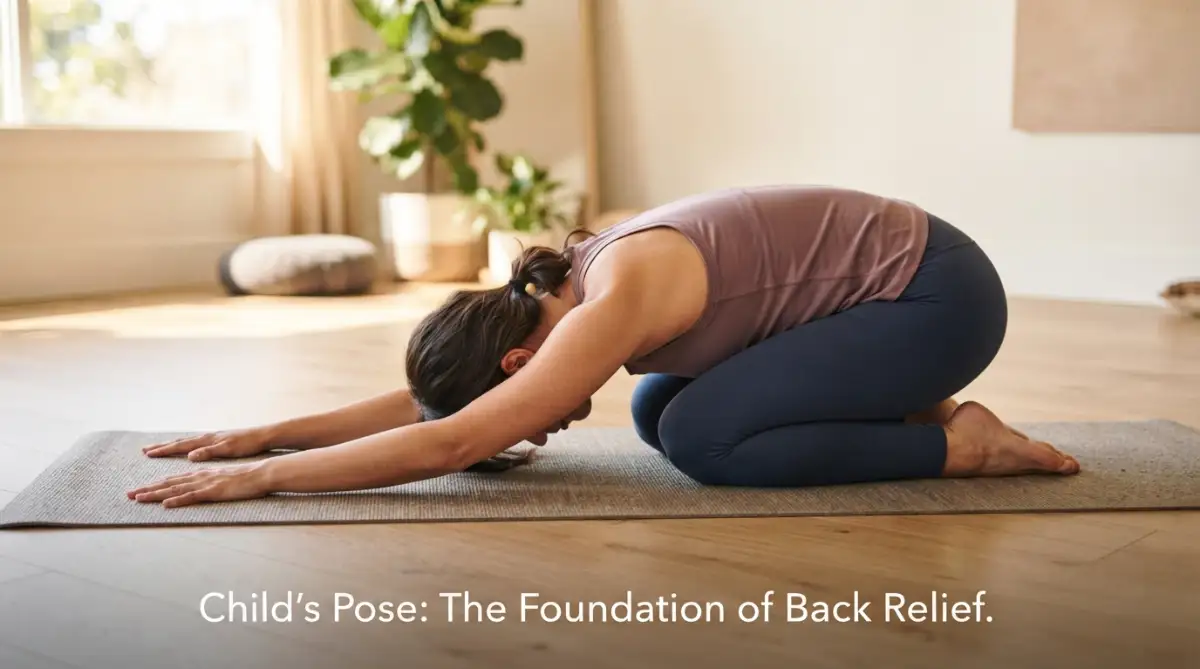
This is one of the most famous resting poses for a reason. It gently elongates the lower back muscles and provides a deep sense of calm.
To do this, start on your hands and knees. Bring your big toes together and push your knees out wide. Now, slowly sit your hips back toward your heels.
Reach your arms forward on the floor and let your forehead rest on the ground. If your head doesn't reach the floor, you can use a pillow.
Breathe deep into your back. Imagine your breath is expanding the space between your vertebrae. Hold this for one minute.
This pose shifts the focus from "doing" to "being." It tells your lower back that it is safe to let go of the day's stress.
Using the Cat-Cow Flow to Wake Up Your Spine
This movement is perfect for improving the "fluidity" of your back. It helps move the joints through their natural range of motion.
Stay on your hands and knees. Your hands should be under your shoulders and knees under your hips.
As you inhale, drop your belly toward the floor and look up slightly. This is the "Cow" part. Feel the front of your body stretch.
As you exhale, round your back toward the ceiling, tucking your chin to your chest. This is the "Cat" part. Imagine you are a cat stretching after a long nap.
Repeat this flow ten times. Move slowly with your breath. Don't rush it. This isn't a race; it’s a conversation with your spine.
Unsure if you are doing these movements correctly? Watch this quick, easy video showing how to flow through these poses safely before moving on to the next stretch below!
Releasing Tension with the Knee-to-Chest Stretch
This is a very simple but effective way to decompress the lower spine. It is great to do right before bed.
Lie flat on your back with your legs straight. Gently pull one knee up toward your chest. Hold it with both hands.
Keep your other leg flat on the floor if you can. If that feels too tight, you can bend the other knee and keep the foot on the floor.
Hold for 30 seconds on each side. You will feel a gentle pull in the base of your spine and your glutes.
This stretch helps reset the pelvic tilt that often causes lower back tightness. It’s like giving your spine a tiny hug.
The Power of the Piriformis Stretch
There is a small muscle deep in your buttock called the piriformis. When it gets tight, it can irritate the sciatic nerve and cause back pain.
Lie on your back with both knees bent and feet on the floor. Cross your right ankle over your left knee.
Gently lift your left foot off the floor and grab the back of your left thigh. Pull it toward your chest until you feel a stretch in your right hip.
Keep your shoulders relaxed on the ground. Don't tense your neck.
Hold this for 40 seconds and then switch sides. This is a game-changer for people who sit at desks all day.
Understanding the "Pain vs. Stretch" Rule
Many people think "no pain, no gain." This is a big mistake when it comes to your back.
A stretch should feel like a "good tension." It should feel like the muscle is being pulled, but it shouldn't be sharp or stabbing.
If you feel a sharp pain, stop immediately. Your body is trying to protect itself.
Always move into a stretch slowly. Imagine you are dipping your toe into a pool of water. You want to test the temperature first.
I used to think I had to push through the pain to get results, which often left me unable to walk comfortably the next day. Once I learned to back off to about seventy percent of my maximum stretch and just breathe, my muscles finally stopped locking up and actually started to relax.
Why Breathing is Your Secret Weapon
Most of us hold our breath when we feel pain or tension. This actually makes the muscles tighter because it triggers a "fight or flight" response.
When you stretch, focus on long, slow exhales. When you exhale, your nervous system switches to "rest and digest" mode.
This signal allows your muscles to actually lengthen. Without deep breathing, you are just pulling on a locked muscle.
Try to breathe in through your nose for four counts and out through your mouth for six counts. You will be amazed at how much deeper you can go.
Myth vs. Reality: Back Pain Edition
Myth: You should stay in bed until the pain goes away.
Reality: Long periods of rest actually make back pain worse. Movement is what keeps the tissues healthy and flexible.
Myth: Back pain means something is permanently broken.
Reality: Most back pain is caused by muscle imbalances and tension, not structural damage. Stretching can often fix it.
Myth: You need to be flexible to do yoga or stretching.
Reality: You don't "get" flexible to stretch; you stretch to "get" flexible. Everyone starts somewhere.
The Role of Your Core in Back Health
Your lower back doesn't work alone. It relies on your stomach muscles (your core) for support.
If your core is weak, your back has to do all the work. This leads to fatigue and tension.
While we are focusing on stretching, remember that simple movements like "Bird-Dog" can help strengthen that support system.
A strong core acts like a natural corset for your spine. It keeps everything in place so your back doesn't have to overwork.
Simple Pelvic Tilts for Subtle Relief
Sometimes, the smallest movements make the biggest difference. Pelvic tilts are great for people in acute pain.
Lie on your back with knees bent and feet flat. Notice the small space between your lower back and the floor.
Gently flatten your back against the floor by tightening your stomach muscles. Hold for three seconds.
Then, relax and let the natural arch return. Repeat this 15 times.
It’s a very small movement, but it helps "turn on" the muscles that support your lumbar spine.
The Importance of Consistency Over Intensity
Doing 10 minutes of gentle stretching every day is much better than doing an hour once a week.
Your muscles have a "memory." If you stretch daily, you are teaching them a new, relaxed state.
Pick a time that works for you. Maybe it’s right after your morning coffee or right before you jump in the shower at night.
Make it a habit like brushing your teeth. Your future self will thank you for those 10 minutes.
Practical Tips for Your Daily Life
If you work at a desk, set a timer for every 30 minutes. Stand up and do a quick "Cat-Cow" standing up by leaning on your desk.
Check your posture when you are on your phone. Are you hunched over? That "text neck" pulls on your entire spine down to your lower back.
Lift your phone up to eye level. It sounds silly, but it takes a massive load off your back.
Think about how you sit on the sofa. If you are slumped, put a small pillow behind your lower back to maintain its natural curve.
Listening to Your Body’s Signals
Your body is always talking to you. Stiffness is a whisper. Pain is a scream.
Don't wait for the scream. When you feel a little bit of tightness, take that as a sign to move.
Some days you will feel more flexible than others. That is okay. Respect where your body is at today.
If you had a stressful day, your muscles will likely be tighter. Stress and physical tension are closely linked.
Creating a Calm Environment
Stretching is as much for your mind as it is for your body. If you can, dim the lights.
Turn off the TV and put your phone on silent. This is your time to reconnect with yourself.
A calm mind leads to calm muscles. When you are stressed, your body produces cortisol, which can increase inflammation and pain.
Use these stretching sessions as a "reset button" for your entire system.
When to See a Professional
While home stretching is amazing, it’s not a fix for everything. If your pain is accompanied by numbness or tingling in your legs, you should see a doctor.
If the pain is so bad that you can't sleep, or if it comes after a fall, seek professional advice.
Physical therapists are wonderful partners in your health journey. They can give you specific exercises for your unique body type.
But for the general tension of daily life, these home stretches are a powerful first step.
Moving Forward with Confidence
You are taking control of your health. That is a huge win.
Don't get discouraged if you don't feel 100% better after one session. It took time for the tension to build up, and it will take a little time to melt away.
Focus on the small victories. Maybe today you can reach an inch further. Maybe today you felt a little less stiff when you got out of your car.
These small changes add up to a life of freedom and movement. You have the tools now. Use them gently and often.
Keep your movements smooth. Keep your breath deep. Your back is not your enemy; it’s a part of you that just needs a little extra care and attention.
The path to a pain-free life doesn't have to be complicated. It starts on your floor, on your mat, with a simple breath and a gentle stretch.
Trust the process. Trust your body. You are doing great.
Master Secrets for Long-Term Spinal Freedom
Stretching once is a great start, but keeping your back happy for a lifetime requires a deeper understanding of how your body works. Most people stop as soon as the sharp pain fades, but that is when the real work actually begins.
One of the best-kept secrets among physical therapists is the concept of micro-movements. Instead of waiting for a 20-minute session at night, you should "snack" on movement throughout the day. This keeps the blood flowing to your lumbar discs and prevents the "setting" of stiffness that happens when we stay still.
Think of your spine like a sponge. When you move and stretch, you are essentially squeezing that sponge and letting it soak up fresh, nutrient-rich fluid. If the sponge stays dry for too long, it becomes brittle and easy to crack. Regular, tiny movements keep that sponge moist and resilient.
Another professional tip is to focus on your Psoas muscle. This is a deep muscle that connects your lower spine to your thigh bone. When you sit too much, this muscle shrinks and pulls your lower back forward, creating a constant ache.
To help this, try a gentle "Lunging Hip Flexor Stretch." Just drop one knee to the ground and push your hips forward slightly while keeping your back straight. It targets the root cause of many back issues rather than just treating the symptoms.
We also have to talk about the connection between your brain and your back. Stress often manifests as physical tension in the lumbar region. If you are stressed, your muscles stay in a "ready to bolt" state, which leads to exhaustion and pain.
Quality rest is where the magic happens. When you sleep, your body repairs the tiny tears in your muscle fibers. If you struggle with sleep because of back pain, it becomes a cycle that is hard to break. You might find it helpful to read about how your brain never forgets a night of lost sleep to understand why prioritizing rest is part of your recovery.
A pro-level secret is to use isometrics. This means tensing a muscle without moving the joint. While lying on your back, try pressing your lower back into the floor for five seconds and then letting go. This "wakes up" the stabilizing muscles that protect your spine during the day.
You should also look at your hydration. Your spinal discs are mostly made of water. If you are dehydrated, those discs lose their height and their ability to absorb shock. Drink enough water so your spine has the cushioning it needs to support your weight.
Consistency is the bridge between where you are now and where you want to be. I always tell my readers to aim for "low-stakes" consistency. Don't promise yourself an hour a day; promise yourself two minutes. Usually, once you start for two minutes, you will want to keep going.
Lastly, pay attention to your feet. The way you walk and the shoes you wear affect your lower back. If your shoes are worn out, your foundation is uneven, and your back has to compensate for every step you take. Investing in a good pair of supportive shoes is an investment in your spine.

The Invisible Traps: Why Your Progress Might Be Stalling
It is heartbreaking to see someone trying so hard to get better, only to unknowingly make things worse. One of the most common traps is over-stretching. You might feel like if a little stretch is good, a big, painful stretch must be better.
This is a dangerous path. When you pull too hard, your body’s "stretch reflex" kicks in. This is a safety mechanism that actually makes the muscle contract to prevent it from tearing. So, by pulling too hard, you are actually making the muscle tighter.
Another huge mistake is ignoring the rest of your body. Your back pain might not even start in your back. For many, it starts in the gut. If you have internal inflammation, it can radiate outward and affect the muscles of your lower spine.
Maintaining a healthy internal environment is a huge part of physical comfort. You can explore how to improve your gut health naturally to see how your diet might be the missing piece in your back pain puzzle. A calm gut often leads to a calm back.
Many people also make the mistake of "sitting into" their stretches. They round their back and collapse their chest while trying to touch their toes. This puts an incredible amount of pressure on the front of your spinal discs.
Always keep your chest open and your spine long. It is much better to reach half as far with a straight back than to touch your toes with a hunched one. Form is everything when it comes to the delicate structures of the lumbar region.
We often see people who only stretch when they are in pain. This is like only brushing your teeth when you have a cavity. If you wait for the pain to return, you are always playing defense. You want to play offense by moving even when you feel "okay."
Don't forget the role of breath holding. If you catch yourself holding your breath while you reach for your toes, stop. This sends a panic signal to your brain. It tells your muscles to lock up for protection, which is the opposite of what you want.
Lastly, many people forget that their daily environment is the biggest factor. You can stretch for ten minutes, but if you then spend eight hours slumped in a chair, the stretch won't win that battle.
According to research from organizations like the Mayo Clinic, proper ergonomics are non-negotiable for long-term health. If your desk setup is wrong, you are fighting an uphill battle every single day.
Your Path to a Life Without Limits
Think back to a time when you didn't have to think twice about bending over to tie your shoes. That version of you is still there; it’s just buried under some layers of tension and habits. You have the power to peel those layers back.
The journey to a healthy back is not about perfection. It’s about small, intentional choices. It’s about choosing to stand up for a minute during a commercial break. It's about taking that one deep breath when you feel your shoulders creeping up toward your ears.
You don't need to be a yoga master or a professional athlete to have a back that works for you. You just need to be a student of your own body. Listen to what it tells you and respond with kindness and movement.
I want you to feel encouraged today. The fact that you are reading this means you are ready to make a change. That mental shift is the hardest part of the entire process.
Start tonight with just one pose. Maybe it’s the Child’s Pose before you get into bed. Notice how it feels. Notice the tiny bit of space it creates in your mind and your muscles.
Over time, these small moments of relief will grow. You will find yourself moving with more grace and less fear. You will start saying "yes" to those walks and those family gatherings again because you trust your body.
Remember, your body wants to be healthy. It is designed to heal and to move. By giving it these gentle stretches, you are simply giving it the tools it needs to do its job.
You have the information, the steps, and the expert secrets. Now, all that’s left is to take that first gentle stretch. You deserve a life defined by freedom, not by stiffness.
Action Plan for Tomorrow:
- Morning: Spend two minutes in Cat-Cow while your coffee brews.
- Mid-day: Do a standing hip flexor stretch at your desk.
- Evening: Hold a Child’s Pose for 60 seconds before bed.
- Always: Breathe deep and move slow.
Your spine is your support system. When you take care of it, it takes care of you. Let's make today the day you stop living with tension and start living with ease.
Healing my back was a slow journey, but taking just two minutes every evening to stretch on the living room rug gave me my life back. You do not need to live in fear of your own movements, so start with just one gentle stretch tonight and let your body heal at its own pace.
Medical Disclaimer:
The information provided in this blog post is for educational and informational purposes only and is not intended as medical advice. Always consult with a qualified healthcare professional or physician before starting any new exercise routine or if you are experiencing severe or chronic back pain. If you feel sharp or increasing pain while stretching, stop immediately and seek medical guidance.