The Secret Struggle of Trying to Understand the Smart Tech World
I still remember the exact night I almost threw my laptop out of my bedroom window. Everyone around me was talking about how smart computers were changing the world overnight. I spent hours reading heavy articles filled with scary mathematical equations and dry academic terms.
It felt like trying to read a completely different language without a dictionary. I felt completely lost, stupid, and worried about my professional future.
Maybe you are feeling the exact same way right now.
You open your social media feed and see posts about new smart tools every single hour. Your boss mentions terms like algorithms at work, and you just nod along while feeling a knot of worry in your stomach.
This constant pressure can really drain your energy and ruin your peace of mind. You might even worry that your job will disappear before you even get a chance to understand these new tools.
The truth is, most explanations out there are made by math professors for other math professors. They use big, scary terms that make simple ideas look like rocket science. This builds a giant wall between everyday people and the technology that is shaping our lives.
You do not need to feel left behind just because you do not have a computer science degree.
Breaking Down the Big Words: What is AI and Machine Learning?
To start your journey, we need to clear up the confusion around the most common terms. People often throw these words around as if they mean the exact same thing.
This confusion makes the topic feel much harder than it actually is. Let us look at how these terms fit together like Russian nesting dolls.
The Grand Umbrella of Artificial Intelligence
Artificial Intelligence is the broadest concept of all. It simply refers to any computer program or machine that can do tasks that usually require human smarts.
This includes everything from a computer playing chess to a robot vacuum cleaning your living room floor. If a machine mimics human decision-making, it falls under this big category.
The Learning Engine: Machine Learning
Machine Learning is a smaller, highly specific part of the big world of artificial intelligence. Instead of writing endless rules for a computer to follow, we teach it to learn from experience.
Think of it as training a friendly puppy rather than writing a massive manual for a robot. The computer looks at examples, finds the patterns, and gets smarter over time on its own.
The Deep Brain: Deep Learning
Deep Learning is a tiny, highly specialized pocket inside machine learning. It uses complex structures modeled after the human brain to process information.
This is the tech that powers advanced tools like self-driving cars and systems that can talk like real humans. It needs massive amounts of information and heavy computer power to work.
A Simple Comparison to Keep Things Clear
To help you visualize these differences, here is a simple breakdown of how they compare.
How Computers Actually Learn: The Dog and Cat Analogy
To understand how a machine learns, let us look at how a young child learns to tell a dog apart from a cat. You do not hand a toddler a book of anatomical rules and scientific definitions.
Instead, you point at a furry animal and say, "Look, that is a dog!" Then you point at another one and say, "That is a cat!"
Over time, the child's brain automatically notices the differences between the two animals. They realize that dogs bark and have certain nose shapes, while cats meow and have pointed ears.
Machine learning does the exact same thing but with digital data.
Step One: Gathering the Examples
First, we need to collect thousands of pictures of dogs and cats. In the tech world, we call this collection of pictures the training data.
The quality of this data is highly important because a computer can only learn from what we show it. If we only show it pictures of brown dogs, it might think all dogs must be brown.
Step Two: Finding the Hidden Clues
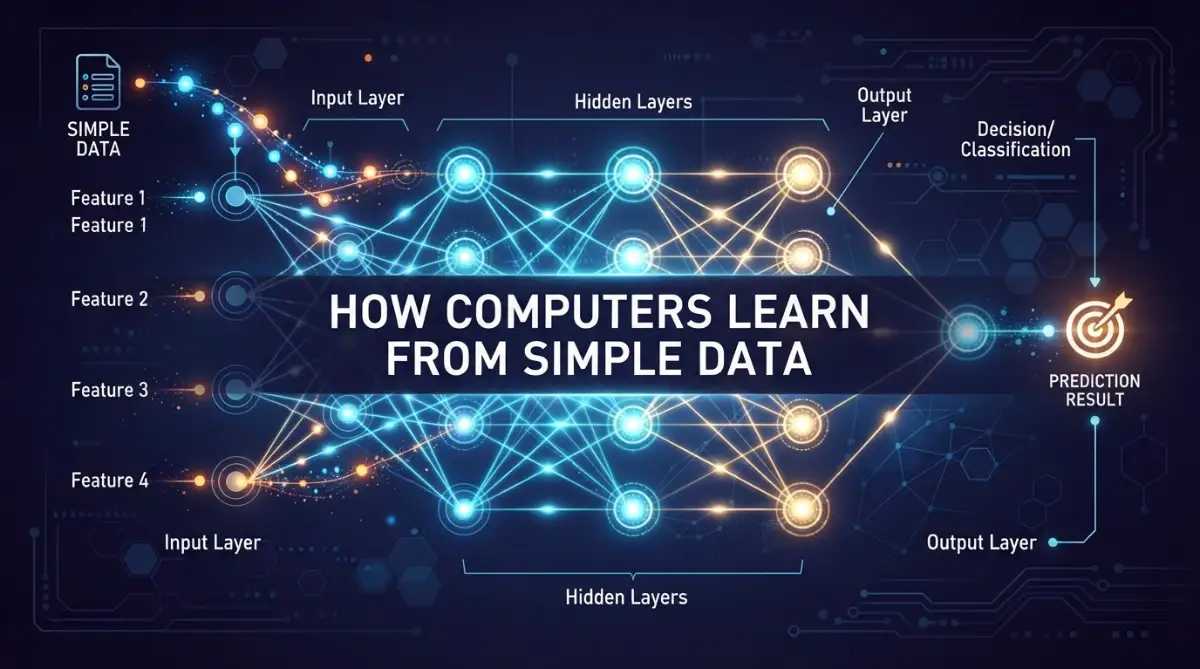
Next, we feed these pictures into our computer program. The program looks at the pixels, the colors, and the shapes in the images.
It starts to notice that certain patterns of pixels always appear in cat photos but not in dog photos. These helpful clues are what engineers call features.
Step Three: Testing the Knowledge
Once the computer has looked at all the photos, we test its new skills. We show it a brand-new picture of an animal that it has never seen before.
The computer uses the patterns it learned to make a guess. It might say, "I am ninety percent sure this is a cat."
Step Four: Making Adjustments
If the computer makes a mistake, we tell it that it was wrong. The program then adjusts its internal math formulas to avoid making that same mistake next time.
This continuous cycle of guessing, failing, and adjusting is how a machine gets incredibly smart over time.
The Two Main Methods of Machine Learning Explained Simply
Now that you know how the learning loop works, let us look at the two main ways we train these systems. Engineers group these training styles based on how much help the computer gets.
Guided Learning: Supervised Learning
In this style of learning, the computer has a teacher holding its hand. Every single piece of data we give to the computer has the correct answer attached to it.
For example, we feed the computer thousands of emails that are already marked as "Spam" or "Not Spam."
The computer learns the common words used in spam emails, like "free money" or "act now." It uses this guided training to flag new incoming junk mail for you.
Independent Learning: Unsupervised Learning
In this style of learning, the computer gets no help at all. We hand it a giant pile of unlabeled data and tell it to find some structure.
Imagine dumping a massive box of mixed buttons on a table and telling a child to sort them. The child might sort them by color, by size, or by the number of holes.
The child does not need to know what the buttons are called to group them logically. This is exactly how computers group similar customer shopping habits together to help businesses understand their buyers.
Real-Life Examples You Use Every Single Day
You might think you do not interact with this technology, but you actually use it constantly. It has quietly become a natural part of our daily routines.
Your Personal Video and Music Playlists
When you open your favorite streaming app, you see a list of recommended shows or songs. The system looks at what you have watched or listened to in the past.
It compares your tastes with millions of other users who share similar habits. Then, it serves up suggestions that you are highly likely to enjoy.
Smart Assistants on Your Phone
When you talk to your smartphone, the device has to convert your voice into text. It then has to figure out what your words actually mean.
This process uses advanced speech recognition patterns to understand your unique accent and speech speed. It gets better at understanding you the more you talk to it.
Instant Map Routing and Travel Times
When you open a map app to find the quickest route home, machine learning is working behind the scenes. It looks at historical traffic patterns and combines them with live data from other drivers.
This allows the app to predict traffic jams before they even happen. It helps you save time and gas by guiding you around the mess.
Before we explore the practical steps to start using this technology, watch this incredible visual breakdown that simplifies these concepts even further.
This quick video will help you see how these ideas come together in the real world.
My Personal Pro Tip for Tech Beginners
When I first started trying to understand this world, I made a massive mistake. I thought I had to sit down and master complex linear algebra and code from scratch.
The truth is, you do not need to write a single line of code to understand or use modern smart tools. Focus on the core logic of how data flows, and let the software handle the heavy math.
How to Start Your Journey Without Feeling Overwhelmed
If you want to get comfortable with this technology, you do not need to go back to school. You can build your confidence by taking a few simple, stress-free steps.
Focus on the Concepts First
Do not worry about the programming languages or the complex math formulas. Focus on understanding the basic goals of the systems you interact with.
Ask yourself: "What data is this tool using, and what pattern is it trying to find?" This simple question will help you see the logic behind almost any smart tool.
Try Out User-Friendly Tools
There are many free, visual tools online that let you play with machine learning without writing code. You can use simple web-based experiments to train a computer using your web camera.
These playful tools make the learning process fun and highly interactive. They turn abstract concepts into something you can see and touch.
Join Welcoming Online Communities
The best way to learn is to hang out with other people who are also learning. Look for beginner-friendly forums, groups, or social media spaces.
Do not be afraid to ask basic questions. You will quickly find that many other people are struggling with the exact same concepts.
Wrapping Up the Basics
Stepping into the world of smart technology does not have to be scary or exhausting. By breaking down the terms and looking at real-world examples, you can easily see the simple logic at play.
You do not need to be a math genius to feel at home in this exciting digital space. Keep exploring, stay curious, and take things one simple step at a time.
Practical Strategies for Mastering Smart Systems in Your Everyday Life
Getting comfortable with software and computing models is not a one-time task. It is a continuous journey of curious exploration that helps you stay ahead in your career. To make this technology work for you, you need to change how you look at your daily work.
When people first start using software, they think it is just about making fun images or writing quick emails. If you want to build real skill, you should start by discovering how to reclaim your time using smart AI productivity tools. This practical step will show you how simple systems can take over your repetitive daily chores.
To build a strong foundation, you must train your mind to think like a data designer. Always look for patterns in your daily tasks to see what can be automated. If you do a task the exact same way three times, a smart system can probably do it for you.
Understanding how algorithms process your daily choices helps you work better with smart systems. According to educational research on machine learning explained by MIT Sloan, knowing the difference between simple predictions and real learning is the key to mastering these systems. This knowledge helps you trust the tool while still keeping your human oversight.
Many beginners quit too early because they feel overwhelmed by the technical setup. If you are starting from scratch, learning how to learn artificial intelligence when you have zero tech skills will give you a clear, stress-free path forward. It breaks the scary tech wall down into small, friendly steps.
Once you have the basics down, you can start experimenting with advanced prompt writing. Prompting is simply the art of asking clear questions to get the best possible answers from a machine. Think of the machine as a highly smart helper who does not know anything about your specific background.
When you write a prompt, give the system a specific role, clear context, and a clear goal. Instead of asking for a general summary, ask the tool to write from the viewpoint of a friendly teacher. This simple change in your approach will immediately boost the quality of your results.
To keep your skills sharp over the long term, make learning a small part of your daily routine. Spend just ten minutes every morning reading about new updates or playing with a new tool. This tiny daily habit will keep you comfortable with the changing tech world without causing mental burnout.
You can also use these tools to organize your personal life and plans. Try using them to plan your weekly meals, organize your study schedules, or budget your monthly expenses. The more you use these systems for real, everyday tasks, the faster you will understand their true potential.
Remember that you do not need to understand the complex math to be a power user. You just need to understand how to guide the system to get the results you want. Treat the technology as a partner that helps you think faster and work smarter every day.

The Hidden Traps: Where Most Beginners Trip and Fall
When people start learning about smart programs, they often fall into common traps that slow down their progress. These mistakes can cause a lot of frustration and make you want to give up entirely. Understanding these pitfalls early on will save you a massive amount of time and energy.
The first major mistake is treating these systems like magic boxes that know everything. Some people think a computer model is always one hundred percent correct. They copy and paste answers without checking the facts or thinking critically about the output.
This lazy approach can cause serious trouble, especially if you use the wrong information for work or school. Smart tools are basically pattern guessing machines, and they can make mistakes with high confidence. You must always use your own human brain to verify the facts before using any generated content.
Another common trap is using bad or messy data to train a simple system. If you feed incorrect or highly biased information into a machine learning program, you will get terrible results. This concept is often called "garbage in, garbage out" by software professionals.
To understand this better, we can look at research papers on machine learning robustness published on arXiv, which show how easily systems fail when their training data is slightly off. If your foundation is weak, the entire system falls apart. This is why spending time cleaning and organizing your data is always the most important step of any project.
Many people also suffer from tech anxiety, which makes them avoid these tools completely. They worry that the technology is too complicated for them to ever understand. They look at the code and the complex math and decide to just stay away.
This fear can hurt your career because these tools are quickly becoming standard in almost every job. If you refuse to learn, you risk falling behind your peers who are using these tools to double their daily output. It is much better to start small and build your confidence slowly than to hide from the future.
We also see people trying to use these systems to solve problems that do not actually need them. You do not need a complex machine learning model to do simple math or organize a basic list. Using too much technology for simple tasks just wastes your time and resources.
Always ask yourself if a simple spreadsheet or a basic rule can solve your problem first. If the answer is yes, save yourself the headache and keep things simple. Technology should make your life easier, not more complicated.
Finally, some people forget to protect their private information when using free online tools. They upload sensitive personal details or company secrets into public systems without reading the safety rules. This can lead to serious privacy issues and put your personal security at risk.
Always treat public tools with caution and never share information that you would not want the world to see. Keeping your data safe is just as important as making your work faster. With a little care, you can enjoy all the benefits of smart tools without any of the risks.
Your Daily Action Plan for a Smarter Future
To help you put this knowledge into action, here is a simple checklist you can follow starting today. It is designed to help you build your skills step by step without feeling overwhelmed.
- Pick one simple tool: Do not try to learn five different programs at once. Choose one popular, friendly tool and spend a week getting to know it.
- Ask better questions: Practice writing highly detailed prompts with clear guidelines and roles.
- Do a daily experiment: Use the tool to help you with one real-world chore, like writing an email or organizing a schedule.
- Check the facts: Never trust an output blindly; always spend a minute verifying the key details.
- Share your learning: Talk to a friend or co-worker about what you discovered to help lock the knowledge in your brain.
Your Next Steps in a Smarter World
Learning about artificial intelligence and machine learning is not about becoming a computer genius overnight. It is about understanding the basic concepts so you can use these tools to make your life easier. Once you see the simple patterns behind the technology, the fear disappears completely.
You can start by looking at how these concepts show up in your regular life. Reading about what artificial intelligence is and how it works in everyday life will help you see these tools in action around you. It turns abstract math into clear, relatable stories.
As you get more comfortable, you can start exploring other areas of your life where smart systems can offer support. For example, the software models used by healthcare providers are changing how we plan for our future. The official guidelines on medical artificial intelligence from the FDA show how deep learning is already helping doctors catch illnesses much faster.
Just like you protect your physical health with smart habits, you protect your financial future by knowing how to handle life's big changes. For instance, understanding how much disability insurance you need is a key part of protecting your family from unexpected events. Taking charge of your tech skills is exactly the same type of smart preparation for your professional life.
To explore more helpful guides on life, tech, and simple decision-making, you can always visit our homepage at TrustPicksHQ. We focus on breaking down complex subjects into warm, friendly guides that anyone can read. Our goal is to give you the confidence to make smart choices in a fast-moving world.
I spent months feeling completely lost and worried about being left behind by all these new systems. Once I stopped focusing on the scary math and started looking at the simple patterns, my entire world opened up. I encourage you to take that first small step today because you are fully capable of mastering this tech.
Simple Answers to Common Tech Questions
What is the main difference between artificial intelligence and machine learning?
Artificial intelligence is the broad idea of making machines smart enough to mimic human decisions. Machine learning is a specific method inside that world where we let the computer learn from data patterns without writing strict rules.
Do I need to know how to code to use these smart systems?
No, you do not need any coding or computer science skills to use modern smart systems. Most tools today are made for everyday people and use simple, conversational English.
Can a machine learning system make mistakes?
Yes, these systems can and do make mistakes quite often because they only predict answers based on past patterns. You should always use your own human judgment to verify any important information they give you.
Disclaimer: The information provided in this article is for educational and informational purposes only. Technology and software systems change rapidly, and users should always exercise their own critical thinking and due diligence when using online tools.