The Quiet Pain of Having an Invisible Brand
A strong product can still disappear when people do not understand the brand behind it. Many business owners focus on improving their offer but forget that customers make quick decisions based on trust, clarity, and recognition. Your brand identity is not just a logo or color palette — it is the reason people remember you and choose you over another option.
You spent months building your product, setting up your website, and perfecting your service. You poured your savings, your late nights, and your hopes into this new business venture. Yet, when you opened your doors to the world, the silence was almost deafening.
The truth is, your product might be amazing, but your brand is failing to tell that story. Many new business owners build brands that confuse people instead of attracting them. When people do not understand what you do, they simply walk away.
You do not have to struggle in the dark any longer. By identifying where your brand identity is broken, you can start building a strong connection with your audience. Let us look at how you can transform your brand from a quiet whisper into a trusted name.

Key Takeaways: Build a Brand People Remember
- A successful brand starts with customer understanding, not personal preference.
- Consistent visuals and messaging help customers recognize and trust your business.
- A simple logo and clear voice are often stronger than complicated designs.
- Your brand should promise something your business can consistently deliver.
The Secret Trap of Designing for Yourself Instead of Your Buyers
One of the most common errors is building a brand based purely on your personal taste. You choose your favorite childhood color, a logo that you think looks cool, and a voice that matches your own mood. While this feels satisfying, it completely ignores the person who matters most: your customer.
Your brand does not exist to please you; it exists to solve a specific problem for your target audience. If your favorite color is bright orange, but you are selling premium sleep aids, your brand colors will confuse your buyers. They want calm, trust, and peace, not high-energy orange.
The 5-Second Brand Clarity Test
Show your homepage to someone for five seconds and ask:
If people cannot answer these quickly, your brand message needs more clarity.
To fix this, you must separate your personal preferences from your business needs. Start by creating a detailed profile of your ideal buyer. Ask yourself what keeps them awake at night and what kind of visuals make them feel safe.
Why Cognitive Bias Ruins Brand Launch Strategies
In psychology, there is a concept called confirmation bias, where we assume others see the world exactly as we do. New business owners often fall into this trap, thinking that because they like a design, their customers will too.
To combat this, look at the cold, hard data of your market. Research your target buyers' habits, the blogs they read, and the brands they already buy from. Let their behavior dictate your design choices, not your own personal mood boards.
he Copycat Trap: Why Imitation is Business Suicide
When you are new to the business world, it is natural to look at successful industry leaders for inspiration. You see their beautiful websites, their catchy slogans, and their modern logos. Then, you try to build a brand that looks almost identical to theirs.
This is a massive mistake because you are teaching people to view you as a cheap copy of someone else. Why would a customer buy from a new, untested brand when they can buy from the established original? Your lack of unique identity actually pushes customers straight back to your competitors.
Instead of copying, you need to find your unique point of difference. What is the one thing you do better than anyone else in your local area or niche? Focus your entire brand story on that single, powerful benefit.
Finding Your True Brand Spark
To stand out, you do not need a million-dollar budget or a giant team of designers. You only need to be clear about what makes your approach different from the rest.
If your competitors are giant, cold corporations, make your brand warm, personal, and highly accessible. If they use complex technical jargon, make your brand simple, friendly, and incredibly easy to understand.
Pro Tip: Write down three things your biggest competitor does poorly. Build your brand identity around doing those exact three things exceptionally well.
The Chaos of Visual Inconsistency and How It Destroys Trust
Many new business owners use one logo on their website, a different font on Facebook, and completely different colors on Instagram. They think this variety keeps things fresh and interesting for their audience.
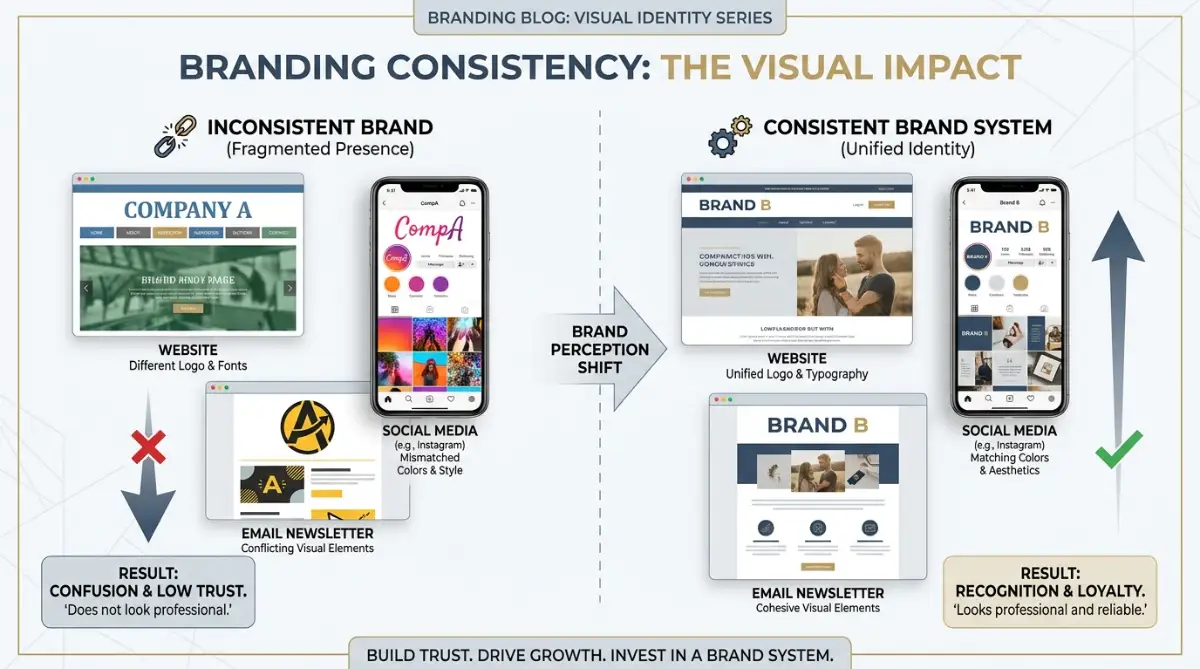
In reality, this visual chaos ruins your chances of being remembered. Human memory relies heavily on repetition and pattern recognition to store information. If your brand looks different every time a person sees it, their brain will treat it as a new, unfamiliar company.
Consistency is the secret key to building deep, lasting consumer trust over time. When your colors, fonts, and images match perfectly across every single platform, you look professional and reliable.
When I first started, I used to change my website fonts and colors every single week because I got bored of looking at the same design. This was a terrible mistake because it confused my small audience and made my business look like three different companies. Once I forced myself to stick to a simple, consistent visual theme, my followers finally started to recognize and trust my work.
The Magic of the Sixty-Thirty-Ten Color Rule
When choosing colors, do not pick a rainbow of shades for your business materials. Use the classic 60-30-10 design rule to keep your visual presentation clean and balanced.
Sixty percent of your visual space should be a neutral dominant color, like clean white or soft grey. Thirty percent should be your secondary brand color, which helps build your main identity. The remaining ten percent should be your accent color, reserved purely for buttons, highlights, and important notices.
Speaking in Too Many Voices: The Identity Split
Imagine meeting a person who acts like a professional lawyer on Monday, a wild party animal on Wednesday, and a quiet academic on Friday. You would find it very difficult to trust them because you do not know who they really are.
Yet, this is exactly how many new startups behave online. They write a formal, dry blog post, then post a chaotic, slang-heavy meme on social media the very next hour. This split personality makes your business look disorganized and highly unprofessional.
You must define your brand voice early on and stick to it across every piece of content you write. Whether you want to be friendly and warm, or authoritative and scientific, keep that tone steady.
Brand Voice Filter: Before You Publish
Ask:
- Does this sound like the same company?
- Would my customer understand these words?
- Does this match the feeling I want people to remember?
Consistency builds familiarity. Familiarity builds trust.
How to Write a Simple Brand Voice Guide
Creating a brand voice does not require a massive textbook of rules. You can define your tone with a simple "This, Not That" exercise.
For example, decide that your brand is "friendly but not silly," or "expert but not boring." Share this short guide with anyone who writes emails, social posts, or articles for your company.
The Overcomplicated Logo: Why Simple Always Wins
A very common trap for new business owners is trying to tell their entire life story inside a small logo. They want a mountain, a rising sun, a hand shaking, and their company name all squeezed into one tiny circle.
These complex logos look incredibly messy when shrunk down to fit on a smartphone screen or a social media profile picture. If people cannot understand your logo in less than one second, your logo has failed.
Think of the most famous brands in the world, like the simple apple with a bite, or the clean checkmark. They are not complex illustrations; they are simple, memorable shapes that stay in the mind.
The Smartphone Test for Brand Marks
Before you finalize your business logo, perform a quick and simple test on your mobile phone. Save your logo image and view it as a tiny icon on your screen.
If the text becomes hard to read, or if the shapes blur together into a dark smudge, you must simplify the design. Remove extra lines, drop the complex gradients, and focus on one clean, bold shape.
Building Your Actionable Brand Strategy from Scratch
Now that you know what mistakes to avoid, let us look at the practical steps to build a brand that actually wins customers. This guide will help you set a strong foundation without spending thousands on agency fees.
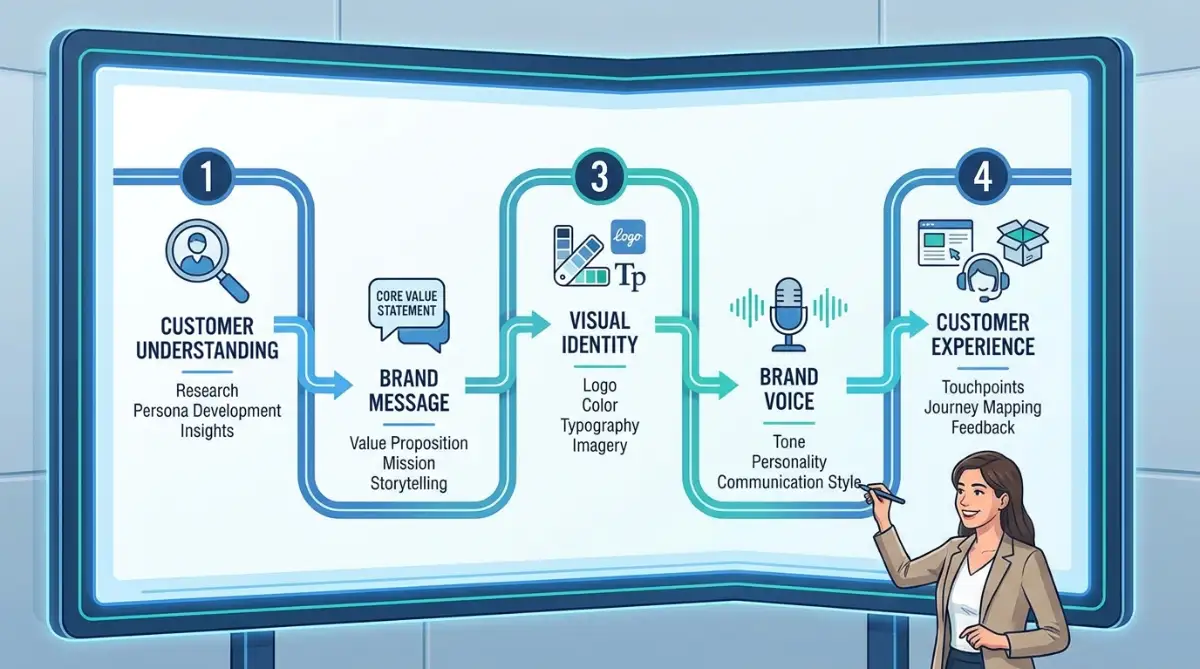
If you want a quick visual guide on how to design a simple, memorable logo and brand style, watch this short video before moving on. It will give you some great ideas before we build your official brand strategy below.
Step 1: Define Your Core Mission in One Sentence
If you cannot explain what your business does in a single, simple sentence, your brand is too complicated. Avoid using big, fancy words that sound like corporate nonsense.
Instead of saying, "We leverage synergistic paradigms to optimize user output," say, "We help busy parents organize their homes in fifteen minutes a day." This instantly tells the reader who you are, what you do, and how you help them.
Step 2: Establish Your Core Color Palette
Select one primary color that matches the emotional feeling of your business. For example, blue builds trust and security, green represents health and growth, and yellow brings energy and warmth.
Add one neutral color, like soft off-white or dark charcoal, to handle your background spaces and body text. Finally, choose one bright accent color that stands out clearly for your call-to-action sections.
Step 3: Pick Two Standard Fonts and Stick to Them
Using too many fonts makes your business look messy and hard to read. Choose one clean, bold font for your headings and one simple, highly readable font for your main body paragraphs.
Ensure that your body font is easy to read on small screens, even for people with poor eyesight. Keep your text size large enough so that users do not have to pinch and zoom to read your advice.
Moving From Confusion to Complete Brand Clarity
Building a beautiful brand is not about having a giant design budget or hiring expensive consultants. It is about understanding your customer deeply and showing up for them with absolute consistency.
When you stop trying to please everyone, you finally start attracting the specific people who need your help. Avoid the temptation to copy others, keep your visual designs clean, and speak with a single, clear voice.
By taking these practical steps, you will build a trustworthy brand that stands out in any market. Your business will no longer be invisible; it will become a trusted, reliable partner for your buyers.
Next-Level Branding Strategies: How to Secure Long-Term Trust
Many business owners believe that choosing colors and a logo is the end of the branding journey. In truth, this is only the starting line for building real market authority.
To build a brand that stays strong over many years, you need to use advanced methods that connect with people on a human level. This means looking beyond basic visuals and focusing on the overall experience you provide.
The Power of an Emotional Brand Story
Your brand story is not just a page on your website with a list of historical facts. It is the core reason why your business exists and how it helps make your customer's life easier.
People do not buy what you do; they buy why you do it. When you share a genuine story about your struggles and successes, your audience feels a deep personal connection.
This emotional connection is the secret to winning lifetime loyalty from your audience. To start this process, you must focus on understanding your target demographic to know what stories will speak directly to their hearts.
Creating a Unified Experience Across Every Touchpoint
Every single interaction a customer has with your business shapes their opinion of your brand. This includes the speed of your website, the way you answer emails, and even the design of your receipts.
If your website looks high-tech but your customer service feels slow and rude, your brand identity is broken. You must design a smooth, friendly experience that keeps the same high quality at every turn.
According to Harvard Business School research on brand purpose, companies that lead with a clear sense of purpose earn far greater trust from both employees and customers. When your actions align with your stated purpose, your brand gains an incredible competitive advantage.
Using Brand Assets to Scale Your Operations
As your business grows, you will likely hire team members, writers, or virtual assistants to help you. Without a clear set of rules, these new helpers might accidentally change the look and feel of your brand.
To prevent this confusion, you should build a simple brand style guide. This document should show your exact logo placements, your chosen fonts, and the specific words your business uses.
This preparation is just as important as writing your first business plan because it keeps your business aligned from day one. When everyone on your team uses the same guide, your visual identity stays perfectly intact across the entire web.
Tracking and Measuring Your Brand's Health
You cannot manage what you do not measure, and this rule applies directly to your brand. Keep a close eye on customer reviews, social media comments, and repeat purchase rates to see how people feel about your company.
If you notice a sudden drop in positive feedback, it means your brand promise is not matching your daily delivery. Use these moments as learning opportunities to adjust your messages and fix any hidden problems.
Using the right digital systems can make this tracking process much easier as your company expands. Learning how to choose the right CRM software will help you collect valuable customer data and keep your brand interactions organized.

The Silent Killers: Fatal Brand Pitfalls You Must Sidestep
When you run a new business, you are constantly making fast decisions under high pressure. Unfortunately, some of these quick brand design decisions can quietly destroy your business before you even get a chance to grow.
The Danger of Constant Rebranding out of Boredom
As a founder, you look at your own logo and website design every single day. Because of this, you might get tired of your brand identity very quickly.
You might feel a strong urge to change your logo, switch your colors, or rewrite your slogan every few months. This is a massive mistake because your audience needs time and repetition to finally recognize your brand.
If you change your look constantly, your customers will get confused and forget who you are. Remember that your audience does not see your brand as often as you do, so stick to your design even when you feel bored of it.
Ignoring Customer Feedback and Staying Stubborn
Sometimes, new business owners fall so deeply in love with their initial brand ideas that they ignore customer opinions. They keep using a confusing font or an offensive color palette because they personally think it looks artistic.
If your target buyers tell you that your website is hard to read or that your logo looks like a competitor's, you must listen. Your brand belongs to the market, and ignoring your users will quickly drive them into the arms of your rivals.
Be willing to make small, careful adjustments to your visual system based on real customer experiences. Staying flexible while keeping your core values the same is the true sign of a mature business owner.
Mixing Visual Excess with Financial Neglect
Many new business owners spend thousands of dollars on expensive graphic designers and premium website features before they make their first sale. They think a luxurious brand look will automatically bring in high-paying clients.
This financial imbalance often leads to early business failure because the company runs out of cash. A beautiful brand is useless if you do not have enough money left to buy inventory or pay your basic bills.
Instead of overspending on complex visuals, focus on keeping your initial brand clean, simple, and affordable. Learning simple bookkeeping for beginners will help you manage your funds wisely so you can invest in branding only when your business starts generating profit.
Misaligning Your Brand Promises with Your Actual Service
If your brand claims to offer "the fastest customer support in the industry," you must deliver on that promise every single time. If a customer sends an email and has to wait three days for an answer, your brand trust is completely shattered.
It is far better to promise less and deliver more than to make grand claims that you cannot support. Keep your brand messages honest, simple, and realistic.
When your real-world service matches your marketing claims, your customers will naturally become your best promoters. They will share their positive experiences with friends, giving you free word-of-mouth advertising that money cannot buy.
Your Roadmap to a Trusted and Unstoppable Brand
Building a memorable brand is a continuous journey that requires patience, focus, and a willingness to learn. By avoiding the common traps and applying simple, honest design principles, you can build a business that commands respect.
Action Plan for Tomorrow Morning
To help you get started right away, here is a practical, step-by-step checklist to improve your brand starting tomorrow:
- Audit Your Touchpoints: Open your website, your Facebook page, and your email signature side-by-side. Make sure they use the exact same logo, matching fonts, and identical primary colors.
- Talk to Your Buyers: Ask three of your current customers what they think of when they hear your business name. If their answers do not match your goals, it is time to simplify your messaging.
- Create a Simple Asset Folder: Gather your official logos, brand colors, and standard fonts in one single folder on your computer. Share this folder with anyone who helps you create content for your business.
- Keep Your Finances Clean: Review your branding expenses to make sure you are not overspending on unnecessary design tools. Focus your money on actions that directly help your customers solve their problems.
A Final Message of Encouragement
Remember that even the largest, most successful companies in the world started with a simple idea and a basic logo. They did not become famous overnight; they built their reputation through daily consistency and honest service.
Do not let the fear of making mistakes stop you from putting your business out into the world. Every step you take to clarify your brand brings you closer to the audience that is waiting for your help.
Believe in the value of your work, keep your presentation simple, and focus entirely on helping your buyers. With time, dedication, and consistency, you will build a brand that you are truly proud to own.
Disclaimer
The information provided in this article is for educational and informational purposes only. It does not constitute professional financial, legal, or business design advice. Always consult with qualified professionals before making major financial investments or business structural decisions.