
The Frustrating Reality of a Dead Wrist Companion
You wake up early, strap on your favorite smartwatch, and head out the door for a busy day. You feel ready to track your steps, check your messages, and keep up with your schedule. By lunchtime, you glance down to check the time, only to see a cold, black screen staring back at you.
This is the daily reality for millions of smartwatch owners around the world. The constant anxiety of watching your battery percentage tick downward minute by minute is exhausting. It turns a helpful, smart accessory into a useless piece of metal and glass on your wrist.
Many people feel cheated when their expensive wearable dies before the day even ends. You might think your device is broken or that you bought a cheap product. In most cases, the hardware is perfectly fine, and the issue lies in how the software runs.
We buy these devices to simplify our busy lives, not to add another item to our charging worries. Let us look at a real-life scenario to see how this constant power drain impacts our mental peace.
The Midnight Runner's Unexpected Disaster
Consider the story of David, an avid runner who relies on his smartwatch to track his evening marathons. One night, he prepared for a ten-mile run through the quiet streets of his neighborhood. He checked his watch before starting, and it showed a promising forty percent battery left.
Halfway through his run, the GPS tracker suddenly disconnected, and the watch vibrated once before shutting down completely. David lost his tracking data, his music source, and his only way to call home in an emergency. He was left in the dark, frustrated and disconnected, all because of an unoptimized battery.
Stories like David's happen every day because we do not treat our smartwatches differently from our smartphones. A watch has a tiny battery compared to a phone, but it often runs the same heavy tracking programs. To fix this, we must look into how these small power cells operate under pressure.
I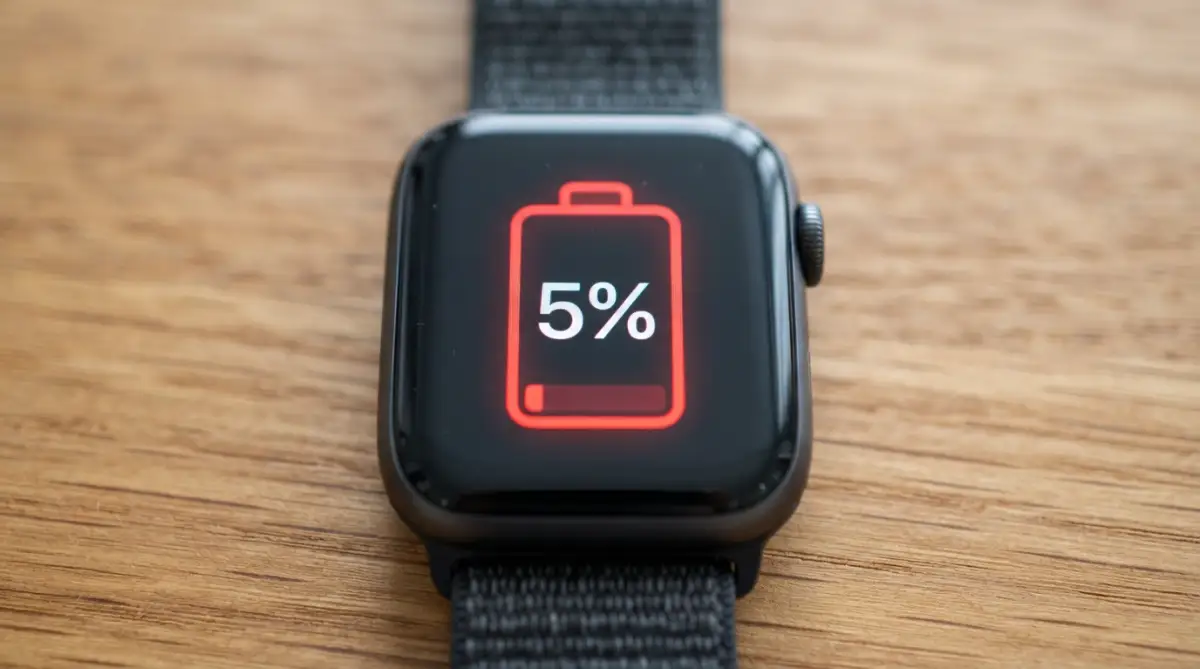
Understanding the True Causes of Rapid Wearable Battery Loss
Before we can solve the problem, we need to understand the physics of your wrist device. A typical smartwatch battery is incredibly small, usually measuring under 500 milliampere-hours (mAh). For comparison, a standard smartphone has a battery that is ten times larger.
This tiny battery is forced to power a bright screen, connect to Bluetooth, run health sensors, and trace satellite locations all at the same time. This is equivalent to running a heavy generator on a cup of fuel. When too many processes run simultaneously, the battery simply collapses under the heavy load.
Let us study the main hardware and software features that consume your battery power. Once you know where the energy goes, managing your daily usage becomes a simple task.
The Silent Energy Consumers on Your Wrist
Many features on your watch run constantly without your direct knowledge. These features are often turned on by default when you unbox your device.
Here is a breakdown of the typical power drain caused by various popular smartwatch features:
By looking at this data, we can see that a few small adjustments can quickly double your watch's battery life. You do not have to turn your smart device into a dumb watch to save power. You just need to configure these features to run only when you truly need them.
Practical Steps to Optimize Your Smartwatch Display
The screen of your smartwatch is the absolute largest consumer of electrical energy. Modern screens are incredibly bright and colorful, which looks beautiful but requires massive amounts of power. Adjusting how your display behaves is the fastest way to gain extra hours of use.
Disable the Always-On Display Mode
The Always-On Display (AOD) feature keeps your screen active even when you are not looking at it. While it is nice to glance at the time without moving your wrist, this convenience comes at a heavy cost.
When you turn off AOD, the screen shuts down completely when your arm is down. This simple change can save up to thirty percent of your daily battery charge. You can still use the "raise to wake" gesture to turn the screen on automatically when you lift your arm.
Reduce Screen Brightness and Timeout Limits
Many users leave their screen brightness set to the maximum level at all times. This is unnecessary, especially when you are indoors or working in a typical office setting.
- Set your screen brightness to automatic so it adjusts to your current environment.
- If automatic brightness is not available, keep it at a comfortable medium level (around 40%).
- Reduce the screen timeout limit to five seconds, which turns the display off quickly after you finish checking your messages.
These small changes prevent the screen from wasting precious milliwatts of power when you are not paying attention. Think of it like turning off the lights when you leave a room in your house.
Managing Wireless Connections and Sensor Tracking
Your smartwatch is constantly communicating with the outside world using Bluetooth, Wi-Fi, and GPS. Managing these wireless pipelines is a highly effective way to keep your watch running longer.
Turn Off Unnecessary Wi-Fi and Cellular Connections
Most smartwatches use Bluetooth to stay connected to your phone. If your watch has built-in Wi-Fi or cellular LTE capabilities, it will search for these networks whenever the Bluetooth connection drops.
Searching for a cellular signal requires a massive amount of power. Turn off Wi-Fi and LTE in your watch settings and rely solely on Bluetooth. Your watch will still receive all your messages and alerts through your phone without draining its own internal power cell.
Restrict Location Services and GPS Use
GPS is a wonderful tool for runners and hikers, but it should only run when you are actively tracking an outdoor workout. Many apps request your location background data even when you are just sitting at your desk.
- Go to your watch settings and change location access to "only while using the app."
- Turn off automatic workout detection if you do not need your watch to constantly guess when you are walking or running.
- Use your phone's GPS instead of the watch's built-in GPS whenever you carry both devices together during a workout.
By letting your phone handle the heavy mathematical calculations of GPS tracking, you save your watch from working too hard. This keeps your wrist device cool and preserves its battery health.
Streamlining Your Daily Notification Flow
Every time your phone receives an alert, your watch vibrates and lights up the screen. If you belong to active group chats or receive frequent work emails, this can happen hundreds of times a day.
This continuous cycle of waking up the processor, vibrating the physical motor, and lighting the screen is a disaster for battery performance. You should filter your alerts so that only the most important messages reach your wrist.
Block Non-Essential App Notifications
Open your smartwatch management app on your phone (such as the Watch app on iOS or Wear OS on Android). Go to the notifications section and review the list of allowed apps.
Disable alerts for social media apps, games, and shopping platforms. You do not need your wrist to vibrate every time someone posts a video or sends a promotional coupon. Keep alerts active only for direct text messages, phone calls, and calendar reminders.
Turn on "Do Not Disturb" and "Bedtime Mode"
When you are sleeping, your watch should go to sleep too. Leaving the device active at night means it will keep lighting up every time you roll over in bed.
Use Bedtime Mode or Theater Mode before you sleep. These modes turn off the lift-to-wake gesture and block all incoming vibrations. This not only saves up to ten percent of your battery overnight but also ensures you get a peaceful, uninterrupted night of rest.
Myth vs. Reality: Smartwatch Charging Habits
There is a lot of outdated advice circulating on the internet regarding how to charge rechargeable batteries. Let us clear up these common misunderstandings with real scientific facts.
- Myth: You must drain your smartwatch to 0% before charging it to 100% to maintain battery memory.
- Reality: Modern lithium-ion batteries do not have a memory effect. Keeping your battery between twenty and eighty percent charge actually extends its overall lifetime.
- Myth: Charging your watch overnight will overcharge and destroy the battery.
- Reality: Smartwatches have built-in safety chips that stop the electrical current once the battery is fully charged. However, keeping the watch on a hot charger for hours can generate excess heat, which can slowly degrade the chemical cells over time.
- Myth: Closing all background apps on your watch saves battery power.
- Reality: Reopening an app from scratch takes more processing power than waking it up from a suspended state. Only force-close apps if they are glitching or frozen.
The Chemical Science of Watch Battery Decay
To understand why your battery performance degrades over time, we have to look at the chemistry inside the cell. Smartwatches use lithium-ion technology because it is lightweight and stores a high amount of energy in a small package.
Inside the battery, lithium ions move back and forth between two electrodes during charging and discharging cycles. As the battery ages, these chemical pathways slowly break down due to heat and usage.
This means that after a year or two of daily use, the battery physical capacity naturally shrinks. While you cannot stop this natural aging process, you can slow it down dramatically by keeping your watch away from extreme heat and freezing temperatures.
How Bluetooth Signal Strength Affects Battery Life
Your watch and phone are constantly talking to each other using low-energy radio waves. When your phone is close to you, the radio transmitters can operate at a very low power level.
However, if you leave your phone in another room and walk away, your watch has to increase its transmitter power to maintain the connection. This extra physical effort causes a rapid drop in battery percentage.
Try to keep your phone nearby when using your watch, or turn off the connection entirely if you plan to be away from your phone for a long time. This small habit keeps your watch from wasting energy trying to find a distant signal.
A Fast Maintenance Checklist for Your Wearable
If you have tried all the settings adjustments and your battery still drains abnormally fast, you might need to perform some simple software maintenance. Over time, temporary system files can get corrupted and cause the processor to run constantly in the background.
First, restart your watch at least once a week. This clears out the temporary memory and shuts down any rogue apps that might be stuck in a processing loop.
Second, check for software updates regularly. Tech manufacturers frequently release software patches that optimize power consumption and fix background bugs.
If all else fails, perform a factory reset on your watch. This wipes the device clean and restores it to its original out-of-the-box state, which often cures mysterious battery drain issues instantly.
By taking these simple, proactive steps, you can transform your smartwatch experience. You will no longer have to look at a dead screen when you need your device the most. Secure your digital life today and enjoy a worry-free, long-lasting wearable connection.
A smart young man looking at his modern smartwatch at a clean desk, learning how to fix rapid battery drain and extend his device's usage time.
Mastering Your Wearable: Deep Settings for Maximum Energy Efficiency
To truly get the most out of your wearable device, you need to look beyond the basic settings menu. Professional users know that default configurations are designed to show off fancy features rather than preserve battery life. By taking control of the advanced settings, you can keep your watch running for days without sacrificing its core smart features.
The OLED Pixel Advantage
If your smartwatch has an AMOLED or OLED screen, you have a massive advantage when it comes to saving power. These displays light up each individual pixel separately to show colors, but they turn the pixel completely off to show black. This means a watch face with a pitch-black background uses significantly less energy than one with bright colors or white accents.
When choosing a design, look for minimalist faces that are mostly black with only tiny spots of color for the hands and numbers. This physical screen characteristic can reduce display-related power draw by more than half. It is a simple design choice that keeps your device looking sleek while protecting your daily battery capacity.
Turning Off the Always-Listening Microphone
Most modern wearables come equipped with smart voice assistants that are constantly listening for a wake word. This means your watch's microphone and audio processor are kept in an active state every second of the day. This silent background process slowly drains your power cell even when the device is completely idle.
Go into your assistant settings and change the trigger method to manual activation only. This allows you to still use voice commands by pressing a button, but it stops the watch from constantly scanning the room for your voice. This small adjustment relieves a continuous load from the processor and gives you hours of extra battery life.
Optimizing Your Battery Profiles
Many advanced smartwatches allow you to create custom battery profiles or choose from pre-set power-saving modes. Instead of waiting for your battery to hit ten percent before turning on power saver, you can configure these modes to run automatically during specific times of day. For example, you can set your watch to enter a low-power state during work hours when you do not need active health tracking.
Think of your smartwatch battery capacity like a tiny solar battery. Just like understanding how do solar panels work on cloudy days helps you plan your power usage, knowing how your watch behaves in low-light and low-connection areas protects your power storage. Managing your battery profiles ensures your device always has enough power when you need it most.
Compressing Your Syncing Schedules
Many apps on your watch are programmed to sync with your phone every few minutes to update weather, news, and stock prices. This constant back-and-forth communication keeps the wireless antennas active and drains your battery. You can manually adjust the sync interval in your watch manager settings to happen hourly instead of every few minutes.
You have to fit a lot of settings into a tiny space. It is a lot like learning how to pack for months of travel using compression bags where you maximize every square inch by removing what you do not need. Compressing your sync schedules allows you to keep getting the information you need without wasting valuable battery life on constant updates.
Managing Bluetooth Audio and Offline Playback
One of the heaviest tasks a smartwatch can perform is playing music directly to wireless earbuds. When you stream music offline from your watch, the tiny processor has to decode the audio files and broadcast them over Bluetooth simultaneously. This double duty can completely drain a fully charged watch battery in just a few hours.
To save power, try to use your phone for music playback whenever possible, using your watch simply as a remote control. If you must run without your phone, try downloading lower-quality audio files to your watch to reduce the processing load. This minor change keeps the processor cool and prevents rapid battery drops during your workouts.

The Silent Mistakes Destined to Kill Your Watch's Lifespan
Many users inadvertently damage their wearable devices by making simple, everyday mistakes. These habits can slowly destroy the health of your lithium-ion battery and shorten the overall life of your watch. Understanding these pitfalls is the first step toward protecting your investment.
The Danger of Cheap Third-Party Chargers
It is tempting to buy cheap, unbranded charging cables online to keep as spares at the office or in your car. However, these low-quality chargers often lack the proper voltage regulation chips found in official accessories. They can send erratic electrical currents and generate excessive heat during the charging cycle.
According to research on prolonging lithium-based batteries, high heat is the single greatest enemy of battery health. Using a charger that causes your watch to feel hot to the touch can permanently reduce its battery capacity in just a few months. Always stick to certified, brand-name chargers to keep your device safe and cool.
The Zero Percent Battery Trap
Another common mistake is letting your smartwatch sit completely dead at zero percent charge for weeks at a time. When a lithium-ion battery remains completely empty, its internal voltage can drop below a safe threshold. This triggers a safety switch inside the battery that can prevent it from ever accepting a charge again.
If you plan to store your watch and not wear it for a while, charge it to around fifty percent first. Turn the device completely off and store it in a cool, dry place. This simple habit keeps the battery chemistry stable and prevents it from dying permanently while in storage.
Background System Clutter and Slowdowns
Just like computers and smartphones, smartwatches can accumulate temporary system cache files that clog up the operating system. When these files get corrupted, they can cause the processor to run at maximum speed in the background, even when your watch screen is off. This leads to sudden, unexplained battery drain and overall sluggish performance.
When many unnecessary processes run at once, it slows everything down, much like why is my premium hosting slow when resource-heavy plugins run silently in the background of a server. Regularly restarting your watch or clearing the app cache helps prevent these silent power hogs from taking over your device.
The Post-Update Battery Drain Myth
Many users notice that their watch battery drains incredibly fast immediately after installing a major software update. This leads people to believe the new update is broken or poorly designed. In reality, the watch is simply rebuilding its system databases and indexing files in the background after the installation.
When updating your watch firmware, sometimes background databases take hours to sync up. This is very similar to how why your new website is invisible due to DNS propagation delay, making you think something is broken when it is simply updating quietly in the background. Give your watch a day or two to complete its internal setup before assuming the update has ruined your battery life.
Your Roadmap to an All-Week Charge
You do not need to be a technology expert to keep your smartwatch running efficiently. By applying these simple strategies, you can easily double your watch's daily battery life and protect its long-term health.
Start by making small changes today, like turning off your always-on display and managing your notification permissions. Over time, these small adjustments will become second nature, and you will enjoy a much more reliable wearable experience.
Your smartwatch is a powerful tool designed to assist you, not to cause daily charging stress. Take control of your device's settings, avoid the common charging traps, and enjoy the freedom of a long-lasting battery.
Your Quick Weekly Maintenance Checklist
To keep your smartwatch running in top condition, try to perform this quick maintenance routine once a week:
- Restart your watch to clear out temporary system cache files.
- Check your watch companion app for any pending software or app updates.
- Review your notification settings and mute any new group chats or active apps.
- Inspect your charging port and clean away any dust or sweat buildup with a dry microfiber cloth.
Disclaimer
The tips and optimization strategies shared in this article are for educational and informational purposes only. Smartwatch hardware, operating systems, and battery health vary by manufacturer and individual usage habits. Always refer to your specific device manufacturer's official user manual for specific safety and charging guidelines.