The Sudden Dark: The Frustration of an Unprepared Home Grid
"Plugging in your first electric vehicle only to have your entire house go pitch black is an incredibly frustrating way to start your EV journey. I used to think my home grid could easily handle charging a car along with all my normal appliances. But after a few tripped circuit breakers, I realized I had to stop guessing and actually look at my home's electrical limits. The good news is that you don't need to spend thousands of dollars on expensive panel upgrades. In this guide, I'll show you how to safely set up your home charger without putting your grid or your budget in danger."
Under the Hood: Key Rules for Safe Home EV Charging
- Know Your Amps: Standard older homes usually have a 100-amp main electrical panel. A Level 2 charger can pull up to 40 amps on its own, which can easily overload your panel if other heavy appliances are running.
- The Smart Splitter Hack: If you have an existing 240V dryer outlet in your garage, you can use a smart circuit splitter to share power safely with your EV charger, saving you hundreds of dollars on a new dedicated line.
- Hardwire for Safety: Hardwired chargers are generally safer and more reliable than plug-in models. Plug-in outlets can degrade over time under continuous high load, creating a potential heat hazard.
- Schedule for 2:00 AM: Set your car to charge late at night when your household appliances are off. This keeps your home grid safe and allows you to take advantage of cheap off-peak utility rates.
The Hidden Electrical Limits of Your Home
To fix a problem, we must first understand how it works. Think of your home’s electrical system as a simple network of water pipes.
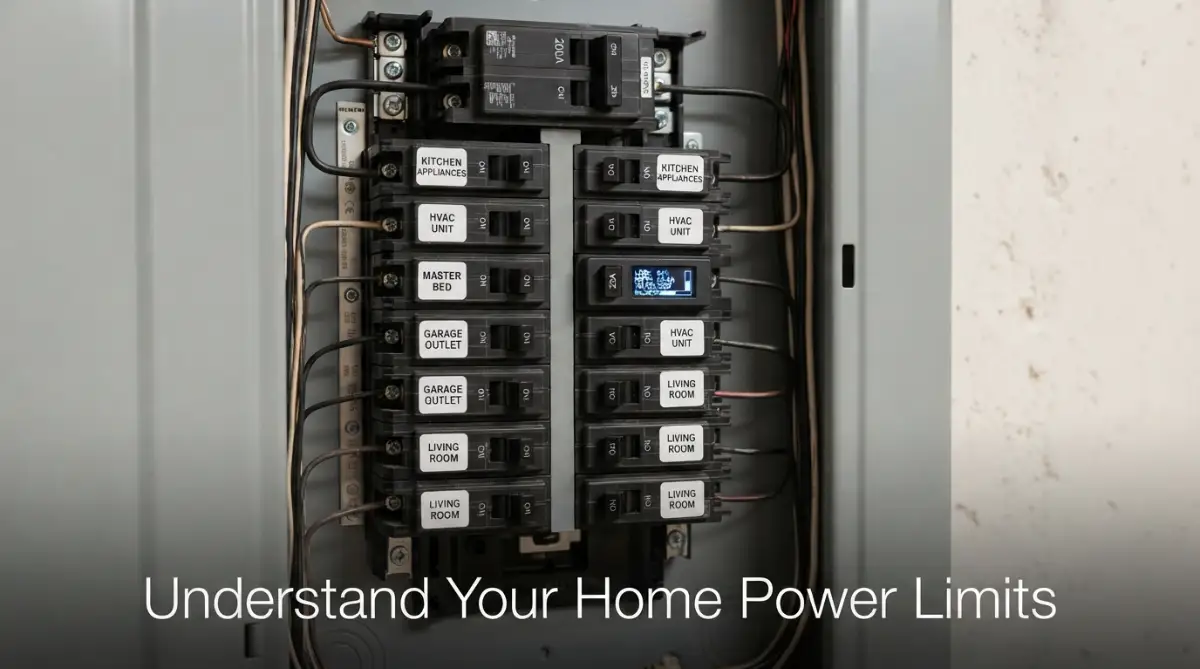
Your main electrical panel acts like the main water valve coming from the street. It only allows a certain amount of water, or electricity, to flow into your house at one time.
If you open too many faucets at once, the water pressure drops. In the world of electricity, if you turn on too many heavy appliances at once, the system overheats, and the breaker trips to protect your house.
Electric vehicle chargers are different from almost any other appliance in your home. They pull a massive, steady flow of electricity for hours at a time.
Checking Your Power Reserve
Most older homes have a 100-amp electrical panel. Newer homes might have a 200-amp panel, which offers much more breathing room.
If your home has a 100-amp panel, you must be careful. A standard Level 2 EV charger can pull 32 to 40 amps all by itself.
That is nearly half of your entire home’s power capacity. If your clothes dryer, your electric oven, and your air conditioner turn on while your car is charging, your system will quickly overload.
As the table shows, a charger takes up a massive portion of an older home's limit. This is why we need to plan your setup with care.
Understanding Level 1 vs. Level 2 Charging Options
You have two main choices when charging your vehicle at home. Let us break down how each option affects your home grid.
Level 1 charging uses a standard 120-volt household outlet. It is the same outlet you use to plug in your phone charger or toaster.
This method is slow, adding about 3 to 5 miles of range per hour of charging. However, it only draws about 12 to 15 amps of current.
For many daily drivers, this is actually enough. If you drive less than 40 miles a day, plugging your car in overnight on a Level 1 charger will meet your needs.
The best part is that it rarely overloads your home grid. It uses about the same amount of power as a portable space heater.
Level 2 charging uses a 240-volt circuit, similar to what your electric clothes dryer uses. It can charge your car up to ten times faster than a Level 1 charger.
This option adds about 15 to 30 miles of range per hour. It is incredibly convenient because you can fully charge your battery in just a few hours.
However, this is where the risk of grid overload lives. Since it pulls a heavy continuous load, your home wiring must be in excellent shape.
Watch this quick guide to see the real difference between Level 1 and Level 2 home charging, so you can decide which setup is the safest and most efficient for your specific home and driving routine.
Myth vs. Reality in Home EV Charging
There are many rumors about home charging safety. Let us clear up the most common misunderstandings.
- Myth: You must always upgrade your electrical panel to 200 amps to charge an EV.
- Reality: You can often use smart charging systems or lower-amp Level 2 chargers to avoid an expensive panel upgrade.
- Myth: Charging your car overnight will damage your home’s battery backup system.
- Reality: Smart home systems are designed to balance these loads safely when set up correctly.
- Myth: Level 2 chargers will always cause your electricity bill to skyrocket.
- Reality: Many power companies offer cheap overnight rates that make charging very affordable.
How to Measure Your Home's Current Power Load
Before buying any charging equipment, you should find out how much power your home actually uses. This is called a load calculation.
You can hire a local electrician to do this, or you can do a basic check yourself. Look at your past utility bills to find your peak usage times.
Look at the main breaker in your electrical panel. It will have a number printed on it, like 100, 125, 150, or 200.
This number tells you the maximum current your home can handle at any single moment. If you have a 100-amp panel, you need to be strategic about your charger choice.
Quick Math: How Much Amps Do Your Appliances Use?
To help you figure out if your panel will overload, here is a quick look at what common household appliances draw when running:
- Central Air Conditioner: 15 to 20 Amps
- Electric Clothes Dryer: 20 to 30 Amps
- Electric Water Heater: 18 to 25 Amps
- Kitchen Oven/Range: 30 to 40 Amps
- Dishwasher: 10 to 15 Amps
- If you have a 100-amp panel and turn three of these on at the same time, adding a standard 32-amp EV charger will instantly trip your main breaker."
The Magic of Dynamic Load Balancing
If you want fast charging but do not want to spend thousands on a panel upgrade, dynamic load balancing is your best friend. This is a smart technology built into modern chargers.
A small sensor is placed inside your main electrical panel. It monitors how much power your home is using in real-time.
If you turn on your electric stove and dryer, the sensor tells the EV charger to slow down. The charger temporarily reduces its power draw to keep your home safe.
Once you turn off your stove, the charger automatically speeds back up. This keeps your home grid completely safe without you ever having to think about it.
Choosing a Low-Amp Level 2 Charger
Many people think they need the fastest 48-amp charger available. In truth, a 16-amp or 24-amp Level 2 charger is more than enough for almost everyone.
A 16-amp Level 2 charger still charges much faster than a standard wall outlet. It only requires a 20-amp circuit breaker, which is easy for almost any home panel to support.
By choosing a slightly slower Level 2 charger, you save money on installation. You also protect your home grid from unnecessary stress.
Smart Charging Habits for Everyday Peace of Mind
You can easily manage your power grid by changing when you charge. Most electric cars let you set a charging schedule through a smartphone app.
Set your car to start charging at 2:00 AM. At this hour, your family is asleep, the lights are off, and no appliances are running.
This simple habit keeps your home grid safe from overloading. It also takes load off the public electric grid during peak hours.
The Importance of Professional Installation
It might be tempting to install a heavy-duty outlet yourself to save money. However, EV charging is not a standard DIY job.
Because the power flow is continuous, even a tiny loose screw in an outlet can cause extreme heat. Over time, this heat can melt plastic and start a house fire.
A licensed electrician will make sure your wires are thick enough to handle the heat. They will also make sure your system meets all local safety codes.
What to Ask Your Electrician
When you call an electrician, you want to sound informed. Here are a few simple questions you should ask them:
- "Can my current electrical panel handle a 24-amp Level 2 charger without an upgrade?"
- "Do you recommend a hardwired charger or a plug-in model for my garage?"
- "Can we install a smart load-shedding device to protect our main breaker?"
These questions will help you get the safest setup for the best possible price.
My Take: Hardwired vs. Plug-in Chargers
When installing a Level 2 charger, many people ask if they should go with a plug-in or a hardwired option. I always recommend hardwiring. Why? A plug-in charger requires an industrial-grade NEMA 14-50 outlet. These outlets are great, but the constant heavy electrical load can make cheap outlets lose their spring tension over time. A loose connection causes heat, which can melt the plug. Hardwiring completely removes this failure point, making your setup much safer and often cheaper because you don't need a costly GFCI breaker."
Smarter Ways to Power Your Ride Without Panel Upgrades
You do not always have to spend a fortune to get your home ready for an electric vehicle. Many homeowners believe they must immediately call an electrician to rip out their old service panel.
Fortunately, smart engineering offers several clever workarounds that keep your home safe while saving your budget. Let us explore some advanced solutions that let you share power safely.
The Power of Smart Circuit Splitters
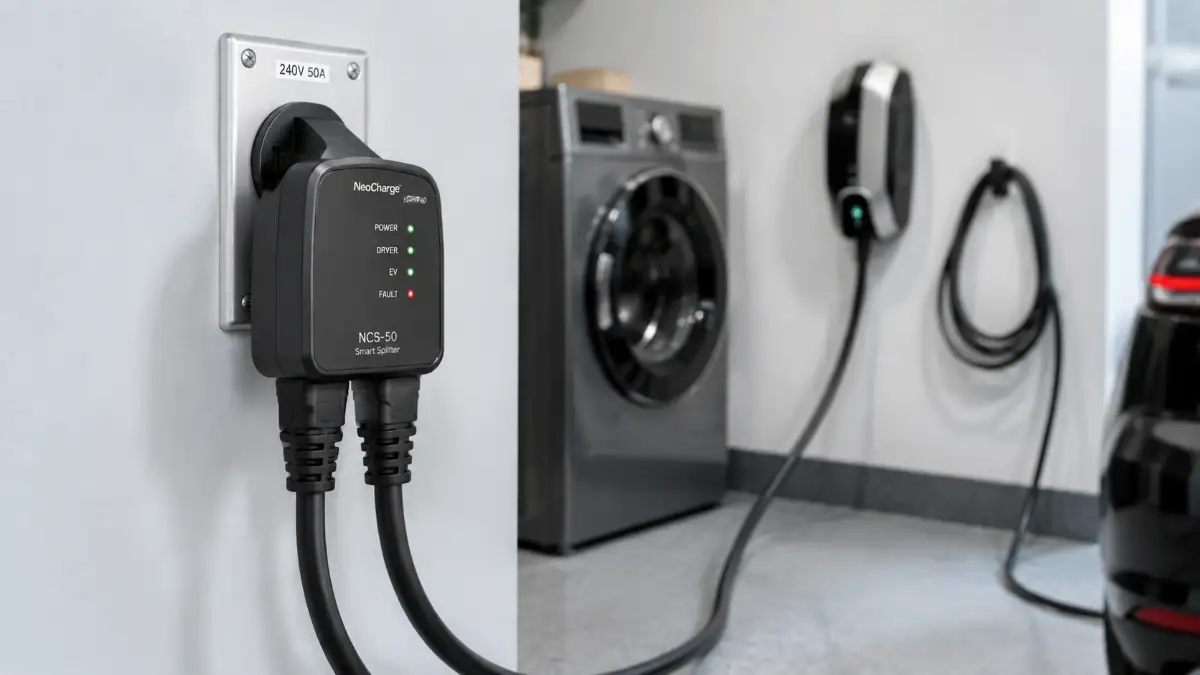
If you have a heavy-duty outlet in your garage, it is likely already connected to an appliance like a clothes dryer. You cannot safely run both a dryer and an EV charger on the same circuit at the exact same time.
This is where a smart circuit splitter becomes incredibly useful. This device plugs directly into your existing 240-volt outlet and splits the power between two appliances.
The splitter is highly intelligent. It acts like a digital traffic cop for your electricity.
If you start your dryer, the splitter automatically cuts off power to your car charger. Once your clothes are dry and the machine stops, the splitter turns the power back on for your car.
This simple device prevents you from overloading the circuit breaker. It also completely removes the need to install a brand-new, dedicated circuit, which can save you hundreds of dollars in labor and materials.
Setting Up Smart Scheduling with Your Utility Company
Your local power company does not supply the same amount of electricity at all times of the day. During the hot afternoon hours, thousands of homes run their air conditioning units, putting immense stress on the city grid.
To manage this, many power companies offer special programs called "time-of-use" rates. Under these programs, electricity is much cheaper late at night and early in the morning when overall demand is low.
You can set your vehicle's software to only accept charge during these off-peak hours. This keeps your home grid safe because your car will not pull power while you are cooking dinner or running the dishwasher.
It is a simple habit that protects your local grid while keeping your monthly energy bills as low as possible. You can check the US EPA guidelines on home EV charging to understand how off-peak charging helps local neighborhoods stay balanced.
Derating Your Charger: The Secret Settings of Modern Units
When you purchase a Level 2 charger, it often comes set to its highest possible power limit. For example, a 40-amp charger usually requires a 50-amp circuit breaker to operate safely.
However, almost all high-quality modern chargers allow you to adjust this setting during installation. This process is called "derating" the charger.
If your home electrical panel only has 20 amps of spare room, your electrician can physically change a switch inside your charger to lock it at 16 amps. Your car will charge a bit slower, but it will still be much faster than a standard wall outlet.
This simple adjustment lets you use a premium charger without putting your main household breaker at risk. It gives you full control over how much power enters your vehicle.
I spent way too much money early on because I assumed I needed the "fastest" charger on the market to keep my car running. It was a huge realization for me when my electrician explained that I could simply "derate" my unit to match my home's actual capacity. I stopped worrying about my breakers tripping entirely, and honestly, the car charges more than fast enough while I sleep anyway.
Keeping Your Vehicle Battery Healthy in the Long Run
Setting up your home grid is not just about protecting your house. It is also about taking care of the expensive battery pack inside your new car.
Charging your car to maximum capacity every single night is actually not ideal for the battery chemistry. For daily driving, it is highly recommended to set your car’s charge limit to eighty percent.
This simple habit reduces chemical stress on the battery cells and prevents early degradation. If you want to dive deeper into this topic, you can read about easy ways to keep your electric car battery healthy for years.
Also, try to avoid letting your battery drop below twenty percent before plugging it back in. Keeping your battery level between twenty and eighty percent is the golden zone for longevity.
How to Build a Future-Proof Setup
If you are running new wires to your garage, it is smart to plan for the years ahead. Even if you only need a low-amp charger today, installing thick wires now will save you money later.
Always ask your electrician to install heavy-gauge copper wiring rather than cheaper aluminum. Copper handles high continuous heat much better and is less likely to degrade over time.
Additionally, make sure your charging equipment has clear safety certifications from recognized groups like UL or ETL. You can find highly detailed information about certified energy-efficient and safe charging hardware through the Alternative Fuels Data Center database.
Using certified equipment ensures that your charger has built-in safety switches to prevent short circuits and ground faults. This extra layer of protection keeps your family safe while you sleep.
Heavy Mistakes That Can Damage Your Home and Car
When people try to install their first EV charger, they often look for shortcuts to save a quick dollar. Unfortunately, cutting corners with high-voltage electricity can lead to dangerous and expensive consequences.
Let us look at the most common traps that new EV owners fall into so you can avoid them completely.
Falling for Cheap, Uncertified Internet Chargers
It is very tempting to browse online store pages and buy the cheapest charger available. Many of these unbranded products cost a fraction of the price of certified units.
However, these cheap chargers often lack internal safety features. They may not have ground-fault protection, which stops the flow of power if a short circuit occurs.
Without these protections, a small power surge from the street could fry your car’s expensive onboard charger. Even worse, these units can overheat at the wall plug, creating a serious fire hazard in your garage.
Always look for a clear safety label on the back of the device before plugging it into your home. Saving a hundred dollars on a cheap charger is not worth risking your entire home and vehicle.

Using Standard Extension Cords for EV Power
This is perhaps the most dangerous mistake a new owner can make. If your garage outlet is too far from your driveway, you might think about grabbing a standard orange extension cord from your tool shed.
Standard household extension cords are not designed to carry heavy, continuous electrical current for hours at a time. The thin copper wires inside the cord will quickly begin to overheat.
Because the cord is long, the resistance increases, causing the plastic insulation to melt. This can easily ignite nearby dry leaves, cardboard boxes, or garage walls.
If you must use a portable charger, always plug it directly into a wall outlet. If the cord cannot reach, you must have an electrician install a new outlet closer to your parking spot.
Ignoring Common Charging Pitfalls That Wear Down Your Battery
Many new owners do not realize that poor charging habits can slowly destroy their vehicle’s range. For example, leaving your car plugged in at one hundred percent in a hot garage for days can cause severe battery wear.
Heat is the absolute worst enemy of any lithium-ion battery pack. If your home charger is set to a higher amperage than your car's cooling system can manage, the battery will heat up rapidly.
Over time, this heat reduces the total amount of energy your battery can hold. To protect your investment, you can learn more about why your electric car battery fails from common charging mistakes.
By matching your charger's speed to your car's natural cooling limits, you keep the battery cool and healthy. This ensures you maintain your vehicle's resale value for a very long time.
Skipping the Local Permit and Inspection Phase
Some homeowners try to avoid the hassle of getting a permit from their local city hall. They hire an unlicensed helper to run wires quickly and quietly.
This is a massive risk. If an unpermitted electrical installation causes a fire, your home insurance company may completely refuse to pay for the damages.
Local building inspectors exist to make sure the wiring in your home is safe for your family. Having a professional inspector review the work gives you official proof that your home is secure.
It also adds value to your property if you ever decide to sell your house. Buyers love seeing documented, professional electrical upgrades.
Ready for the Road: Your Step-by-Step Electrical Action Plan
To help you get started without any confusion, let us look at a simple plan you can follow tomorrow. This checklist keeps the entire process simple and stress-free.
Action Plan for Tomorrow
- Check Your Panel: Open your main electrical panel and write down the total amps printed on the main breaker.
- Locate Your Outlets: Measure the distance from your parking spot to the nearest heavy-duty outlet.
- Call a Professional: Contact two local licensed electricians to get quotes for a basic load calculation.
- Review Your Drive: Calculate your average daily mileage to see if a slower, safer charging speed fits your routine.
A Final Word of Encouragement
Transitioning to electric driving is a wonderful milestone for you and your family. It represents a cleaner way of living and brings incredible fuel savings over time.
You do not need to let the fear of electrical grids hold you back. By taking simple, measured steps, you can create a highly efficient home charging setup.
Talk to a professional, understand your home's current limits, and select the right smart accessories. With a small amount of planning, you will enjoy a safe, reliable charge every single morning.
aking control of your home energy setup might feel like a big project, but it is one of the smartest things you can do for your peace of mind. Once you get your charging routine dialed in, the daily convenience of waking up to a "full tank" makes every bit of the effort worth it. Take that first step today, get a professional to take a look, and start enjoying your electric lifestyle without any more unexpected blackouts.
Disclaimer
The information provided in this article is for educational and informational purposes only. Electrical installations involve high-voltage systems that can carry serious risk of injury, death, or property damage. Always consult with a licensed, certified, and insured electrical professional in your local area before making any modifications to your home electrical system, panel, or outlets. Do not attempt to install high-voltage wiring without professional guidance and proper local government permits.