
My Personal Crypto Heartbreak: Waking Up to Red Charts
I still remember the night I woke up at three in the morning to check my phone. My heart dropped instantly when I saw a massive sea of bright red numbers across my screen. In just a few short hours, my small savings had shrunk by almost forty percent. I felt a cold sweat run down my back as panic started to take over my mind.
My first reaction was to sell everything immediately to save what little money I had left. I was terrified, confused, and felt like a complete failure for trusting this wild market. It took me a long time to realize that almost every single person who steps into this space goes through this exact same panic.
Watching your hard-earned money bounce up and down like a toy can truly ruin your daily peace of mind. It makes you constantly check your phone during family dinners, work meetings, and even in the middle of the night. This endless loop of worry can make you feel completely helpless and exhausted.
Many people lose their sleep, their calm, and eventually their money because they do not know how to handle these sudden market drops. They buy when everyone is excited and sell in a panic when prices start to fall down. This painful cycle keeps repeating because we are wired to react to fear rather than logic.
But I want to tell you that you do not have to live your life in fear of the charts. You can actually build a healthy relationship with your money and stay perfectly calm during wild market moves. Let us look at how you can navigate these big swings without losing your mental peace.
I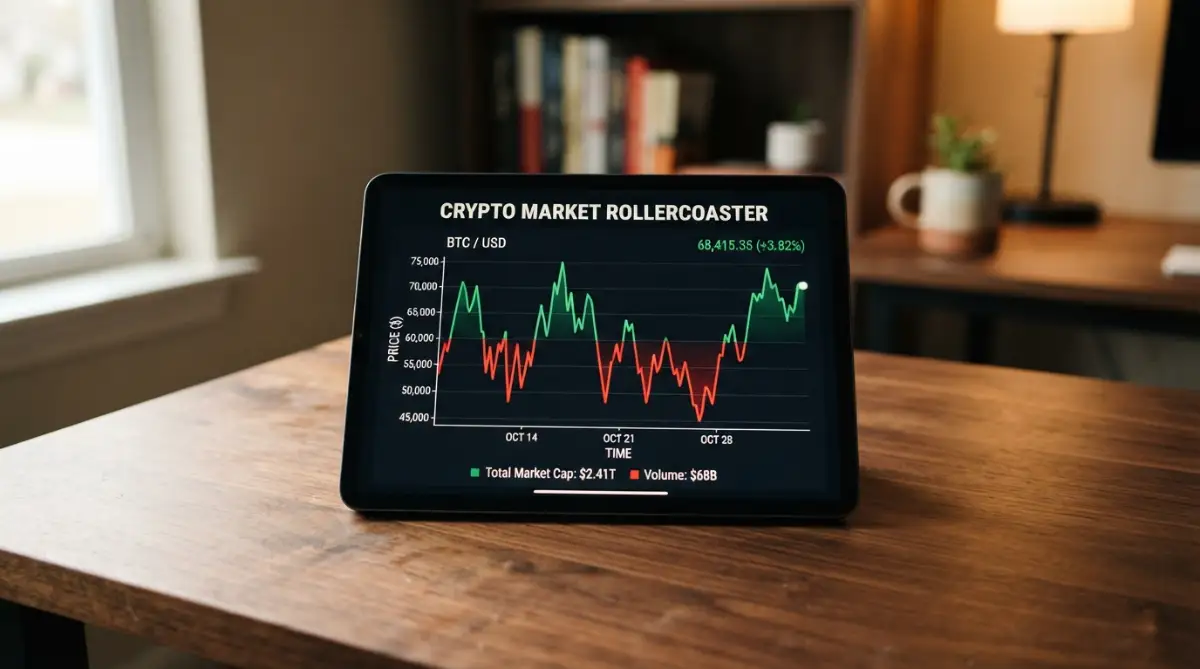
Why Crypto Prices Move Like a Rollercoaster
To stay calm when the market drops, we first need to understand why these wild swings happen in the first place. The main reason is that the crypto market is still very small compared to old financial markets like gold or stocks. Because the total pool of money is smaller, even a medium-sized buy or sell order can push prices up or down very quickly.
Another big factor is the presence of heavy traders who hold massive amounts of coins, often called market whales. When one of these big players decides to sell a large portion of their coins, it creates a sudden drop in price. This drop triggers fear in regular everyday investors, who then start selling their own coins out of panic.
Unlike traditional stock markets, the crypto market never sleeps or takes a break for the weekend. It runs twenty-four hours a day, seven days a week, and is open to anyone across the entire globe. This constant, non-stop trading means news and rumors can spread and change prices in a matter of seconds.
The Power of Public Mood and Social Hype
Public feeling plays a massive role in how crypto prices behave from day to day. A single post from a famous person or a new regulation rumor can send a coin soaring or crashing. This happens because a large portion of the market is driven by pure emotion rather than real business value.
When people see a coin rising rapidly, they experience a strong fear of missing out, which we call FOMO. This fear makes them buy into the asset at the highest possible price point. On the flip side, when bad news breaks, the opposite emotion takes over, leading to massive panic selling.
Understanding that these movements are driven by crowd psychology can help you step back and look at the market objectively. You begin to see that a price drop is usually just a temporary wave of fear, not the end of the world. By recognizing this pattern, you can train your brain to stop reacting to every small shift in price.
Smart Strategies to Keep Your Balance and Protect Your Cash
You do not need to be a math genius or a professional wall street trader to protect your money from market drops. You simply need to set up a few basic rules that keep your emotions out of your financial decisions. Let us look at some of the most reliable and time-tested ways to keep your investments safe.
The Magic of Dollar-Cost Averaging
One of the easiest ways to handle market swings is to use a method called Dollar-Cost Averaging, or DCA for short. Instead of throwing all your money into a coin at once, you invest a small, fixed amount at regular times. For example, you might choose to buy twenty dollars worth of a coin every single week, no matter what the price is.
When the price of the coin is high, your twenty dollars buys a smaller amount of the asset. When the price crashes, your twenty dollars suddenly buys a much larger amount of that same asset. Over time, this natural balance gives you a very fair average purchase price without any of the stress.
If you want to see a clear visual guide on how regular automated investing beats trying to time the market, watch this helpful video.
This simple strategy completely removes the need to stare at price charts all day long. You no longer have to guess if the price will go up or down tomorrow morning. You simply let your plan run on autopilot and enjoy your free time.
The Five Percent Rule for Safe Money Management
Another classic mistake is putting too much of your total savings into highly volatile digital coins. A simple way to protect your sleep is to limit your crypto holdings to a small fraction of your total money. Many experienced financial advisors recommend keeping this number under five percent of your total net worth.
If you only have five percent of your money in crypto, even a massive fifty percent market crash will only hurt your total portfolio by a tiny fraction. Knowing that your main savings are safe in stable places gives you incredible peace of mind. You can watch the market bounce around without feeling any real threat to your daily life.
Always make sure you have a solid emergency fund in your local bank before you even think about buying crypto. This cash fund should easily cover your basic living expenses for at least three to six months. When you know your rent and food are covered, market charts lose their power to scare you.
My Personal realization: I used to try and buy the exact bottom of every single price drop, but I always ended up losing money and sleep. Once I switched to a simple weekly purchase plan, my mental stress disappeared and my average purchase price actually improved over the long run.
The Role of Stablecoins During Stormy Times
If you want to keep some of your funds ready inside the market without facing wild price swings, stablecoins are a great tool. These are digital coins that are tied directly to the value of a steady fiat currency like the US Dollar. They do not bounce up and down like regular cryptocurrencies do.
Holding a portion of your funds in stablecoins allows you to stay close to the market without facing any price risk. If the market starts shaking too much for your comfort, you can easily swap your volatile coins into stablecoins. This acts like a safe harbor where you can park your funds and wait for the storm to pass.
However, always remember to choose well-established and highly trusted stablecoins for your peace of mind. Do your research to make sure the stablecoin you use has real cash reserves backing it up. This extra step keeps your funds safe from unexpected failures.
Common Myths About Market Swings
To truly master your feelings, you must learn to separate common internet myths from actual market reality. Many online influencers spread bad advice that can make you make poor choices with your money. Let us clear up some of the most common misunderstandings.
Myth 1: A Big Drop Means the Asset is Dead
When a coin drops by thirty or forty percent, social media is often flooded with posts claiming the asset is going to zero. This dramatic reaction is almost always driven by short-term panic and loud voices online. In reality, big price corrections are a completely normal part of any healthy market cycle.
Even the strongest assets in the world have gone through massive drops before reaching new highs. These drops are often just the market taking a breath after a long run upward. Instead of seeing a drop as a failure, experienced investors often look at it as a discount sale.
Myth 2: You Must Monitor the Screen Every Hour
Many beginners believe that successful investors spend their entire day glued to multiple computer screens tracking charts. This lifestyle is not only highly stressful, but it also usually leads to bad, emotional trading decisions. The most successful long-term investors actually check their portfolios very rarely.
Staring at the screen does not make the price go up, nor does it help you make smart choices. It only fills your head with noise and makes you want to click the buy or sell button too quickly. Try setting a rule to only check your balances once a week or even once a month.
Myth 3: High Risk Always Leads to High Rewards
You will often hear people say that you must take massive risks if you want to make any real money. While it is true that crypto has high potential gains, taking unguided risks is just gambling under a different name. You do not need to buy highly dangerous meme coins to participate in the space.
Focusing on established, highly developed projects with real utility is a much smarter path for beginners. These assets still experience price swings, but they have a much higher chance of recovering over time. Steady, careful choices will always beat wild gambles in the long run.
Creating a Healthy Daily Routine for Your Money
The best way to fight off market anxiety is to build strong habits that protect your time and energy. By changing how you interact with the market, you can turn a stressful hobby into a calm, quiet plan. Here are three simple steps you can start using today.
Step 1: Write Down Your Long-Term Goals
Before you put a single dollar into any digital asset, write down exactly why you are doing it. Are you saving for a house ten years from now, or are you just trying to learn about new tech? Having a clear target in writing helps you ignore the daily noise.
If your goal is ten years away, a price drop today has absolutely no effect on your long-term plan. You can easily ignore the daily news because you know your target is far out in the future. Whenever you feel panic starting to build, open your notebook and reread your original goal.
Step 2: Delete Fast Tracking Apps From Your Phone
Mobile apps make it incredibly easy to buy coins, but they also make it too easy to obsess over prices. If you find yourself opening your tracking app every ten minutes, it is time to take a break. Try deleting the app from your home screen or removing it from your phone entirely.
You can still manage your investments using a desktop computer when you are sitting down for dedicated weekly planning. This simple barrier prevents you from making impulsive trades while you are bored, tired, or emotional. You will be amazed at how much free time and mental peace you gain back.
Step 3: Filter Your Social Media Feed
The internet is full of noise, hype, and people trying to make a quick buck off your fear. If your social feeds are filled with loud predictions and constant drama, it is time to clean them up. Unfollow accounts that use dramatic language or try to pressure you into quick actions.
Instead, look for calm, educational creators who focus on teaching the basic technology and long-term trends. Surrounding yourself with quiet, logical voices will help you maintain a balanced perspective. Remember, your mental peace is far more valuable than any online trend.
Your Path to Becoming a Mindful Investor
Learning to handle cryptocurrency volatility is not about guessing where the price will go next. It is entirely about learning to manage your own mind, your emotions, and your daily habits. By setting up a simple plan, keeping your risks low, and ignoring the daily noise, you can invest with total confidence.
You do not have to let red charts ruin your sleep or steal your happiness ever again. Take a deep breath, trust your long-term plan, and remember that patience is the greatest tool an investor can have. Step away from the screen today and go enjoy the real world around you.
Tactical Adjustments for Long-Term Portfolio Survival
Once you feel comfortable with the basics, it is time to look at how the pros handle sudden price changes. Expert investors do not just sit back and watch their portfolio values swing up and down all year. They use specific habits to keep their money safe and growing even during the most chaotic weeks.
One great habit is setting up automatic buying rules instead of making investment decisions manually. Many people log in to trade only to find themselves frozen by fear or over-excited by greedy market moves. By letting technology do the heavy lifting, you protect your hard-earned funds from your own emotional errors.
Another clever secret is focusing on security just as much as you focus on profits. It does not matter how much money you make from price swings if you lose access to your digital wallet. If you want to keep your long-term assets safe, you must learn the basics of protecting your seed phrase from physical damage or theft.
You should also study how market trends are influenced by human psychology. A recent academic paper published by the Universitat de Barcelona explains that cryptocurrency prices are often highly connected to traditional financial markets. This means global economic news can cause ripples in your portfolio faster than you might think.
To offset these global shifts, smart investors often look for ways to grow their main income source. If you have extra money flowing in every month, you will not feel forced to sell your assets during a bad market dip. One highly profitable option is learning how to start a profitable blog with almost zero money to build a steady side stream of revenue.
Having a reliable secondary income completely changes how you look at market drops. Instead of panicking about a temporary drop, you will view it as a great buying opportunity. You can comfortably use your extra blog earnings to buy assets when prices are low and everyone else is scared.
Additionally, you should make sure your home trading environment is stable and fast. If you are trying to make a trade during high volatility, a slow connection can cost you real money. You can learn why your wi-fi signal drops in specific rooms to prevent frustrating lag when you need to access your accounts.
Keeping your home network healthy is a key part of protecting your overall digital setup. This is especially true if you are running smart devices that might slow down your bandwidth. It is always a good idea to know how to fix older smart home devices dropping Wi-Fi so your trading laptop always gets the fastest speed.
Another pro-level secret is practicing the art of taking profits during market bubbles. It is easy to buy when prices are low, but it is incredibly hard to sell when everyone is celebrating online. Setting simple target prices ahead of time allows you to lock in some wins without feeling guilty or greedy.
For instance, you could promise yourself to sell ten percent of your holdings every time the price doubles. This keeps some cash ready in your wallet so you can buy back in when the market eventually drops. This balanced loop turns wild market drops from a scary threat into a profitable cycle.
Lastly, make sure you are not wasting your household funds on high utility bills that drain your investing power. Many homeowners do not realize how much money they leak each month through poor home energy choices. Finding out why your solar panels underperform can help you cut down energy bills and free up more cash for your monthly portfolio.
By cutting your household waste, you can put more money into steady, long-term assets. You can find more practical household tips on the main page of Trust Picks HQ to build a smarter, more efficient daily budget. Saving money on small daily items adds up to a much larger investing pool over time.
Let us look at a simple scenario to see how these advanced ideas work in the real world. Imagine an investor who has set up automated weekly buys, protected their wallet, and created a side income. When a forty percent crash hits, they do not feel any fear at all.
Instead of crying over red charts, they simply let their automated system buy more assets at a huge discount. They use their side income to cover their daily bills without ever touching their long-term savings. This is how the quiet, smart investors win the game while everyone else is panicking on social media.
I
Dangerous Mistakes That Can Wipe Out Your Savings
When trying to survive wild price movements, many beginners fall into dangerous traps that end up costing them everything. These mistakes do not just hurt your wallet; they can also cause immense mental pain and strain your relationships with family. Understanding these mental traps is the first step to keeping your funds safe.
One of the most common errors is trading on high leverage to make quick money. Leverage allows you to borrow money from an exchange to buy more coins than you can actually afford. While this can boost your wins when prices go up, it can completely erase your entire account in a matter of minutes during a sudden drop.
A detailed study on market risks by the Government Accountability Office points out that these digital assets have uniquely high volatility. Because there is no standard way to project future returns, borrowing money to trade is incredibly risky. You should only ever trade with cash that you already own and can afford to lose.
Another painful mistake is letting your phone battery die or losing your connection during critical market moments. It might sound silly, but many traders have lost thousands of dollars simply because their phone turned off when they needed to make a quick trade. You should always look into whether is overnight smartphone charging safe to keep your trading tools fully charged and ready.
Keeping your phone healthy and charged ensures you can always access your accounts during a sudden market dip. You do not want to be locked out of your wallet simply because of a dead battery or a broken charger. Simple daily habits can protect both your tech tools and your hard-earned savings.
Many people also make the mistake of trusting anonymous internet strangers for financial advice. They join private chat groups and buy random coins because someone promised they would get rich overnight. These groups are often set up by scammers who want to push the price up before selling their own shares and leaving you with nothing.
According to research on market behavior from PubMed Central, public feeling and online rumors are the main causes of sudden price drops. When bad news or fake rumors start spreading, the herd quickly runs for the exit in a panic. If you build your investment plan around online hype, you will always be at the mercy of other people's fear.
Another huge trap is failing to keep a simple written record of your trades. When you do not track your purchases, you easily lose sight of your average buy price and total performance. This lack of tracking makes it very easy to make emotional decisions based on what you feel rather than actual data.
Lastly, many investors make the mistake of checking their portfolio balance multiple times every single hour. This constant checking keeps your brain in a state of high stress, making you feel tired and anxious all day long. It eventually leads to a state of exhaustion where you make a desperate, unguided trade just to make the anxiety stop.
Your Action Plan for a Calm and Profitable Future
Surviving the ups and downs of the digital market is not about staring at charts all day. It is about building a solid system that protects your money and keeps your mind completely relaxed. When you automate your trades, manage your risks, and keep a strong side income, market swings lose all their power to scare you.
You should treat your investing journey like a slow, steady walk rather than a wild race. The people who make the most money are not the ones who trade the fastest or take the biggest risks. They are the ones who stay calm, stick to their simple plans, and focus on their real lives while their money grows quietly in the background.
Take a moment today to step away from the charts, turn off your screen, and enjoy your time with family. Your long-term success will come from your ability to stay patient and logical during times of high stress. By putting these simple steps into practice, you can build a secure financial future while keeping your peace of mind fully intact.
I remember when I used to let every small market drop ruin my entire weekend and keep me awake at night. Once I stopped chasing quick riches and started focusing on steady, automated habits, my stress completely washed away and my portfolio finally began to grow. I hope you take that same breath of relief today and start your journey toward becoming a calm, mindful investor.
Common Questions About Market Volatility
Why does crypto price jump up and down so fast?
The market is still relatively small compared to traditional stock markets, which means large trades can move prices easily. Additionally, since trading never stops and is heavily driven by online feelings, news and rumors can cause quick price shifts in seconds.
Is it possible to completely avoid losses during a market crash?
It is impossible to predict every single price drop, but you can protect your cash by keeping your investments small. By using stablecoins and avoiding high-leverage trades, you can keep your money safe without needing to time the market perfectly.
How often should I check my investment portfolio?
Checking your portfolio once a week or even once a month is more than enough for a long-term investor. Looking at your screen every hour only increases your daily stress and makes you more likely to make emotional, rushed trades.
Can I lose all my money if the market drops by fifty percent?
You only experience a real loss if you panic and sell your assets at a lower price than you bought them for. If you hold strong, established assets and let the market recover over time, your portfolio value has a great chance of bouncing back.
Disclaimer: The information provided in this article is for educational and informational purposes only and should not be considered financial or investment advice. Always conduct your own research or consult with a certified professional before making any financial decisions.