When Your Back Feels Like a Locked Door: The Hidden Toll of Tension
For years, I dreaded mornings because my back always felt like a solid block of concrete. I tried to ignore the stiffness, gulping down pain relievers just to get through my daily commute, until a simple bend to pick up a dropped pen left me completely stuck on the floor in tears. That was my wake-up call to finally stop ignoring the signals and start treating my spine with some real respect.
Do you remember the last time you woke up and jumped out of bed without feeling a sharp tug in your lower spine? For many of us, that feeling is a distant memory.
You reach down to tie your shoes, and suddenly, it hits you. A dull ache or a sharp pinch that makes you catch your breath. It isn't just about the physical sensation.
It's the way it steals your focus during a meeting. It’s the way you have to turn down an invitation to play with your kids or go for a walk because you’re afraid of "throwing your back out."
I’ve talked to so many people who feel like they are trapped in their own bodies. They feel old before their time.
They wonder, "Is this just my life now? Am I stuck with this stiffness forever?"
The mental weight is often heavier than the physical pain. You feel grumpy, tired, and frustrated.
You try to sit up straight, but within minutes, you’re slouching again because your muscles are too tired to hold you. This cycle of tension and fatigue can make you feel like you're losing your spark.
But here is the truth: Your body is not your enemy. It is actually sending you a signal.
That tension is a cry for a little bit of movement and a lot of care. You don't need fancy gym equipment or a medical degree to start feeling better.
You just need a few minutes, a flat surface, and the willingness to listen to what your back is telling you.
Let's look at how we can break that cycle of stiffness together. It starts with small, gentle movements that tell your nervous system it is safe to let go.
Why Your Lower Back Gets So Tight (And How to Fix It)
Before we jump into the movements, we need to understand the "why." Most lower back tension doesn't happen because of a single injury.
It happens because of micro-habits. Sitting for eight hours a day is like asking your back to hold a heavy weight without moving.
Your muscles eventually "freeze" in that position. The hip flexors get tight, the glutes go to sleep, and the lower back takes the hit.
It’s like a bridge where one support beam is weak. The rest of the bridge has to work twice as hard.
When you stretch, you aren't just pulling on a muscle. You are re-training your brain to relax those "guarding" muscles.
The Golden Rule: Never Force a Stretch
I want you to promise me one thing before you start. Do not push through pain.
In the fitness world, we often hear "no pain, no gain." That is a lie when it comes to back health.
If a movement causes a sharp or shooting sensation, stop immediately. We are looking for a "sweet discomfort"—that feeling where the muscle is lengthening but you can still breathe deeply.
If you can't breathe naturally, you are pushing too hard. Your breath is your safety gauge.
I used to hold my breath and grit my teeth during stretches, thinking a deeper pull meant faster healing. All it did was make my muscles clamp up even tighter in defense. The moment I started backing off and focusing on soft, slow exhales, my back finally began to let go of its grip.
The "Morning Melt" Routine: Gentle Movements for Your Spine
Let’s start with some foundational movements. These are designed to be done right on your floor or even a firm mattress.
1. The Child’s Pose: A Sanctuary for Your Spine
This is perhaps the most famous resting pose for a reason. It gently elongates the lower back.
How to do it:
Get on your hands and knees. Bring your big toes together and push your knees out wide.
Now, slowly sink your hips back toward your heels. Reach your arms out in front of you on the floor.
Rest your forehead on the mat. As you breathe in, feel your back ribs expand.
As you breathe out, let your chest sink closer to the floor. This pose decompresses the vertebrae.
It creates space where there was once pressure. Stay here for at least one minute.
2. The Cat-Cow Flow: Waking Up the Vertebrae
Think of this as a massage for your spinal cord. It moves the spine through its full range of motion.
How to do it:
Stay on your hands and knees. Make sure your wrists are under your shoulders and knees are under your hips.
As you inhale, drop your belly toward the floor and look up slightly. This is the Cow.
As you exhale, round your back toward the ceiling, tucking your chin to your chest. This is the Cat.
Move slowly. Match each movement to your breath.
This helps lubricate the joints in your back. It’s like putting oil on a rusty hinge.
Do this for 10 repetitions. You will notice that each rep feels a little bit smoother than the last.
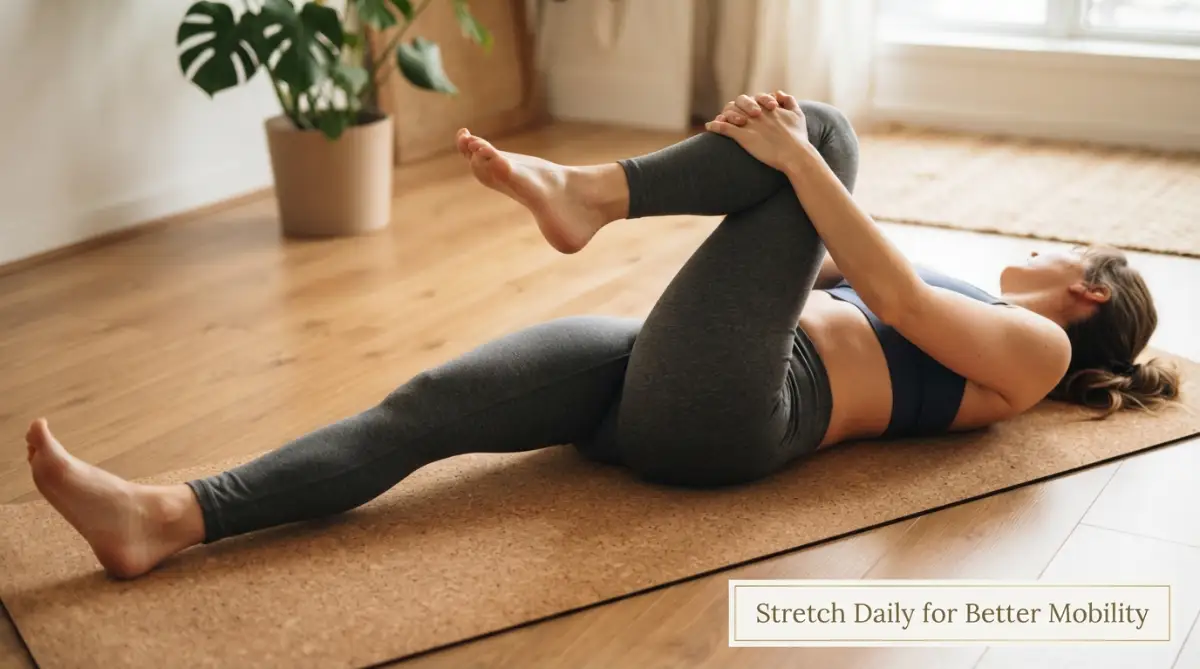
3. The Knee-to-Chest Hug
This is a great way to stretch the muscles in the very base of your spine. It also helps with sciatica symptoms for some people.
How to do it:
Lie flat on your back. Keep your legs straight or bent, whichever feels better.
Slowly pull one knee toward your chest. Wrap your hands around your shin and pull gently.
Keep your other leg flat on the ground if you can. If that hurts, bend the other leg and put your foot on the floor.
Hold this for 30 seconds. Then switch sides.
This stretch targets the erector spinae muscles. Those are the long muscles that run up your back and often get overworked.
The Science of Why Gentle Is Better
You might think you need to do intense exercises to fix a "big" problem like back pain. But science shows that gentle, consistent movement is often more effective.
When you do a hard, fast stretch, your body has a "stretch reflex." It actually pulls the muscle back to protect it from tearing.
By going slow and gentle, you bypass that reflex. You allow the fascia (the web-like tissue around your muscles) to actually change shape.
This leads to long-term flexibility rather than just a temporary fix.
Myth vs. Reality: Back Pain Edition
- Myth: If my back hurts, I should stay in bed all day.
- Reality: Movement is medicine. Bed rest for more than 48 hours can actually make back pain worse because the muscles become even stiffer.
- Myth: Only old people get lower back tension.
- Reality: Because of smartphones and office jobs, people in their 20s are now the fastest-growing group seeking help for back pain.
Advanced Gentle Stretches: The Next Level of Relief
Once you feel comfortable with the basics, we can add a few more targeted movements.
4. The Piriformis Stretch (The Figure Four)
Often, back pain isn't caused by the back at all. It's caused by tight hips.
The piriformis is a small muscle deep in your glutes. When it gets tight, it pulls on the pelvis and causes lower back tension.
How to do it:
Lie on your back with both knees bent and feet flat on the floor.
Cross your right ankle over your left knee. You will see a "4" shape with your legs.
If you feel a stretch already, stay there. If you need more, reach behind your left thigh and pull both legs toward your chest.
Flex your right foot to protect your knee. Hold for 30 to 45 seconds.
Repeat on the other side. This is a game-changer for people who sit at desks all day.
5. The Spinal Twist: Rinsing Out the Tension
Think of your spine like a wet towel. Sometimes you need to "wring it out" to get rid of the stiffness.
How to do it:
Lie on your back. Pull your knees into your chest.
Slowly let both knees fall over to the right side. Try to keep your shoulders flat on the ground.
Reach your left arm out to the side and look toward your left hand. This creates a gentle rotation in the lower back.
Take five deep breaths here. Then, use your stomach muscles to pull your knees back to the center and switch sides.
This stretch helps improve the rotation capacity of your spine. Most back injuries happen during twisting movements, so keeping this range of motion is vital.
Creating a "Back-Safe" Environment at Home
Stretching is only half the battle. If you stretch for 10 minutes but sit poorly for 10 hours, you are fighting an uphill battle.
Check your chair: Are your hips higher than your knees? If not, use a cushion.
Check your monitor: Is it at eye level? If you are looking down, your back has to work harder to hold your head up.
Hydration: Did you know your spinal discs are mostly water? If you are dehydrated, those discs lose their "cushion" effect.
Pro Tip: Try to drink a glass of water every time you finish a stretching session. It helps flush out the metabolic waste released from the muscles.
The Power of Consistency Over Intensity
I always tell my readers: It is better to stretch for 5 minutes every day than for 60 minutes once a week.
Think of your back like a garden. If you only water it once a month, the plants will die.
If you give it a little bit of water every day, it thrives. Your muscles are the same way.
Set a timer on your phone. Even if you only do two stretches, do them every single day.
You will start to notice that you move more "fluidly." That morning stiffness will start to fade away after just a few days.
Understanding the "Mind-Back" Connection
Stress is a major cause of physical tension. When we are stressed, we subconsciously clench our muscles.
We hike our shoulders up and tighten our lower back. This is part of the "fight or flight" response.
When you perform these stretches, try to visualize the stress leaving your body. Use a long, slow exhale.
This tells your brain that the danger is over. It allows the muscles to actually let go of their "guarding" state.
I have seen people find more relief from deep breathing during a stretch than from the stretch itself. Don't underestimate the power of your mind in this process.
Frequently Asked Questions About Home Stretches
Can I stretch if I have a herniated disc?
You should always talk to your doctor first. However, many doctors recommend gentle movements like the Child's Pose. Avoid heavy twisting or forward bending if you have a known disc issue.
How long does it take to see results?
Most people feel a reduction in tension immediately after one session. For long-term changes in flexibility, expect to see a difference in 2 to 4 weeks of daily practice.
Is it better to stretch in the morning or at night?
Both have benefits! Morning stretches wake up the body. Night stretches help you relax for better sleep. If I had to pick one, I would choose the evening to undo the damage of the day.
Summary of the First Steps
In this first part of our guide, we have covered:
- The emotional and physical reality of back pain.
- The fundamental "Why" behind back stiffness.
- Five essential, gentle stretches you can do right now.
- The importance of breathing and consistency.
Remember, you are taking a proactive step toward a better life. Every stretch is a small victory.
Don't be discouraged if you feel tight at first. It took time for the tension to build up, and it will take a little time to melt it away.
In the next sections, we will explore even more specific routines and how to adapt these movements if you have very limited mobility. We will also talk about how to prevent future tension before it even starts.
Stay with me, and let’s keep moving toward a pain-free life. Your back will thank you for it!
Moving Beyond the Basics: Pro Secrets for a Supple Spine
Once you feel comfortable with the initial stretches, it is time to look at the hidden factors that keep your back tight. Many people think stretching is just about pulling on a muscle until it feels long.
True relief comes from understanding how your body works as a whole unit. For example, did you know that your pelvic position determines how much stress your lower back carries?
If your pelvis tilts too far forward, it creates a "pinch" in your lower spine. To fix this, you don't just stretch the back; you have to awaken your core.
The Magic of the Pelvic Tilt
Think of your pelvis like a bowl of water. If you tilt the bowl forward, the water spills out, and your back arches painfully.
Try this: Lie on your back with your knees bent. Instead of pulling your knees to your chest, simply try to flatten the small of your back against the floor.
Hold that flat position for five seconds, then relax. This tiny movement teaches your brain how to neutralize your spine.
It is a pro-level secret because it resets the foundation of your posture. You can do this while lying in bed or even while sitting in a car during a red light.
Why Temperature Matters for Muscle Release
If you try to stretch a cold muscle, it is like trying to stretch a cold rubber band. It might snap or feel very resistant.
Expert Tip: Always apply a warm compress or take a warm shower before your stretching routine. The heat increases blood flow to the area and makes the tissues more "plastic."
This allows you to reach a deeper state of relaxation without the risk of injury. On the other hand, if you feel a sharp "hot" pain, that might be inflammation.
In that case, ice is your friend. Learning when to use heat versus ice is a major step in managing your own health at home.
The 90/90 Breath: A Hidden Gem for Relief
Most people breathe into their upper chest when they are stressed. This actually makes back pain worse because it tightens the neck and mid-back.
Try the 90/90 breathing technique. Lie on the floor and rest your calves on a chair or a couch so your knees are at a 90-degree angle.
Place one hand on your belly and one on your chest. Breathe so that only the hand on your belly moves.
This position takes all the weight off your lower spine. It allows the deep "psoas" muscle, which connects your legs to your spine, to finally let go.
Just like you might follow a simple daily skincare routine to keep your skin healthy, this breathing exercise is your daily "skincare" for your internal muscles. Doing this for five minutes every evening can significantly lower your tension levels.
The Hydration Connection to Spinal Discs
Your spinal discs are like little sponges filled with fluid. They act as shock absorbers for every step you take.
When you are dehydrated, these discs shrink slightly. This brings the vertebrae closer together and can pinch nerves.
If you want your stretches to work, you must stay hydrated. Water is the lubricant that allows your muscles to slide over each other smoothly.
If you feel "sticky" or "stiff" even after stretching, you might just be thirsty. Aim for a steady intake of water throughout the day to keep those "sponges" full and bouncy.

Invisible Traps: The Mistakes That Keep You Hurting
It is heartbreaking to see someone try so hard to get better, only to stay in pain because of a few simple mistakes. I have seen many people treat their bodies like a piece of wood that needs to be forced into a shape.
Your body is a living, breathing system that reacts to how you treat it. If you approach a stretch with aggression, your nervous system will fight back.
The Danger of "Bouncing" During a Stretch
We have all seen people in old workout videos bouncing up and down while reaching for their toes. This is called ballistic stretching, and it is one of the worst things you can do for a tight back.
When you bounce, your muscles think they are being torn. To protect you, they contract and tighten even more.
This is the opposite of what we want. You should move into a stretch like a slow-motion film.
If you feel a "rebound" effect, you are going too fast. Stay still and breathe. Let time do the work, not force.
Holding Your Breath: The Silent Tension Builder
I often see people's faces turn red when they stretch. This means they are holding their breath.
When you hold your breath, your body enters a "fight" state. It sends a signal to every muscle to brace for impact.
You cannot relax a muscle that is bracing for impact. If you find yourself holding your breath, back off the stretch until you can breathe easily again.
Your exhale is the key that unlocks the door to flexibility. Every time you breathe out, imagine the tension melting like butter in a hot pan.
Ignoring the "Referral" Pain
Sometimes, people focus so much on the spot that hurts that they miss the real cause. If your lower back hurts, the problem might actually be your tight hamstrings or your weak glutes.
If you only stretch your back and ignore your legs, the pain will keep coming back. It is like fixing a leak in the roof but ignoring the hole in the wall.
According to research from the National Institutes of Health, a lack of hip mobility is a leading cause of lumbar strain. You have to look at the joints above and below the area of pain to find the true source of the trouble.
The "Too Much, Too Soon" Trap
When we are in pain, we want it gone now. This often leads people to do 30 minutes of heavy stretching on the first day.
If your back isn't used to it, this will cause muscle soreness and inflammation. You might wake up the next day feeling worse than before.
This often makes people quit because they think "stretching doesn't work." In reality, they just did too much too soon.
Start with two minutes a day. Build a habit first, then build the intensity. Consistency is far more powerful than a one-time "mega-session."
Your 24-Hour Plan for a Pain-Free Back
You don't need a miracle to feel better. You just need a rhythm.
Imagine waking up and doing a gentle "Cat-Cow" before you even have your coffee. This clears out the "sleep stiffness."
During your workday, you could set a timer every hour. When it goes off, you just do a standing pelvic tilt or a quick side stretch.
In the evening, you spend five minutes on the floor with your legs up on the couch. This is the reset button for your nervous system.
It is also important to remember that quality sleep is essential for muscle recovery. If you aren't sleeping well, your back muscles never get the chance to fully repair the daily micro-tears.
A Final Message of Encouragement
I want you to know that recovery is possible. You are not "broken," and you don't have to accept a life of limited movement.
The journey of a thousand miles starts with a single, gentle stretch. Be patient with yourself.
Celebrate the small wins. Maybe today you can reach an inch further, or maybe today you just breathed a little deeper.
These small moments add up to a healthy, vibrant life. You have the tools, you have the knowledge, and most importantly, you have the power to change how you feel.
If you missed the initial steps, you can always go back and review how to melt away lower back tension to ensure you have the basics down.
Take a deep breath right now. Feel your ribs expand.
Your journey to a stronger, more flexible back starts the moment you decide to listen to your body. You’ve got this!
Finding relief was not a straight path for me, but taking just five minutes of quiet floor time every night made a world of difference. Your back wants to heal, so give yourself permission to start slow tonight and trust the gentle process.
Disclaimer:
The information in this post is for educational purposes only and does not replace professional medical advice. Always consult with a qualified healthcare provider or physical therapist before starting a new exercise routine, especially if you have chronic pain or a pre-existing medical condition. If you experience sharp pain, numbness, or tingling, stop immediately and seek medical attention.