The Overwhelming Storm of Raw Data and the Quest for Answers
I remember sitting in front of my computer, staring at a massive spreadsheet with fifty thousand rows of messy numbers. My manager wanted me to predict which products would sell best next month, and my mind went totally blank. I spent three sleepless nights trying to guess the patterns manually, but my simple formulas kept crashing.
It is a terrible feeling when you feel completely drowned in data but starving for simple answers. Many small business owners and content creators go through this exact struggle every single week. They look at analytics screens and feel completely lost, wondering if they are making the right choices.
Trying to predict what comes next based on raw numbers is stressful, especially when your hard-earned money is on the line. You worry about ordering too much stock or wasting your daily budget on the wrong ideas. This constant worry ruins your weekends and keeps your brain running at night.
Most people think they can just use basic math or standard human intuition to find these deep trends. The truth is, our brains are not built to spot small connections buried inside millions of data points. When we rely on pure guessing, we almost always make mistakes that cost us time and peace of mind.
This endless guessing game creates a lot of mental fatigue and self-doubt. You start to feel like you are walking in the dark without a clear map to guide your steps. The stress of not knowing where your business is going next week can make you want to throw your hands up in defeat.
We need a reliable way to make sense of this pile of digital noise without losing our minds. Thankfully, there is a smart way to let computers do the heavy lifting for us. Let us look at how smart systems can turn this painful mess into a clear path forward.
How Smart Programs Learn to See the Future
Feeding the Machine the Right Kind of Clean Information
Before a system can make any smart guess, we have to clean the dirty information. This means removing empty spaces, fixing double entries, and making sure all the numbers speak the same language. If you put bad data in, you will get bad predictions out.
This cleaning process is often the most time-consuming part of the entire journey. Engineers spend hours organizing columns and filtering out useless background noise. Once this step is complete, the data is ready for the program to study.
A clean dataset allows the software to run smoothly without getting confused by random errors. It is like clearing the clutter off your desk before you start studying for a big test.
Teaching the System to Recognize Patterns
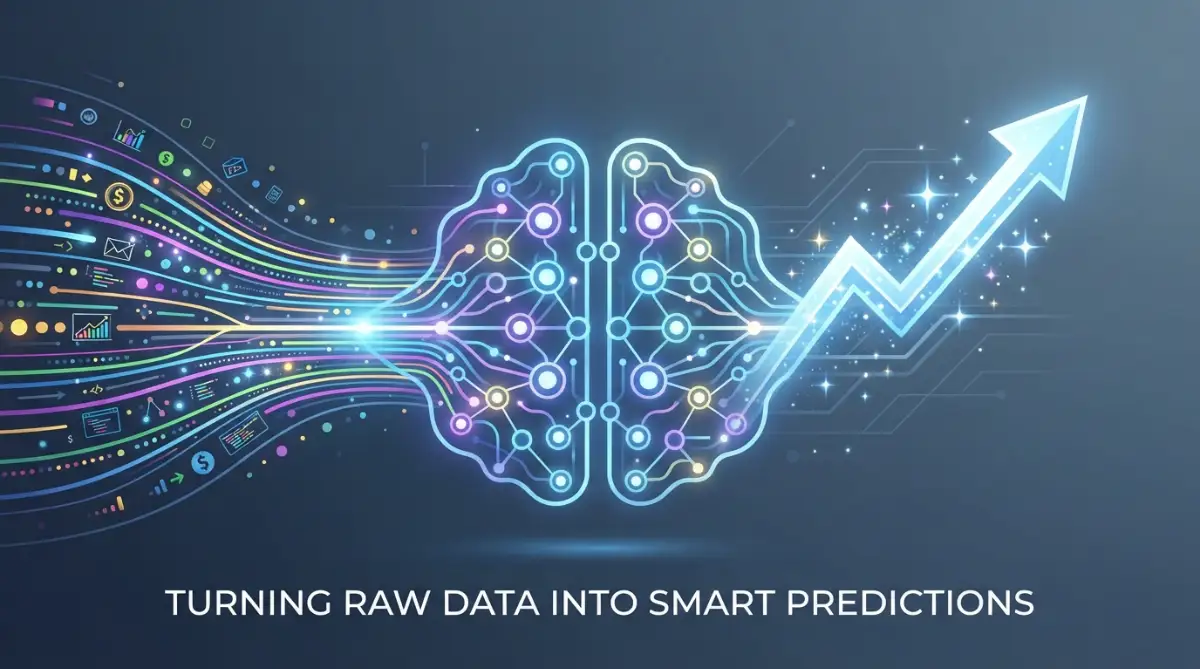
Once the data is clean, the program looks for repeating patterns that human eyes usually miss. It compares things like weather, shopping times, and customer ages to find hidden links. These small connections are the key to seeing what might happen next.
The program runs these comparisons millions of times in just a few seconds. It builds a digital map of how different events influence each other. Over time, the software gets better at noticing which actions lead to specific results.
This pattern recognition is not magic; it is just highly advanced scanning. The program simply remembers every single detail and finds the common thread.
Using Math Rules to Build a Working Model
The system uses special mathematical guidelines to create a model of your business. This model acts like a virtual helper that learns from the past to guess the future. It adjusts its internal rules as you feed it more fresh information.
I used to think I needed the most complex math model to get good results. My biggest realization was that starting with a very simple model works best because it is easier to fix when things go wrong. Keep it simple in the beginning.
As the model improves, it becomes highly customized to your specific needs. It learns your customers' unique habits and your seasonal sales peaks. This makes the predictions much more useful for your daily planning.
How Algorithms Think: A Visual Guide
If you want to see exactly how these mathematical models process millions of data points in real time, watch this helpful video.
Popular Ways Smart Systems Group and Sort Information
Simple Path Guesses Using Linear Lines
This method draws a straight line through your past data points to see where they are heading. It works incredibly well when you want to predict simple things like monthly energy bills. It is the easiest way to start your forecasting journey.
Because the math is simple, this model does not require a supercomputer to run. You can easily set it up on a basic laptop using standard tools. It gives you a quick baseline estimate that you can trust for basic tasks.
However, life is not always a straight line, so this method has its limits. It struggles when customer behavior suddenly changes due to unexpected events.
Choosing Branches with Decision Trees
Imagine a game of twenty questions where each answer leads to a new branch of choices. This system asks simple questions about your data until it reaches a logical prediction. It helps you see the different paths your customers might take.
For example, it might ask if the user is on a mobile phone. If the answer is yes, it follows one path; if no, it goes down another. This makes the decision-making process very easy for humans to understand and follow.
You can look at a decision tree map and see exactly why the computer made a specific guess. This transparency builds a lot of trust for business owners.
Random Forests for Better Accuracy
Instead of trusting just one decision tree, this method creates a whole forest of them. It combines the guesses of many different trees to find the most popular answer. This group approach makes your predictions much more stable and reliable.
If one tree makes a mistake due to a weird data point, the other trees correct it. This teamwork prevents the system from giving you wild, inaccurate guesses. It is one of the most popular methods used by top data analysts today.
Setting up a forest takes a bit more computing power, but the accuracy boost is highly worth it. It handles complex business questions with ease.
Neural Networks for Human-Like Thinking
These systems mimic the way our own brain cells connect and share information. They are excellent for processing highly complex datasets like spoken words or digital images. While they require a lot of computing power, their results can be incredibly impressive.
A neural network has different layers that look at different parts of your data. The first layer might spot simple shapes, while the deeper layers recognize entire faces. This layered learning makes them incredibly smart over time.
They are perfect for massive businesses that have millions of customer interactions every single day. For smaller projects, however, they might be more than you actually need.
The Real Magic of Training and Testing Models
Splitting Your Information for Practice
We never show the system all our data at the same time. We keep some of the old information hidden so we can test the system later. This helps us see if the program is actually learning or just memorizing the past.
If you test a student with the exact same questions they practiced on, you will not know if they truly understand. By using fresh test data, we get a true measure of the program’s real ability. This step keeps our predictions realistic and honest.
Most teams split their data using an eighty-twenty rule. Eighty percent goes to training, and twenty percent is saved for testing.
The Power of Constant Adjustment
Just like a human student, the algorithm makes mistakes during its first few attempts. The programmers adjust the settings to help the system improve its accuracy over time. This continuous learning process is what makes the software smarter every single day.
Small tweaks to the mathematical weights can lead to massive improvements in results. It is a slow process of trial and error that requires patience. But once the settings are balanced, the system runs beautifully.
This constant tuning ensures that the program stays relevant as new trends begin to form. It prevents the model from becoming outdated and useless.
Checking Your Results Against Reality
Once the training is done, we test the system using the hidden data we kept earlier. We compare the program's guesses with what actually happened in real life. This gives us a clear percentage score of how trustworthy our model is.
If the score is low, we go back to the drawing board and check our data quality. If the score is high, we can start using the model to make real-world decisions. This testing phase prevents expensive mistakes in your business.
Never skip this step, as an untested model can easily lead you in the wrong direction.
How Everyday Industries Use These Predictions
Smart Shopping and Retail Choices
Online stores use these tools to guess which products you will want to buy next week. This helps them stock their warehouses ahead of time so you get your packages faster. It also helps them offer you personalized discounts that actually match your interests.
By predicting demand, stores waste less inventory and save a lot of shelf space. This efficiency keeps prices lower for everyday shoppers like us. It is a win-win situation for both the business and the customer.
You probably benefit from these smart retail guesses every time you open your favorite shopping app.
Predicting Health Issues Before They Happen
Doctors use smart programs to look at patient history and spot early warning signs of illness. These systems can find tiny changes in medical tests that might suggest a future health problem. This early knowledge gives patients a much better chance at recovery.
It can scan thousands of patient records in minutes to find similar case histories. This helps medical teams choose the most effective treatment plans faster. It is changing how hospitals care for people around the world.
Using data this way saves lives and makes healthcare much more personalized.
Keeping Your Tech Running Smoothly
Large software systems use predictive algorithms to guess when a server might crash. By spotting unusual activity patterns, the system can fix itself before users even notice a problem. This keeps your favorite apps online day and night.
Instead of waiting for something to break, tech teams can perform maintenance early. This active approach saves companies millions of dollars in repair costs. It also keeps your digital life running without annoying interruptions.
Almost every major website you use relies on this background technology to stay active.
Common Myths About Smart Machine Predictions
Myth One: The Program is Always Correct
Many people believe these systems are magic crystal balls that never make mistakes. The truth is, they only make guesses based on past patterns. If the world changes suddenly, the predictions can be completely wrong.
An unexpected event can throw off even the most advanced computer models. It is important to use these predictions as a helpful guide, not an absolute truth. Always combine computer insights with your own common sense.
Systems are only as smart as the historical data we feed them.
Myth Two: You Need a PhD to Use Them
You do not need to be a math genius to benefit from modern prediction tools. Many user-friendly platforms now let you upload your data and get results with a few clicks. The software does all the hard work behind the scenes.
Many free online tutorials can teach you the basics in just a few hours. You do not need to write complex equations by hand anymore. The barrier to entry has never been lower for regular creators and business owners.
Do not let the scary technical terms keep you from trying these tools.
Myth Three: More Data Always Means Better Results
Having millions of data points is useless if the information is messy and incorrect. A smaller set of clean, high-quality data will always give you better answers. Focus on quality rather than just collecting endless piles of numbers.
Messy data leads to confusing patterns that waste your computing power. It is much better to track five key metrics accurately than fifty metrics poorly. Keep your data collection clean, focused, and organized.
This simple focus will save you time and produce much clearer forecasts.
Simple Steps to Build Your First Predictive System
Step One: Pick a Clear and Simple Question
You must start with a very specific question that you want the system to answer. For example, ask how many visitors will click your link next Tuesday. Avoid asking vague questions that the system cannot measure.
A clear question makes it easy to know which data points you need to collect. It also gives your math model a direct target to aim for during training. This focus is key to getting a helpful result.
Write your question down on a piece of paper before you touch any software.
Step Two: Clean Up Your Spreadsheet
Take some time to look through your current business records and delete any errors. Make sure your dates, prices, and names are written in the exact same format. This clean base will save you hours of frustration later.
Look for extreme numbers that seem like mistakes, such as a product priced at zero dollars. Fix these errors manually so they do not throw off your program. A little preparation work here goes a long way.
Once your sheet is clean, save a backup copy in a safe place.
Step Three: Start with Free and Simple Tools
Do not buy expensive enterprise software when you are just starting out. Use simple, free tools like online spreadsheet add-ons or basic prediction platforms. This lets you learn the basics without spending any money.
These basic tools are surprisingly powerful and can handle most small business tasks. They help you understand the workflow without feeling overwhelmed by advanced options. You can always upgrade to bigger systems later as you grow.
Focus on learning the basic process first before spending your hard-earned cash.
Step Four: Check and Update Your System Weekly
The world does not stay the same, and your data models should not either. Feed your system fresh information every week to keep its predictions sharp and accurate. Consistent updates ensure your business choices remain smart over time.
As you add more clean data, your program's guesses will naturally become more accurate. It is a continuous habit that builds a highly valuable asset for your business. Treat your prediction model like a garden that needs regular care.
This simple routine will keep you ahead of the curve and give you true peace of mind.
Wrapping Our Minds Around the Future of Smart Data
Using smart programs to spot future trends does not have to be scary or complicated. By breaking the process down into clean steps, anyone can start making data-backed choices. You do not need to be a master programmer to benefit from these tools.
Start small by asking a single question and cleaning up your basic records. As you see the patterns emerge, you will feel much more confident in your daily decisions. The stress of guessing will slowly fade away, replaced by clear, actionable plans.
With a little practice, you can turn your messy pile of numbers into a powerful roadmap for your future success.
Pro-Level Strategies to Keep Your Predictive Models Accurate Over Time
Perfecting Your Input with Feature Engineering
Building a basic prediction tool is a great first step, but the real secret to success lies in feature engineering. This is the process of taking your raw numbers and combining them into new, more helpful categories. For example, instead of just tracking the exact hour of a purchase, you can create a simple category for weekend versus weekday shopping.
These smart combinations help your algorithm see the bigger picture without getting lost in tiny details. It is like giving your program a pair of glasses that highlights the most important shapes. When you clean up and combine your data points, your model can make much sharper guesses with less effort.
Many people skip this step because they think the computer will figure out everything on its own. While modern systems are smart, they still benefit heavily from human guidance and clear logic. By setting up these clear categories, you save your computer from wasting energy on meaningless calculations.
Fighting Model Drift and Keeping Systems Fresh
Even the best prediction models can lose their accuracy as human habits change over time. This common problem is known as model drift, and it happens when your old training data no longer matches real life. If you do not update your system regularly, your predictions will slowly become less reliable and eventually useless.
To prevent this decline, you need to establish a consistent schedule for adding fresh records to your system. If you want to study how experts track these shifts, you can read public studies on the Stanford Artificial Intelligence Laboratory website. Checking your system weekly or monthly ensures that your program adapts to new shopping behaviors as they happen.
Think of your model as a living map that needs constant updates to reflect new roads and detours. If you ignore the changes in your market, your map will quickly lead you in the wrong direction. Keeping your system fresh is the easiest way to protect your hard work and maintain high accuracy.
Shifting to Open-Source Tools for Ultimate Flexibility
When you are ready to scale up your systems, you do not need to buy incredibly expensive software licenses. Many of the most powerful prediction tools are completely free and supported by helpful communities around the globe. To see a great example of this trend in action, check out why smart small businesses are switched to open source tools for their daily work.
Using these free resources gives you complete control over how your software processes sensitive customer data. You can easily modify the code, add custom features, and connect different systems without paying extra fees. This freedom allows you to build a prediction setup that perfectly matches your unique business goals.
Additionally, open-source communities are constantly updating their libraries to make them faster and more secure. You can easily find helpful templates and forums where other developers share their personal tips. This shared knowledge makes it much easier to solve technical problems when you get stuck.
Preparing for High-Risk Events and Safety Margins
Predictive systems are excellent at spotting daily patterns, but they can struggle during sudden, extreme crises. Just because a model says a risk is low does not mean you should ignore basic safety margins. It is always wise to prepare for unexpected events that do not show up in your historical spreadsheets.
This strategy is very similar to how people protect their personal property against unexpected natural disasters. For instance, people often ask do you really need flood insurance in a low risk zone x because they want a backup plan just in case the weather behaves unexpectedly. In the same way, your business needs a buffer zone to survive sudden market shifts that your data model could not predict.
Always keep a small portion of your budget set aside to handle these sudden, unpredictable surprises. Relying completely on a computer's guess without a backup plan is a recipe for disaster. Combining smart math with sensible safety nets is the true mark of a professional.
Creating Clear Feedback Loops with Human Experts
A great prediction system should never run completely on autopilot without any human eyes watching it. You need to create a simple feedback loop where actual people review the computer's predictions. This helps you catch weird errors that might seem logical to a machine but make no sense in real life.
For example, if your system predicts a sudden spike in sales because of a single massive order, a human can quickly mark that as an exception. This manual check prevents the system from making bad orders based on one-time events. It combines the speed of modern technology with the wisdom of human experience.
Over time, this cooperative approach makes your system incredibly resilient and highly customized. Your team will learn how to trust the data, and your algorithm will benefit from your real-world insights. It is the absolute best way to build long-term trust in your technology.

Steer Clear of These Major Traps in Data Forecasting
Falling Into the Overfitting Trap
One of the biggest mistakes newcomers make is training their program to be too perfect on past data. This common error is called overfitting, and it happens when your model memorizes past numbers instead of learning general patterns. If your model gets a perfect score on old tests but fails in the real world, you have likely fallen into this trap.
To understand how to prevent this issue, you can explore the official documentation on the Scikit-Learn Machine Learning guide. They offer great visual explanations of how to keep your models flexible and adaptable. A flexible model might have a slightly lower score during practice, but it will perform much better when dealing with real-world surprises.
Think of it like a student who memorizes the exact answers to a practice exam instead of studying the actual formulas. When the real test has slightly different questions, the student will fail completely. Keep your models simple and broad so they can handle the natural messiness of everyday life.
Gathering Poor Evidence and Bad Historical Records
Your predictions will only be as good as the raw information you gather in the beginning. If you keep messy, incomplete, or inaccurate records, your machine learning model will give you highly misleading results. Taking shortcuts during the data collection phase is a major mistake that will cost you both time and money.
This situation is very similar to preparing evidence for an important official claim. If you want to get a fair result, you must know how to document storm damage correctly for a smooth claim so that every single detail is clear and undeniable. The same exact rule applies to your business spreadsheets; if you do not record your daily sales and customer visits accurately, your predictions will be useless.
Spend extra time setting up automated systems that log your numbers without any human errors. This clean tracking pays off massive dividends when it comes time to build your prediction models. Consistent, high-quality data is the foundation of every successful tech project.
Ignoring Your Human Instincts and Intuition
Another dangerous mistake is assuming that the computer is always smarter than you are. Some business owners blindly follow whatever their software says, even when their gut tells them something is wrong. Remember that algorithms only look at numbers; they do not understand human relationships, feelings, or local community news.
This blind trust can put you in a very difficult spot, especially when dealing with giant automated systems. For example, if you blindly accept automated insurance calculations, you might end up losing money. Learning how to handle a lowball car insurance offer and win requires using human negotiation and showing real-world evidence, which computer models often ignore.
Use your data as a helpful advisor, but let your human experience make the final call. If a computer prediction feels completely wrong, take a moment to look into the raw numbers yourself. Your personal experience in your industry is a highly valuable asset that no machine can truly replicate.
Trying to Build Too Many Features at Once
When people first discover machine learning, they often try to predict ten different things at the same time. This excessive ambition usually leads to cluttered models, messy databases, and extreme confusion for the team. It is far better to focus on one simple, highly valuable metric before trying to build a massive system.
If you try to track too many variables, your model will struggle to find which factors actually matter. This lack of focus makes it very difficult to fix errors when your predictions start to fail. Start with a single, clear goal and build your system outwards as you gain confidence and experience.
Patience is a key part of working with modern technology. Master the basics first, and the complex projects will become much easier to handle.
Your Roadmap to Confident Data-Driven Decisions
Small Steps Lead to Massive Future Gains
Starting your journey into data prediction can feel a bit scary in the beginning, but the long-term rewards are incredible. You do not need a massive budget or a team of scientists to start seeing real improvements in your daily work. Even a simple spreadsheet with basic trend lines can give you an edge over your competitors.
Over time, these small technical habits build up to create massive financial benefits for your projects. This compound effect is very similar to how improving your personal finances can save you thousands of dollars down the road. For instance, just like learning how a simple credit boost can slash your insurance bills over time, organizing your data step-by-step will steadily lower your operating costs.
Commit to spending just one hour every week organizing your databases and checking your model's accuracy. This small investment of time will protect you from expensive mistakes and give you massive peace of mind. The future belong to those who take simple, consistent actions to master their information today.
You can visit resources like trustpickshq to find more helpful guides on using simple digital systems to protect and grow your assets. Making smart choices with your digital tools is the easiest way to build a reliable, stress-free future.
Simple Summary of Your Action Plan
Every major tech success starts with a single clean spreadsheet and a simple question. Do not let the complex vocabulary of modern software keep you from taking action today. By moving slowly and keeping your projects simple, you will easily build a system that supports your long-term dreams.
My personal journey with these tools taught me that the best discoveries always come from starting small and staying incredibly patient. I want to encourage you to take that first simple step today, because organized data will completely change how you see your business.
Answers to Your Top Questions on Predictive Data Systems
How much data do I actually need to make accurate predictions?
You do not need billions of rows of information to get helpful results from your models. For most small businesses, having a few months of clean, consistent daily records is more than enough to start spotting trends. Focus heavily on the quality and accuracy of your records rather than just trying to collect massive piles of numbers.
Can machine learning predict sudden shifts like market crashes?
These programs struggle to predict sudden, rare events because they rely heavily on past patterns to make their guesses. If an event has never happened before, the system will not have the training data needed to foresee it. This is why you should always maintain a sensible human backup plan instead of relying completely on computer models.
Do I need to be a master programmer to start predicting trends?
No, you do not need to write complex computer code from scratch to use predictive analytics today. Many modern platforms offer simple, visual drag-and-drop interfaces that do all the heavy mathematical work for you. You can find more advanced, free resources on websites like the Google AI Research page as you feel more comfortable.
How often should I update and retrain my machine learning model?
It is a great habit to feed your system fresh information at least once a month to prevent model drift. If your industry changes very quickly, you might want to update your data weekly to keep your predictions sharp. Regular updates ensure that your system stays useful and adapts to new habits as they develop.
Disclaimer
The information provided in this article is for educational and informational purposes only. Machine learning predictions are based on statistical probabilities and do not guarantee specific real-world outcomes. Always use your personal judgment and consult with professional advisors before making major financial or business decisions based on automated software data.